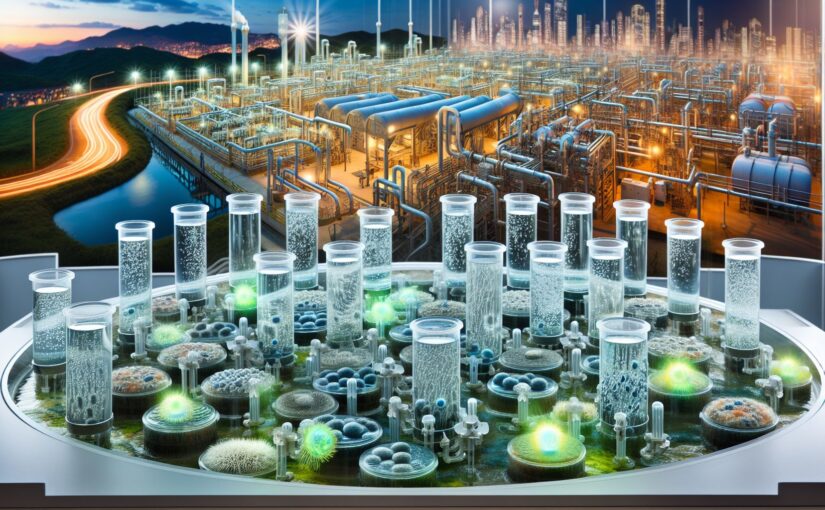
The quest for sustainable and renewable energy sources has become paramount in our modern society. As we strive for innovations that not only power our lives but also protect the environment, an exciting development in the field of renewable energy has emerged: the ability to generate electricity directly from wastewater using microbial fuel cells (MFCs). This breakthrough offers a two-pronged solution—treating wastewater and simultaneously producing bioelectricity.
The Promise of Microbial Fuel Cells (MFCs)
Microbial fuel cells are bioelectrochemical systems that harness the power of electroactive bacteria to convert organic matter from wastewater into electricity. MFCs are a beacon of hope in both energy generation and wastewater treatment, providing a renewable energy source while reducing the organic load of the effluent.
How Microbial Fuel Cells Work
In an MFC, bacteria attach themselves to the anode, forming a biofilm. As these microbes consume the organic matter in the wastewater, they undergo metabolic processes that release electrons. These electrons are then transferred to the anode, flow through an external circuit (producing electricity), and finally reach the cathode, where they combine with protons and oxygen to form water – completing the circuit. This process not only cleans the water but also generates a direct current that can be used or stored for later use.
The Dual Benefits: Wastewater Treatment and Bioelectricity
Wastewater treatment plants are energy-intensive, often consuming 3% of the total electrical load in developed countries. MFCs offer a significant advantage by potentially reducing or even reversing this energy demand. Conventional methods focus solely on purifying water using biological, chemical, or physical processes that require large amounts of energy. MFCs, on the other hand, provide an avenue for passive wastewater treatment while generating energy.
Image source: example.com
The Challenges and Innovations in MFC Technology
Advancements in MFC technology are rapidly emerging, yet there are still several challenges that need to be addressed to maximize the potential of renewable energy from wastewater.
Electrode Materials
One of the key challenges in optimizing MFCs is the development of efficient and cost-effective electrode materials. Electrodes need to be not only conductive but also chemically stable and biocompatible to promote microbial attachment and activity. Carbon-based electrodes, particularly graphene and carbon nanotubes, are promising due to their high surface area and electrical conductivity.
Proton Exchange Membranes
Proton exchange membranes (PEMs) are crucial in preventing oxygen from diffusing to the anode, which would inhibit the activity of anode-respiring bacteria. The ideal PEM should be selectively permeable, only allowing the necessary ions to pass while blocking other compounds. Researchers are exploring various materials, including modified Nafion and biopolymer-based membranes.
Electron Transfer Mechanisms
The electron transfer mechanism from bacteria to the electrode surface is a vital area of research. Understanding and enhancing the ways through which exoelectrogens transfer electrons—whether through direct contact (conductive pili) or via electron shuttles—can significantly improve electricity generation efficiency.
Scaling up MFCs
Scaling up MFCs from laboratory settings to real-world applications poses a significant challenge due to factors such as the high cost of construction materials and the complexity of maintaining optimal conditions for microbial growth. The development of continuous flow and stacked MFC systems is pivotal in overcoming these hurdles.
Turning Waste to Watts: Case Studies and Real-World Applications
Despite the challenges, several pilot projects and studies have shown that MFC technology can be successfully applied in the real world.
Pilot Wastewater Treatment Plants
Pilot-scale MFCs have been set up in wastewater treatment plants in countries like the United States, China, and Spain. These systems have successfully demonstrated the removal of pollutants from wastewater while generating electricity. The power generated is currently modest, but it represents a significant step towards energy-neutral wastewater treatment facilities.
Biosensors
Apart from energy generation, MFCs have valuable applications as biosensors for monitoring wastewater quality. By measuring the electrical output, MFCs can provide real-time data on the concentration of pollutants, offering an energy-efficient and cost-effective monitoring solution.
Bioremediation Projects
Bioremediation using MFCs has been explored for the removal of heavy metals and other toxic compounds from industrial wastewater. The application of MFCs in bioremediation not only contributes to cleaner water but also generates a surplus of electricity that could be used or sold back to the grid.
The Future Is Bright: Advancements and Potential
The potential of renewable energy from wastewater is vast, but realizing this potential depends on continued research and technological breakthroughs.
Emerging Electrode Technologies
Ongoing research focuses on developing more affordable and efficient electrode materials. Innovations in nanotechnology offer exciting prospects for creating electrodes with increased surface area and improved electron transfer capabilities.
Novel Architectures
The design of MFCs is evolving to include novel architectures that optimize bacterial growth and electron transfer. Stacked and sediment MFCs, for example, maximize the available surface area and are better suited for large-scale operations.
Integrating with Renewable Energy Grids
As MFC technology matures, there is the potential to integrate it with existing renewable energy grids. MFCs could provide a steady supply of baseload power, complementing intermittent sources like wind and solar.
Conclusion
Renewable energy from wastewater using microbial fuel cells is a groundbreaking concept that aligns with global sustainability goals. While challenges remain, the benefits of treating wastewater and generating power simultaneously are too significant to ignore. As research continues to drive innovation, the future of MFCs looks promising, serving not only as a testament to human ingenuity but also as a vital tool in our pursuit of a greener planet.
Sources:
- “Scaling up microbial fuel cells and other bioelectrochemical systems,” Applied Microbiology and Biotechnology, 2010. https://link.springer.com/article/10.1007/s00253-009-2378-9
- “The potential for generating electricity from microbial fuel cells,” Water Science and Technology, 2012. https://iwaponline.com/wst/article/65/6/1113/14911
- “Electroactive biofilms: Current status and future research needs,” Energy & Environmental Science, 2008. https://pubs.rsc.org/en/content/articlelanding/2008/ee/b808239a