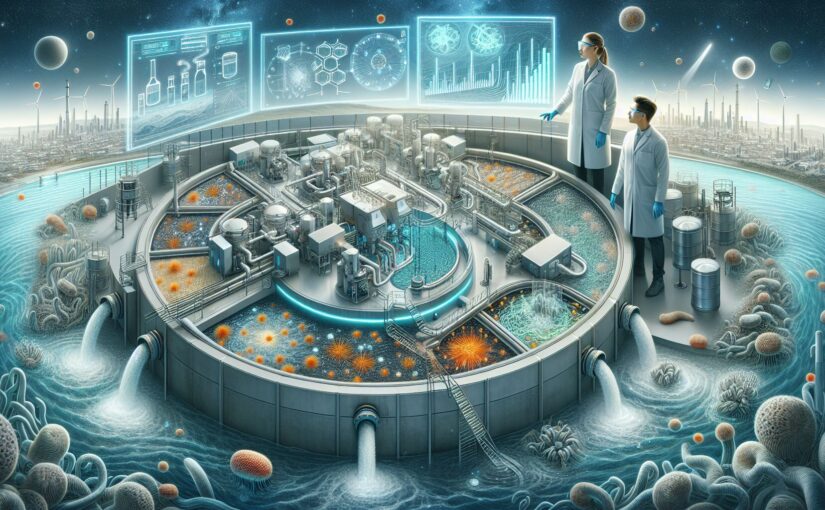
In the quest for sustainable and renewable energy sources, a groundbreaking technology has emerged that holds the potential to transform waste into wonder. This technology utilizes microbial fuel cells (MFCs) to harvest electrical power directly from wastewater. This solution not only tackles the growing issue of wastewater management but also offers a renewable energy source that could revolutionize the way we perceive and manage waste. In this in-depth article, we’ll explore the potential of renewable energy from wastewater through microbial fuel cells, examining the process, applications, benefits, and challenges.
What are Microbial Fuel Cells?
Microbial fuel cells (MFCs) are bioelectrochemical systems that harness the power of electroactive bacteria to convert organic substances in wastewater into electrical energy. These remarkable bacteria, known as exoelectrogens, can transfer electrons outside of their cells to an electrode. The basic components of an MFC are an anaerobic anode chamber and a cathode chamber, typically separated by a proton exchange membrane.
The MFC Process
The technology functions on the principle that certain wastewater bacteria can oxidize organic matter, releasing electrons and protons. Here’s a simplified step-by-step process:
- Organic Matter Oxidation: Bacteria in the anode chamber consume organic matter from the wastewater, breaking it down and releasing electrons and protons in the process.
- Electron Transfer: Electrons travel through an external circuit to the cathode chamber, producing an electric current.
- Proton Migration: Protons pass through the proton exchange membrane to the cathode chamber, where they combine with the electrons and oxygen (from air or another source) to form water.
Applications in Wastewater Treatment
The immediate application of MFCs is in wastewater treatment facilities. Here they serve a dual purpose: treating the water by breaking down pollutants and generating electricity that can potentially power the treatment plants or be fed back into the grid.
Advantages of MFCs in Wastewater Treatment
- Sustainable Power Generation: Renewable energy is produced as a byproduct of the wastewater treatment process.
- Reduced Energy Consumption: MFCs can decrease the overall energy demand of wastewater treatment plants.
- Lower Sludge Production: MFCs can potentially produce less sludge than conventional treatment processes.
Renewable Energy Potential
The most exciting aspect of MFCs is their ability to generate electricity. While the power densities are currently lower than those from traditional sources, ongoing research aims to improve the efficiency and scalability of this process.
Sources:
- Logan, B. E., & Regan, J. M. (2006). Electricity-producing bacterial communities in microbial fuel cells. Trends in Microbiology, 14(12), 512-518.
- Rabaey, K., & Verstraete, W. (2005). Microbial fuel cells: novel biotechnology for energy generation. Trends in Biotechnology, 23(6), 291-298.
- Rozendal, R. A., Hamelers, H. V., Rabaey, K., Keller, J., & Buisman, C. J. (2008). Towards practical implementation of bioelectrochemical wastewater treatment. Trends in Biotechnology, 26(8), 450-459.
The Science Behind MFCs and Their Efficiency
The efficiency of microbial fuel cells in wastewater treatment and energy production is a key area of interest for researchers. Two critical parameters of MFC performance are power density and coulombic efficiency.
Power Density in Wastewater MFCs
Power density refers to the amount of electrical power generated per unit volume of the reactor. It is affected by factors such as the type of wastewater, the electroactive bacteria involved, electrode materials, and the design of the MFC itself.
Challenges to Optimal Power Density
- Electrode Surface Area: Insufficient surface area limits the space for bacterial colonization and electron transfer.
- Electrode Materials: The search for cost-effective yet highly conductive materials is ongoing.
- System Design: Suboptimal designs can lead to resistance in electron flow, reducing efficiency.
Coulombic Efficiency in Wastewater MFCs
Coulombic efficiency measures the percentage of electrons derived from the substrate’s chemical energy that is converted to electrical energy. This figure indicates the overall effectiveness of the fuel cell in energy recovery.
Factors Influencing Coulombic Efficiency
- Organic Load: High organic loads can lead to incomplete oxidation and loss of electrons.
- Electron Loss Mechanisms: Electrons might be lost to alternative electron acceptors or inefficient pathways.
Polarization Curves in MFCs
Polarization curves are used to evaluate MFC performance. They graph the relationship between current density and cell voltage, providing insight into the system’s internal and external resistances and maximum power point.
Significance of Polarization Curves
- Performance Analysis: Helps in identifying losses and optimizing the MFC design.
- Material Selection: Guides in choosing the best electrode and membrane materials.
Sources:
- Fan, Y., Hu, H., & Liu, H. (2007). Sustainable power generation in microbial fuel cells using bicarbonate buffer and proton transfer mechanisms. Environmental Science & Technology, 41(23), 8154-8158.
- Logan, B. E. (2008). Microbial fuel cells. John Wiley & Sons.
Scaling Up and Future Directions
For microbial fuel cells to become a mainstream renewable energy technology and wastewater treatment solution, they need to be effectively scaled up.
Challenges in Scaling Up Wastewater MFCs
- Cost Concerns: Large-scale operations require cost-effective materials and construction techniques.
- System Stability: Maintaining consistent performance over time and under varying conditions is crucial.
- Energy Harvesting: Efficient energy capture and storage systems need to be integrated.
Vision for the Future
- Innovative Designs: Continuous flow and stacked MFCs are being explored for better scalability and performance.
- Material Breakthroughs: Electrode and catalyst advancements could lead to higher power outputs and long-term stability.
- Integration with Other Systems: MFCs might be paired with other renewable technologies like solar or wind.
Conclusion: Wastewater MFCs as a Sustainable Solution
Microbial fuel cells offer a rare opportunity to address two of the modern world’s pressing issues—wastewater treatment and the search for renewable energy sources—with a single solution. While challenges remain, the strides made thus far in MFC research hint at a not-too-distant future where wastewater plants are not only self-sufficient in energy terms but also contributors to the energy grid. The transformation of waste into a resource reflects the kind of circular economy that could lead to a more sustainable and less wasteful society.
Additional Sources:
- He, Z., Minteer, S. D., & Angenent, L. T. (2005). Electricity generation from artificial wastewater using an upflow microbial fuel cell. Environmental Science & Technology, 39(14), 5262-5267.
- Pant, D., Van Bogaert, G., Diels, L., & Vanbroekhoven, K.