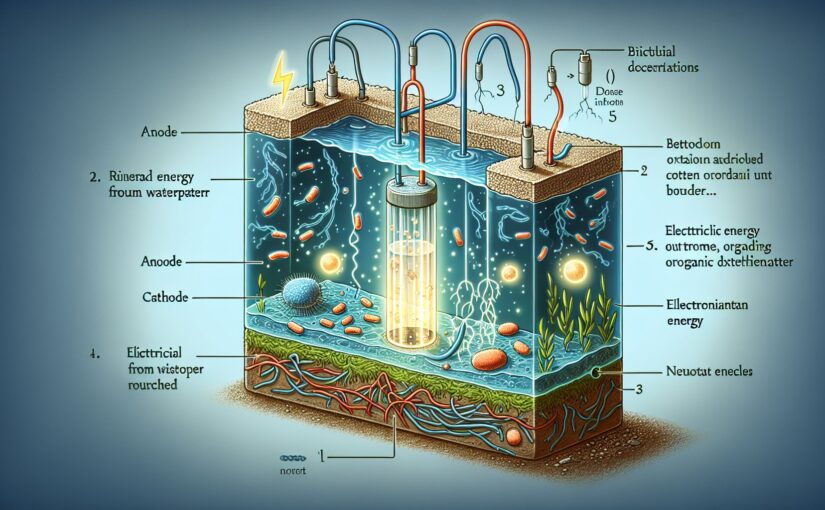
Wastewater is typically viewed as a disposal problem that requires treatment to prevent environmental and health issues. Nonetheless, in the context of sustainability and resource recovery, wastewater is a potential source of renewable energy, particularly through the application of Microbial Fuel Cells (MFCs). This innovative technology, though still under active research and development, proposes a future where wastewater treatment is coupled with the generation of electricity—turning a costly process into a value-added one. In this article, we unpack the potential for renewable energy generation from wastewater and examine the processes, challenges, and future perspectives of this promising technology.
The Potential of Wastewater as an Energy Source
Wastewater contains organic compounds that represent stored energy. These organic substances are essentially the remnants of food or other biological sources that, through microbial metabolisms, can be converted into various forms of energy, one of which is electricity. The utilitarian approach to viewing wastewater as a resource is gaining ground in the context of increased demand for energy and the global pursuit of sustainability.
Microbial Fuel Cells for Wastewater Treatment
Microbial Fuel Cells (MFCs) are devices that use bacteria to convert the organic materials present in wastewater directly into electrical energy through biochemical reactions. They function on the principle that certain types of bacteria, known as electrogenic or exoelectrogenic bacteria, can transfer electrons out of their cells to an external electrode during the metabolic breakdown of organic substrates. The technology is attractive due to its dual-functionality: organic waste degradation and energy production.
How MFCs Work
The typical MFC consists of an anode and a cathode compartment separated by a proton exchange membrane (PEM). At the anode, bacteria oxidize the substrate, releasing electrons and protons. The electrons travel to the cathode via an external circuit (producing current), while the protons pass through the PEM to the cathode compartment. At the cathode, electrons, protons, and oxygen (from air or added as an oxidant) combine to form water.
Electricity Generation
Electricity generation in MFCs occurs as a result of the flow of electrons from the anode to the cathode. The voltage generated depends on various factors including the type of microbial community, the nature of the wastewater substrate, and the design of the MFC. While the power densities of current MFCs are lower than conventional batteries, ongoing research aims to improve this by optimizing system design, electrode materials, and operational conditions.
Challenges and Opportunities
The prospect of generating renewable energy from wastewater faces several challenges. Understanding these challenges is crucial for advancing MFC technology.
Electrode Materials
The electrode materials greatly impact the efficiency of electron transfer and thus the MFC’s performance. Carbon-based electrodes are common due to their high conductivity and biocompatibility, but research into alternative materials and coatings could further enhance performance. Catalyst-coated electrodes can increase the rate of reactions, improving power output.
System Design and Scaling
Current MFC systems often suffer from high internal resistance and low power densities, particularly in larger-scale operations. Research into stacked or continuous flow MFCs could mitigate these issues. Scaling up MFCs for practical application in wastewater treatment plants presents design, operation, and economic challenges that must be overcome through innovation.
Efficiency Metrics
The efficiency of an MFC can be assessed through parameters such as power density and coulombic efficiency. Power density measures the power output per unit area or volume of the reactor, while coulombic efficiency indicates the proportion of electrons recovered as current out of the total available from substrate degradation. Continuous improvement in these metrics is essential for making MFCs competitive.
Future Perspectives
Research in MFC technology is expanding the possibilities for wastewater treatment. Innovative ideas such as using plant-microbial fuel cells, where plants contribute to the system by generating oxygen for the cathode, or integrating biosensors within MFCs to monitor treatment processes, are being explored.
Renewable Energy Integration
MFCs for wastewater treatment can be integrated into a broader renewable energy system, contributing electricity to the local grid or powering on-site processes. With further development, MFCs might play a role alongside solar, wind, and other renewable sources, reducing reliance on fossil fuels.
Environmental and Economic Benefits
Aside from producing renewable energy, MFCs can significantly reduce the environmental impact of wastewater treatment by lowering the associated carbon footprint. Economically, the energy generated can offset some treatment costs, though more advancements are required to make this a financially viable standalone solution.
Concluding Thoughts
Renewable energy generation from wastewater using MFCs presents a tantalizing solution to two global challenges: managing wastewater and increasing clean energy production. Although still emerging, this field offers significant potential to contribute to a more sustainable future. Its success hinges on research and technological improvements to make MFCs a practical and economically sound choice for renewable energy and wastewater treatment.
Sources for Further Reading
- Logan, B.E. (2008). “Microbial Fuel Cells”. John Wiley & Sons, Inc.
- Pant, D., Singh, A., Van Bogaert, G., et al. (2012). “Bioelectrochemical systems (BES) for sustainable energy production and product recovery from organic wastes and industrial wastewaters”. RSC Advances, 2(4), 1248–1263.
- Rabaey, K. and Verstraete, W. (2005). “Microbial fuel cells: novel biotechnology for energy generation”. Trends in Biotechnology, 23(6), 291-298.
“`markdown
Renewable Energy from Wastewater: Harnessing Power with Microbial Fuel Cells
Wastewater treatment coupled with the generation of electricity could turn a costly process into a value-added one through the application of Microbial Fuel Cells (MFCs). This article explores the processes, challenges, and future perspectives of this promising technology.
The Potential of Wastewater as an Energy Source
Organic compounds in wastewater represent stored energy that can be converted into electricity through microbial metabolisms.
Microbial Fuel Cells for Wastewater Treatment
MFCs use bacteria to directly convert organic materials in wastewater into electrical energy.
How MFCs Work
MFCs consist of an anode and a cathode compartment separated by a proton exchange membrane. Electrogenic bacteria at the anode release electrons and protons; the electrons produce current as they travel to the cathode.
Electricity Generation
Electricity is generated as electrons flow from anode to cathode, depending on microbial community, substrate, and system design.
Challenges and Opportunities
Electrode Materials
Optimizing electrode materials and coatings can improve MFC performance.
System Design and Scaling
Scaling up MFCs for practical application requires innovation in design and operation.
Efficiency Metrics
Power density and coulombic efficiency are crucial metrics for assessing MFC efficiency.
Future Perspectives
Integration of MFCs with other renewable energy sources, and development of innovative systems like plant-microbial fuel cells and biosensor-integrated MFCs, are being explored.
Renewable Energy Integration
MFCs can contribute to local energy grids or on-site power needs.
Environmental and Economic Benefits
MFCs can reduce