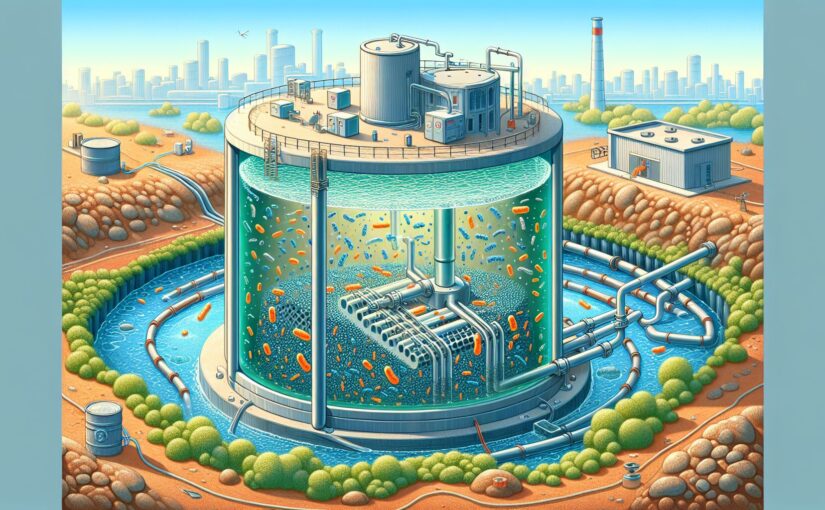
Wastewater treatment is an essential function in maintaining public health and environmental standards. However, the process can be costly and energy-intensive. Amid rising energy demands and environmental concerns, innovative solutions like Microbial Fuel Cells (MFCs) are being explored for their potential to treat wastewater while simultaneously generating electricity. In this article, we will delve into the world of MFCs, their operation, advantages, and the challenges faced in scaling them up for widespread use.
What Are Microbial Fuel Cells?
Microbial Fuel Cells (MFCs) are bio-electrochemical systems that utilize bacteria to convert organic materials found in wastewater into electrical energy. This technology harnesses the metabolic process of electroactive bacteria, which can transfer electrons to an electrode during the degradation of organic substances.
How Do MFCs Work?
MFCs typically consist of two compartments, an anode and a cathode chamber, separated by a proton exchange membrane (PEM). The anode chamber contains wastewater and electroactive bacteria, known as exoelectrogens. As these bacteria consume organic material in the wastewater, they produce electrons and protons as byproducts. The electrons are transferred to the anode and travel through an external circuit to the cathode, generating an electrical current. Meanwhile, the protons pass through the PEM to the cathode chamber, where they combine with electrons and an oxidizing agent (frequently oxygen) to form water.
Electroactive Wastewater Bacteria
Electroactive bacteria are vital to the MFC’s function. These bacteria are capable of extracellular electron transfer (EET), which means they can transfer electrons outside their cell membranes. Thanks to this capability, they can directly interact with electrodes, making them perfect for use in MFCs. Among these bacteria, certain types, such as Geobacter sulfurreducens and Shewanella oneidensis, are well-studied for their efficient electron transfer capabilities.
Proton Exchange Membrane
The PEM plays a critical role in maintaining the separation of charge within the MFC. It allows protons to move from the anode to the cathode while preventing the mixing of the reactants from each chamber. This separation is crucial for maintaining a potential difference between the electrodes and ensuring the continuous flow of electricity.
Electron Transfer Mechanisms
Electron transfer within MFCs can occur through multiple pathways:
- Direct Transfer: Bacteria form a biofilm on the anode and transfer electrons directly to the surface.
- Mediator-Based Transfer: Some bacteria require a mediator—a substance that can shuttle electrons from the bacteria to the electrode.
- Nanowire Transfer: Certain bacteria produce conductive appendages known as pili or ‘nanowires’ that enable electron transfer to the anode.
The Benefits of MFCs in Wastewater Treatment
The integration of MFCs into wastewater treatment offers numerous advantages, such as:
- Renewable Energy Production: They can generate electricity from waste products, potentially offsetting a portion of the treatment plant’s energy needs.
- Low Operational Costs: MFCs can operate at ambient temperatures and pressures, reducing energy requirements compared to conventional treatment methods.
- Reduction in Sludge Production: They produce less waste biosolid byproduct, reducing disposal costs.
- Pollutant Degradation: Some MFC configurations can enhance the breakdown of difficult-to-degrade compounds in wastewater.
Challenges and Future Outlook
While microbial fuel cells offer an enticing glimpse into a sustainable future for wastewater treatment, several challenges need to be overcome for them to become mainstream:
- Scaling Up: Laboratory-scale success needs to be replicated on a larger scale, which presents engineering, financial, and practical challenges.
- Power Density: Current MFCs have low power densities compared to traditional power sources, necessitating advances in design and materials to enhance efficiency.
- Cost of Materials: High costs associated with electrode materials and PEMs are prohibitive, pushing researchers to find affordable and sustainable alternatives.
- Commercial Viability: A sustainable business model is yet to be established for the broad application of MFC technology.
Electrode Materials for Future MFCs
Innovations in electrode materials are critical to improving the performance and cost-effectiveness of MFCs. Researchers are exploring carbon-based electrodes, catalyst-coated electrodes, and novel composites for enhanced conductivity and biocompatibility.
Carbon-Based Electrodes
Carbon materials, due to their conductivity, chemical stability, and bio-compatibility, are popular choices for electrodes. In particular, graphite and activated carbon are used, but researchers are also investigating carbon nanotubes and graphene due to their superior electrical properties.
Catalyst-Coated Electrodes
Catalysts can increase an MFC’s efficiency by accelerating the reactions at the electrodes. While platinum is a highly effective catalyst, its high cost motivates the search for more economically viable alternatives such as transition metal and biocatalysts.
Concluding Thoughts
Microbial fuel cells represent an exciting frontier in wastewater treatment, providing a sustainable path to turn waste into watts. Despite the challenges ahead, ongoing research and technological advances could pave the way for these bio-electrochemical systems to play a significant role in global water treatment strategies while contributing to renewable energy portfolios.
Sources:
- Logan, B.E., Hamelers, B., Rozendal, R., Schröder, U., Keller, J., Freguia, S., … Aelterman, P. (2006). Microbial fuel cells: Methodology and technology. Environmental Science & Technology, 40(17), 5181-5192.
- Pant, D., Van Bogaert, G., Diels, L., & Vanbroekhoven, K. (2010). A review of the substrates used in microbial fuel cells (MFCs) for sustainable energy production. Bioresource Technology, 101(6), 1533-1543.
- Rabaey, K., & Verstraete, W. (2005). Microbial fuel cells: novel biotechnology for energy generation. Trends in Biotechnology, 23(6), 291-298.