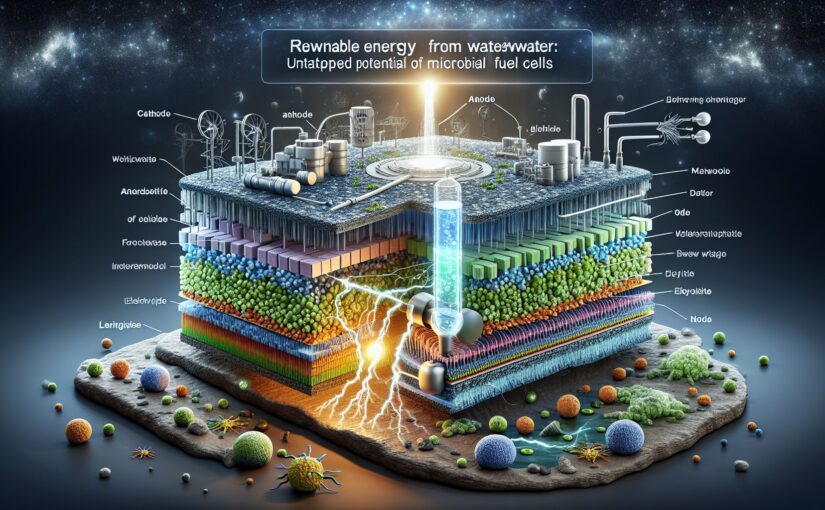
The quest for renewable energy sources has led to various innovative technologies designed to harness energy from the sun, wind, and water. However, one often overlooked source of energy remains hidden within the very infrastructure of our cities – wastewater. This article delves into the potential for generating renewable energy from wastewater using a fascinating technology known as Microbial Fuel Cells (MFCs).
Understanding Microbial Fuel Cells (MFCs)
Microbial Fuel Cells are bio-electrochemical systems that use the metabolism of microorganisms to convert organic compounds in wastewater into electricity. MFCs consist of two compartments, an anode and a cathode, separated by a proton exchange membrane. Microbes at the anode consume organic material from the wastewater, generating protons, electrons, and carbon dioxide. Electrons travel through an external circuit to the cathode, producing an electric current, while protons pass through the membrane to the cathode, where they combine with electrons and oxygen to form water.
The Process of Generating Bioelectricity from Wastewater
- Organic Matter Breakdown: Electroactive bacteria in the anode chamber break down organic pollutants in the wastewater, releasing electrons and protons.
- Electron Transfer: Electrons travel through an external circuit from the anode to the cathode chamber, generating an electric current.
- Proton Exchange: Protons move through the proton exchange membrane towards the cathode chamber.
- Water Formation: In the cathode chamber, protons, electrons, and oxygen react to form water.
The Benefits of Microbial Fuel Cells for Wastewater Treatment
- Dual Functionality: MFCs treat wastewater while simultaneously generating electricity, offering a sustainable approach to waste management.
- Renewable Energy Generation: The electricity produced through MFCs is renewable, reducing reliance on fossil fuels.
- Carbon Footprint Reduction: By utilizing organic waste, MFCs can lower greenhouse gas emissions associated with wastewater treatment.
- Low Operational Costs: MFCs require less energy compared to conventional wastewater treatment methods, leading to cost savings.
Current Challenges with MFC Technology
Despite the potential benefits, several challenges impede the widespread utilization of MFCs:
- Lower Power Output: MFCs currently have lower power density compared to other renewable energy sources.
- Scaling Up: The transition from lab-scale to full-scale MFC systems remains a technical hurdle.
- Electrode Materials: Finding cost-effective and high-performing electrode materials is crucial for efficient electron transfer.
- Public Awareness: Increased awareness and acceptance are necessary to facilitate investment and research in MFC technology.
Key Research and Success Stories in MFCs for Wastewater Treatment
Researchers and engineers across the globe have made significant progress in improving MFC technology. Notable achievements include:
- Enhanced Electrode Design: The development of carbon-based and catalyst-coated electrodes has improved MFC efficiency.
- System Integration: MFCs are being combined with other renewable systems, such as solar panels, to increase overall energy output.
- Pilot Projects: Various pilot projects around the world have successfully demonstrated the feasibility of using MFCs for wastewater treatment on a larger scale.
The Future of MFCs in Renewable Energy
The potential for MFCs to contribute significantly to the renewable energy landscape is vast. Future advancements may include:
- Sophisticated Designs: Novel MFC designs that optimize microbial activity and electron transfer are on the horizon.
- Material Science Breakthroughs: Continued research into electrode materials may yield more effective and affordable options.
- Scalability Solutions: Advancements in MFC technology could enable full-scale systems capable of servicing large populations.
How the Public Can Support MFC Research
Public support is vital for the advancement of MFCs. Individuals can contribute by:
- Advocating: Promoting the benefits of MFCs through social media and community platforms can increase awareness.
- Investing: Supporting crowdfunding campaigns or investing in startups can accelerate research and development.
- Educating: Sharing knowledge about MFCs and sustainability can inspire future generations to pursue careers in this field.
Conclusion
The intersection of wastewater treatment and renewable energy presents a unique opportunity to address two critical challenges of our time – waste management and energy sustainability. Through the continued development and support of Microbial Fuel Cells, we can unlock the potential of wastewater as a substantial and untapped source of renewable energy.
Sources:
- Logan, B. E., & Regan, J. M. (2006). Microbial fuel cells—challenges and applications. Environmental Science & Technology, 40(17), 5172-5180. DOI: 10.1021/es0627592
- Rabaey, K., & Rozendal, R. A. (2010). Microbial electrosynthesis — revisiting the electrical route for microbial production. Nature Reviews Microbiology, 8(10), 706-716. DOI: 10.1038/nrmicro2422
- Li, W.-W., Yu, H.-Q., & He, Z. (2014). Towards sustainable wastewater treatment by using microbial fuel cells-centered technologies. Energy & Environmental Science, 7(3), 911-924. DOI: 10.1039/c3ee43106a
“`markdown
Renewable Energy from Wastewater: The Untapped Potential of Microbial Fuel Cells
Discover how the renewable energy potential locked in our wastewater can be exploited through Microbial Fuel Cells (MFCs), offering dual benefits of energy generation and waste treatment.
Understanding Microbial Fuel Cells (MFCs)
An introduction to the basic structure and function of MFCs, which leverage the metabolic processes of microbes to turn organic waste in wastewater into electricity.
The Process of Generating Bioelectricity from Wastewater
Outline the step-by-step process through which MFCs convert organic matter into a renewable source of energy.
The Benefits of Microbial Fuel Cells for Wastewater Treatment
Highlight the dual functionality, renewable energy generation, carbon footprint reduction, and low operational costs of MFCs.
Current Challenges with MFC Technology
Discuss the various obstacles such as low power output and scaling up that need to be overcome for MFCs to become mainstream.
Key Research and Success Stories in MFCs for Wastewater Treatment
Present research breakthroughs and successful pilot projects that demonstrate the practical feasibility of MFC technology.
The Future of MFCs in Renewable Energy
Explore the potential of MFCs in the renewable energy sector and what future advancements may look like.
How the Public Can Support MFC Research
Provide ways in which the general public can contribute to promoting and supporting the development of MFC technology.
Conclusion
Summarize the potential and significance of utilizing MFCs for sustainable energy generation and wastewater treatment.
Sources:
- [Environmental