The treatment of wastewater is an essential, yet energetically demanding process. With the rising global population and urbanization, traditional wastewater treatment methods are experiencing increased strain, necessitating the exploration of alternative, more sustainable approaches. A particularly promising avenue lies in the utilization of bioelectrochemical systems (BESs) to not only treat wastewater but also to harvest renewable energy in the form of bioelectricity. This article delves into the potential of extracting renewable energy from wastewater using innovative technologies and cutting-edge scientific understanding.
Unveiling the Potential of Bioelectrochemical Systems
Bioelectrochemical systems (BESs) represent a fascinating intersection of biology and electrochemistry. These systems harness the natural metabolic processes of microorganisms to break down organic matter in wastewater and simultaneously generate electricity. BESs, particularly microbial fuel cells (MFCs), have emerged as a promising technology that can contribute to sustainable wastewater management and energy generation.
Microbial Fuel Cells: A Primer
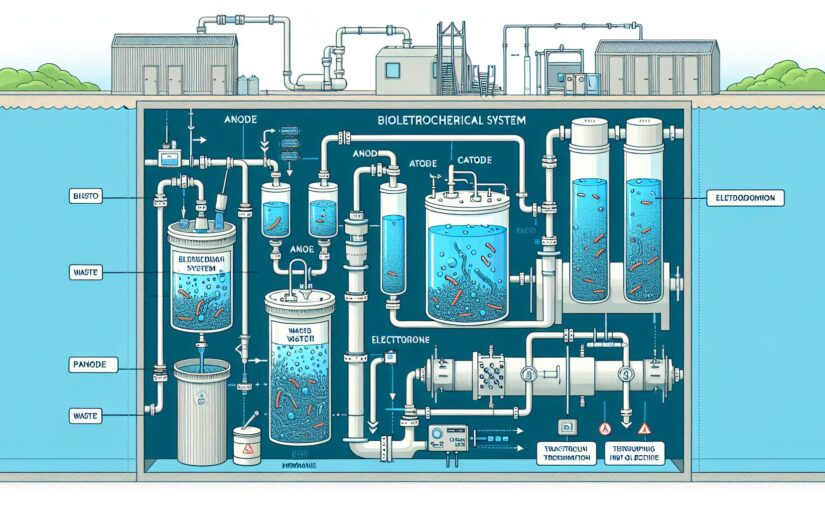
A microbial fuel cell is a device that uses bacteria to convert organic waste material into electrical energy. This process takes place in a two-chambered cell separated by a proton exchange membrane. In the anode chamber, electroactive bacteria, sometimes known as exoelectrogens, metabolize the organic compounds in the wastewater, releasing electrons and protons. The electrons travel through an external circuit to the cathode, where they combine with the protons and oxygen to form water. This flow of electrons is harnessed as electricity.
The Dual Benefit: Wastewater Treatment and Energy Production
On the wastewater treatment front, MFCs offer significant advantages over conventional methods. They operate at ambient temperatures, require fewer chemicals, and boast a lower carbon footprint. More intriguing is the ability of MFCs to target and degrade complex pollutants, including those that are typically difficult to break down in standard treatment processes.
Simultaneously, the prospect of generating renewable energy from wastewater offers a twofold environmental benefit. This approach not only seeks to decrease the reliance on fossil fuels but also proposes a novel method to manage wastewater, transforming it from a costly byproduct into a valuable resource.
Exploring the Inner Workings: Electroactive Bacteria and Electron Transfer
The core of bioelectricity generation lies in the metabolic activities of electroactive wastewater bacteria. These microorganisms, such as those from the genera Shewanella and Geobacter, have specialized mechanisms enabling extracellular electron transfer (EET). They can effectively “breathe” metals or electrodes, thus releasing electrons during the metabolic breakdown of organic substrates.
EET can occur via direct contact between the bacterial cell membranes and the electrode or indirectly through soluble mediators that shuttle electrons. Mediator-less MFCs rely on the former, promising cleaner and more cost-effective energy extraction, if the technical challenges associated with scaling up can be efficiently addressed.
Addressing the Challenges: Efficiency and Scalability
Despite the appeal of BES technology, several challenges must be resolved to unlock its full potential. Key among these are the power density and coulombic efficiency — measures of the system’s electricity generation capability and the efficiency of electron transfer from the substrate to the current, respectively.
To enhance these parameters, research has focused on optimizing electrode materials, including the use of carbon-based electrodes and catalyst-coated electrodes, to improve the conductivity and surface area available for bacterial colonization. Advancements in electrode design and the integration of novel materials such as graphene and conductive polymers have shown promising results.
Scaling up MFCs for real-world application remains a persistent hurdle. Various configurations, such as stacked or continuous flow MFCs, have been explored to align the system with industrial standards of wastewater treatment plants. Yet, the complexity and costs associated with these systems demand further innovation and optimization.
Sustainable and Renewable: The Path Forward
The pursuit of sustainability in wastewater management must be complemented with the goal of renewable energy generation. Bioelectrochemical systems present an opportunity to converge these pathways, leading to a more resilient and environmentally harmonious future.
Efforts to integrate BESs into existing wastewater infrastructure or to design new treatment facilities around these systems are ongoing. Continuous research and development, coupled with industry collaboration and policy support, could propel this technology from the lab bench to widespread application.
Looking Ahead: Innovative Applications and Global Impact
Apart from electricity generation, BES technology holds potential for a range of other applications, including microbial electrolysis cells for hydrogen production and microbial desalination cells for the removal of salts from saline waters. Moreover, BESs could be employed as biosensors to monitor wastewater quality, providing real-time data that could be vital for environmental protection efforts.
Although significant progress has been made, the translation of BES technology into a widespread utility will require a concerted effort from scientists, engineers, industry leaders, and policymakers. Bridging the gap between theoretical possibilities and practical solutions remains a critical objective for the scientific community.
Conclusion
The intersection of wastewater treatment and renewable energy generation presents a unique opportunity to address two of the most pressing environmental challenges of our time. Bioelectrochemical systems, and microbial fuel cells in particular, stand at the forefront of this intersection, promising a future where energy flows not just from the sun and wind but also from the very byproducts of human civilization.
As research advances and the technology matures, the hope is that BESs will become a standard in the field of wastewater management, contributing significantly to the global push towards sustainability. The journey towards this goal is already underway, and every innovation brings us a step closer to realizing the full potential of renewable energy from wastewater.
Sources
- Logan, B. E., & Regan, J. M. (2006). Electricity-producing bacterial communities in microbial fuel cells. Trends in Microbiology, 14(12), 512-518.
- Rabaey, K., & Rozendal, R. A. (2010). Microbial electrosynthesis — revisiting the electrical route for microbial production. Nature Reviews Microbiology, 8(10), 706-716.
- Heidrich, E. S., Curtis, T. P., & Dolfing, J. (2011). Determination of the internal chemical energy of wastewater. Environmental Science & Technology, 45(2), 827-832.