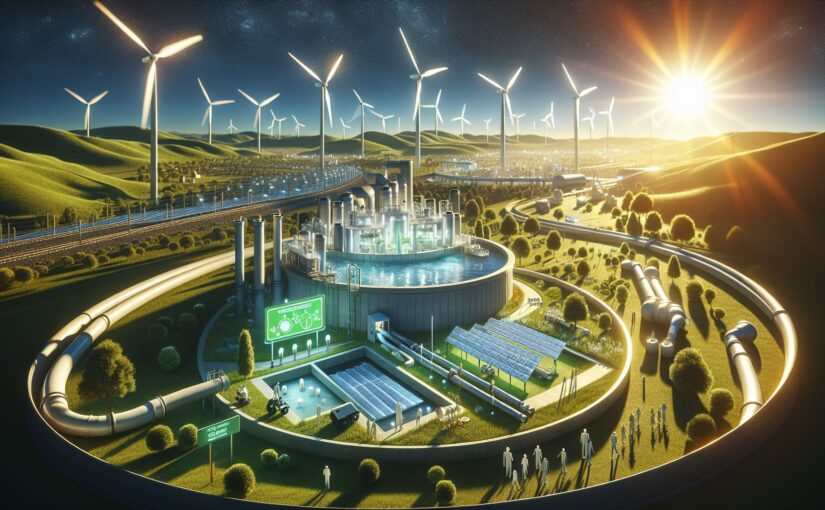
The quest for renewable energy sources has become more imperative than ever before as we face the challenges of climate change and finite fossil fuels. One innovative solution lies in a place often associated with waste and pollution: our wastewater systems. In this comprehensive look at renewable energy from wastewater, we delve into how this unlikely source can contribute to a greener future.
The Potential of Wastewater
Wastewater is a byproduct of domestic, industrial, and agricultural activities. While it is primarily seen as something to be treated and disposed of, wastewater also represents a vast reservoir of potential energy in the form of organic matter. The energy content of wastewater has been estimated to be sufficient to fulfill a significant portion of global energy demand if effectively harnessed.
Microbial Fuel Cells: A Path to Bioelectricity
One of the most promising technologies for extracting energy from wastewater is the Microbial Fuel Cell (MFC). MFCs are devices that use electroactive bacteria to break down organic matter and release electrons, which can then be captured as electricity. This technology allows for the direct conversion of the chemical energy in wastewater into electricity without the need for combustion.
The Working Principle of MFCs
An MFC typically comprises two chambers separated by a membrane. The anode chamber houses the wastewater and electroactive bacteria. When these bacteria consume the organic matter, they release electrons and protons. The released electrons travel through an external circuit to the cathode chamber, creating an electrical current. Meanwhile, the protons pass through a proton exchange membrane to the cathode chamber, where they combine with electrons and oxygen to form water.
Advantages of MFCs
MFCs offer several compelling advantages over traditional wastewater treatment and energy harvesting methods:
- Energy-Efficiency: MFCs treat wastewater while simultaneously generating electricity, thus reducing the overall energy consumption of the wastewater treatment process.
- Low Emissions: Since MFCs operate at ambient temperatures and pressures, they have a minimal carbon footprint compared to combustion-based power generation.
- Resource Recovery: In addition to electricity, MFCs can facilitate the recovery of valuable resources, such as water and nutrients, from wastewater.
- Decentralization: MFCs can be operated on various scales, making them suitable for both centralized treatment plants and remote or off-grid locations.
Scaling Up the Technology
Despite the potential of MFCs, scaling up from laboratory prototypes to full-scale wastewater treatment facilities remains a challenge. Below are some current areas of research and development that are critical to the widespread adoption of this technology:
- Material Advances: Finding cost-effective and efficient electrode and membrane materials can improve the energy output and durability of MFCs.
- Microbial Performance: Further understanding of the electroactive microbes can lead to enhanced electron transfer rates and substrate degradation.
- System Design: Innovative design solutions for large-scale MFCs, including stacked and continuous flow configurations, can help to optimize performance and integration into existing infrastructure.
- Economic Viability: Continuous improvements in power density, coulombic efficiency, and overall system efficiency are essential to making MFCs economically competitive.
Case Studies and Real-World Application
Some pilot projects and real-world applications of MFC technology have demonstrated encouraging results. For instance, a pilot plant in the United States has successfully operated an MFC capable of treating 1,000 liters of wastewater per day, generating a peak power of around 2.5 kW.
Moreover, in developing regions, small-scale MFC systems are being used in remote areas to provide electricity for lighting and charging small devices, demonstrating the potential of this technology to address energy poverty.
Environmental Benefits and Sustainability
The environmental benefits of generating renewable energy from wastewater align with the principles of sustainability and circular economy. By transforming waste into a resource, we can reduce greenhouse gas emissions, mitigate pollution, and decrease our reliance on non-renewable energy sources.
Future Directions
Looking forward, it’s clear that renewable energy from wastewater holds great promise for contributing to a sustainable energy mix. Continued research and investment in this field could see MFCs and related technologies becoming a cornerstone of modern, eco-friendly wastewater treatment facilities.
Sources
-
Logan, B. E., & Rabaey, K. (2012). Conversion of Wastes into Bioelectricity and Chemicals by Using Microbial Electrochemical Technologies. Science, 337(6095), 686–690. DOI: 10.1126/science.1217412
-
Pant, D., Van Bogaert, G., Diels, L., & Vanbroekhoven, K. (2010). A review of the substrates used in microbial fuel cells (MFCs) for sustainable energy production. Bioresource Technology, 101(6), 1533–1543. DOI: 10.1016/j.biortech.2009.10.017
-
Heidrich, E. S., Dolfing, J., Scott, K., Edwards, S. R., Jones, C., & Curtis, T. P. (2014). Production of hydrogen from domestic wastewater in a pilot-scale microbial electrolysis cell. Applied Microbiology and Biotechnology, 98(15), 6827–6835. DOI: 10.1007/s00253-014-5750-y
Adopting renewable energy from wastewater not only promises cleaner energy but also echoes our collective responsibility towards a more sustainable future. As the research evolves and technologies mature, the byproducts of our daily lives may just become the powerhouse of tomorrow.