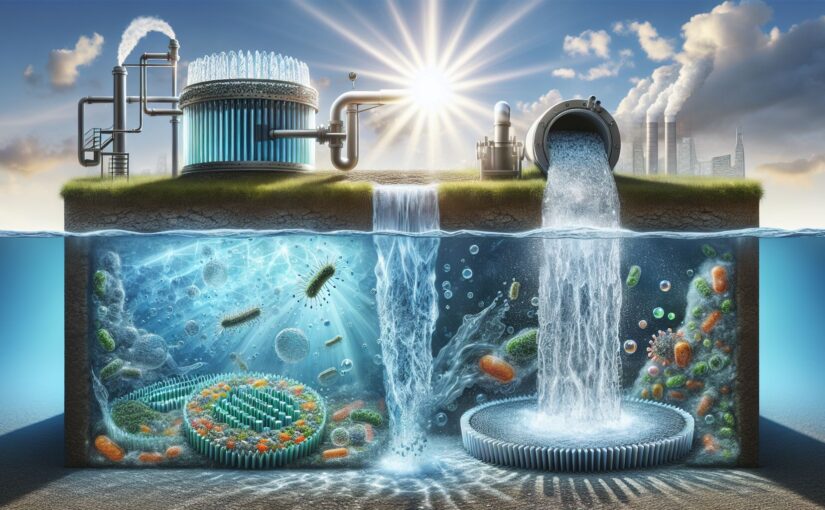
In our ongoing quest for sustainability and environmental conservation, innovative technologies are constantly emerging to address some of our most pressing challenges. One such innovative approach involves harnessing the abilities of microorganisms to treat wastewater while simultaneously generating clean energy. This fascinating intersection of biology and technology has led to the development of microbial fuel cells (MFCs) designed specifically for wastewater treatment. In this comprehensive article, we will delve into the promising potential of Microbial Fuel Cells for Wastewater Treatment, exploring how this emerging technology can contribute to a greener and more sustainable future.
Understanding Microbial Fuel Cells (MFCs)
Before we dive into the specifics of wastewater treatment, let’s establish a basic understanding of what microbial fuel cells are. MFCs are bio-electrochemical systems that convert the chemical energy found in organic compounds directly into electrical energy through the metabolic processes of electroactive bacteria. These systems comprise two compartments, the anode and the cathode, separated by a proton exchange membrane (PEM)^[1^].
- Anode Compartment: This is where the wastewater is introduced. Electroactive bacteria, also known as exoelectrogens, oxidize the organic substrates (fuel), releasing electrons and protons. The electrons are transferred to the anode surface and flow through an external circuit to the cathode, generating electricity.
- Cathode Compartment: Meanwhile, the protons diffuse through the PEM to the cathode compartment, where they recombine with the electrons (coming from the external circuit) and an electron acceptor, usually oxygen, to form water.
The core advantage of MFCs is that they offer a dual benefit: wastewater treatment and the generation of bioelectricity, which can potentially make the wastewater treatment process more energy-efficient or even energy-positive^[2^].
Microbial Fuel Cells for Wrenovating Usewater Treatment
Wastewater treatment has historically been energy-intensive and costly, presenting numerous environmental challenges. MFCs are being explored as a way to revamp this process for a number of compelling reasons.
Environmental Sustainability
MFCs for wastewater treatment are attractive because they can potentially reduce the carbon footprint associated with traditional treatment plants. With bacteria performing the treatment naturally, there might be less need for added chemicals or energy-intensive mechanical processes^[3^].
Bioelectricity Generation
As the bacteria break down the organic pollutants in the wastewater, they release electrons, which are captured to generate an electric current. This bioelectricity can be used to power low-energy-consuming devices, sensors, or even contribute towards the power needs of the treatment plant itself.
Cost-Effective Operations
The operational costs associated with MFCs are potentially lower than those for conventional treatment systems because they can operate at ambient temperatures and do not require aeration, which is one of the most energy-consuming processes in standard treatment facilities.
The Challenges of Scalability and Efficiency
Despite their promise, scaling up MFCs for widespread use in wastewater treatment faces several hurdles. Current MFC designs often suffer from low power densities and coulombic efficiencies, meaning that they don’t convert all the available energy in the wastewater into electricity^[1^]. Additionally, the cost and durability of materials—especially the proton exchange membranes and electrodes—remain a challenge for making MFCs economically viable at a larger scale^[4^].
Strategies for Improvement
Innovations in electrode materials and configurations, such as the use of carbon-based electrodes or catalyst-coated electrodes, are being researched to enhance the power output and efficiency of MFCs^[2^]. Furthermore, different configurations of MFCs, including stacked and continuous flow designs, are being tested to improve their scalability and integration into existing wastewater treatment infrastructures^[5^].
Future Prospects and Applications
Looking forward, MFC technology holds great potential not only for wastewater treatment but also for other applications such as biosensors for detecting pollutants and microbial electrolysis cells for producing hydrogen fuel. The prospects of integrating MFCs with renewable energy sources and developing plant-microbial fuel cells broaden the horizon for creating truly sustainable and energy-positive wastewater treatment systems^[3^].
Conclusion
Microbial fuel cells represent a promising convergence of biology and technology, with the potential to transform wastewater treatment into a process that’s not only environmentally friendly but also generates renewable energy. While challenges in scalability and efficiency remain, ongoing research and development are continuously pushing the boundaries of what’s possible with MFCs.
With continued innovation and investment, MFCs could play a crucial role in our sustainable future, contributing to the conservation of water resources and the generation of clean energy. As our understanding of electroactive bacteria and the electron transfer mechanisms in MFCs deepens, we move closer to a reality where treating wastewater no longer comes at such a great environmental and economic cost.
References:
-
Logan, B. E., & Regan, J. M. (2006). Microbial fuel cells—challenges and applications. Environmental Science & Technology, 40(17), 5172-5180. https://doi.org/10.1021/es0627592
-
Rozendal, R. A., Hamelers, H. V. M., Rabaey, K., Keller, J., & Buisman, C. J. N. (2008). Towards practical implementation of bioelectrochemical wastewater treatment. Trends in Biotechnology, 26(8), 450-459. https://doi.org/10.1016/j.tibtech.2008.04.008
-
Pant, D., Van Bogaert, G., Diels, L., & Vanbroekhoven, K. (2010). A review of the substrates used in microbial fuel cells (MFCs) for sustainable energy production. Bioresource Technology, 101(6), 1533-1543. https://doi.org/10.1016/j.biortech.2009.10.017
-
Li, W. W., Sheng, G. P., Liu, X. W., & Yu, H. Q. (2011). Recent advances in the separators for microbial fuel cells. Bioresource Technology, 102(1), 244-252. https://doi.org/10.1016/j.biortech.2010.07.017
-
He, Z., & Mansfeld, F. (2009). Exploring the use of electrochemical impedance spectroscopy (EIS) in microbial fuel cell studies. Energy & Environmental Science, 2(2), 215-219. https://doi.org/10.1039/B813393G