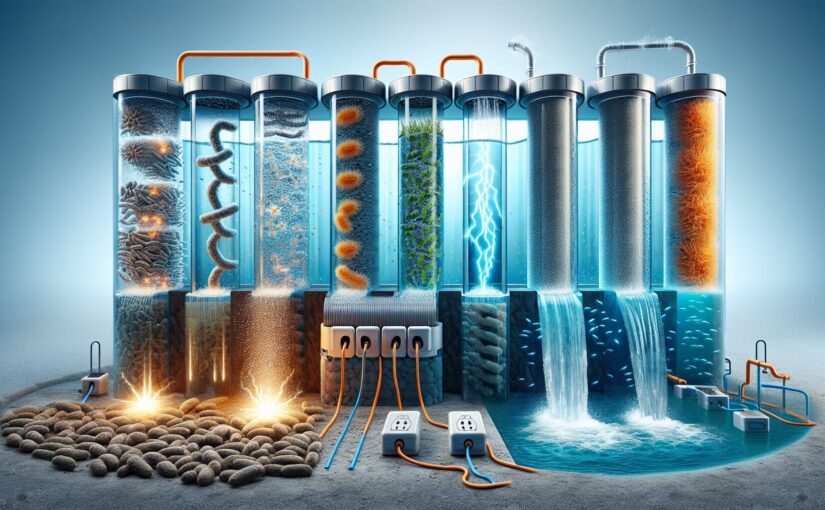
The modern world is facing two growing challenges that have spurred scientists and engineers to seek innovative solutions: the need for sustainable wastewater treatment and the quest for renewable energy sources. Interestingly, these two issues converge in an exciting field of research revolving around the harnessing of bioelectricity from wastewater through Microbial Fuel Cells (MFCs). MFCs offer a promise not just for cleaner water, but also for a greener planet by generating electricity as a by-product of the treatment process.
In this comprehensive exploration, we’ll delve into the fascinating world of microbial fuel cells, focusing primarily on their role in wastewater treatment and bioelectricity generation, a subject that represents a remarkable amalgamation of biotechnology and renewable energy engineering.
Understanding Microbial Fuel Cells (MFCs)
At the core of a microbial fuel cell is the principle of bioelectrochemical systems (BES), wherein bacteria act as the catalysts, breaking down organic matter and simultaneously producing electrons. These electrons are then harnessed to generate electric current. To fully grasp this process, it’s crucial to understand each component and its function within an MFC:
- Electroactive Wastewater Bacteria: Also known as exoelectrogens, these bacteria are capable of transferring electrons outside of their cells during the process of breaking down organic compounds in wastewater.
- Anode: This is the electrode where oxidation occurs. Anode-respiring bacteria attach themselves here and start the degradation of wastewater substrates, transferring electrons to the anode.
- Proton Exchange Membrane (PEM): It separates the anode and cathode compartments, allowing protons (H+) to pass through while containing the electrons within the circuit for electricity generation.
- Cathode: This is where the electrons, after traveling through the electrical circuit, combine with protons and an electron acceptor (often oxygen in the air) to form water or other compounds.
- Electron Transfer Mechanisms: These mechanisms describe how electrons flow from the bacteria to the anode. In some MFCs, this occurs via direct contact or nanowires (extracellular electron transfer), while others require mediators (chemicals that shuttle electrons).
Bioelectricity Generation from Wasteware
The idea of generating electricity from wastewater is not just a novelty but an emerging reality. Bioelectricity generation occurs when the chemical energy present in the organic matter of the wastewater is converted into electrical energy through the metabolic processes of electroactive bacteria. This conversion is an environmentally friendly alternative to traditional wastewater treatment methods, which are often energy-intensive and contribute to greenhouse gas emissions.
Types of Microbial Fuel Cells for Wastewater Treatment
MFCs can take on various designs and configurations depending on their intended application, scalability, and the nature of the wastewater to be treated. Here are a few notable types:
- Mediator-less MFCs: These systems do not require additional chemicals to facilitate electron transfer, as the bacteria involved can transfer electrons directly to the anode.
- Mediator-based MFCs: These rely on chemical mediators to transport electrons from bacteria to the anode.
- Continuous Flow MFCs: Designed for real-world applications, these MFCs receive a continuous influx of wastewater, mimicking the flow of treatment plants.
- Sediment MFCs: These are used in natural settings like sediments where they exploit the organic matter present in the sediment-water interface.
- Stacked MFCs: An arrangement that increases the overall voltage and power output by stacking multiple MFC units.
Advancements and Challenges in Scaling up MFCs
Several challenges must be addressed when transitioning from laboratory-scale MFCs to full-scale wastewater treatment plants:
- Power Density: For MFCs to be practical on a large scale, they need to achieve higher power densities, meaning more power output per volume of the reactor.
- Coulombic Efficiency: This measures how efficiently electrons produced from substrate degradation are captured as electrical current.
- Electrode Materials: The search for efficient and cost-effective electrode materials, such as carbon-based or catalyst-coated electrodes, is ongoing.
- Design and Process Optimization: Continuous advancements are made in the configuration and operation of MFCs to improve their effectiveness and economic viability.
The Potential of Bioelectricity in a Sustainable Future
The dream of extracting value in the form of clean energy from wastewater is closer than ever, thanks to the rapid developments in microbial fuel cell technology. As these systems become more sophisticated, they offer a dual benefit to society—mitigating water pollution and contributing to renewable energy production.
Environmental and Economic Implications
By improving the energy efficiency of wastewater treatment and even producing excess energy, MFCs could significantly reduce the carbon footprint of water treatment facilities. Moreover, this technology has the potential to lower operational costs and make wastewater treatment more accessible in remote or off-grid locations.
Perspectives on Implementation and Research
As R&D in this field continues to flourish, pilot projects around the world are demonstrating the practical viability of microbial fuel cells. Further interdisciplinary research is crucial to accelerate the integration of this revolutionary technology into mainstream wastewater management practices.
Inching Towards a Cleaner and More Energetic Tomorrow
Revolutionizing the way we deal with wastewater while tackling energy issues is no small feat. Microbial fuel cells stand at the intersection of sustainability and innovation, reflecting a harmonious marriage between ecological stewardship and technological advancement. As this field reaches maturity, we may witness wastewater treatment plants not just as necessary utilities but as powerhouses in the literal sense, lighting up the path towards a sustainable future.
Sources
- Logan, B. E. (2008). Microbial Fuel Cells. John Wiley & Sons.
- Rabaey, K., & Rozendal, R. A. (2010). Microbial electrosynthesis — revisiting the electrical route for microbial production. Nature Reviews Microbiology, 8(10), 706-716.
- He, Z., & Mansfeld, F. (2009). Exploring the use of electrochemical impedance spectroscopy (EIS) in microbial fuel cell studies. Energy & Environmental Science, 2(2), 215-219.