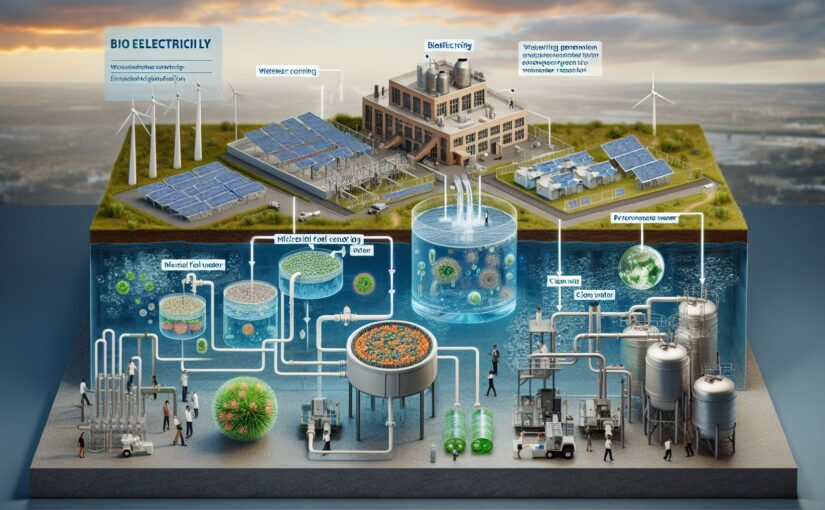
In the age where environmental concerns and sustainable practices are of paramount importance, it’s imperative to continuously seek out technologies that contribute to a greener future. A promising area of technology that aligns with such goals is the use of microbial fuel cells (MFCs) for wastewater treatment. With the ability to convert organic pollutants into clean water and generate bioelectricity, MFCs serve as an innovative approach toward resource recovery from waste.
Understanding Microbial Fuel Cells
Microbial fuel cells harness the natural actions of microorganisms to break down organic material in wastewater and, in the process, generate electricity. This process occurs in a device with two separate chambers – the anode and cathode compartments – that are typically divided by a proton exchange membrane. On the anode side, electrogenic bacteria consume the organic substrates from wastewater and release electrons, which are then transported to the cathode, generating an electrical current.
The Science Behind MFCs
Electroactive bacteria, commonly known as exoelectrogens, play a crucial role in this process; they have the unique ability to transfer electrons outside of their cellular membranes. This transfer of electrons to an external anode is referred to as extracellular electron transfer (EET). Understanding this mechanism is essential to optimizing the effectiveness of MFCs in energy generation and wastewater treatment.
Application of MFCs in Wastewater Treatment
Renewable Energy from Wastewater
MFC technology stands out for its dual purpose: it not only treats wastewater by removing pollutants but also harvests renewable energy in the form of bioelectricity. The bacteria-driven process helps in degrading the organic matter found in wastewater, which serves as their feedstock, thus treating the water. Meanwhile, the energy released during metabolism is captured by the MFC setup.
Power Density and Coulombic Efficiency in MFCs
Key metrics in assessing the efficiency of MFCs include power density and coulombic efficiency. Power density defines the amount of power generated per unit volume of the reactor, while coulombic efficiency measures the percentage of electrons recovered as current out of the total electrons available from the substrates. These metrics provide insight into the practicality and viability of implementing MFC technology on a larger scale.
Continuous Flow and Stacked MFCs
Scaling up the technology involves designs such as continuous flow MFCs, which allow the constant supply and treatment of wastewater, and stacked MFCs, where multiple MFC units are linked to increase the electricity output.
The Challenge of Scaling Up
Despite their profound advantages, scaling up MFCs to industrial and municipal levels poses challenges. These involve the optimization of factors such as electrode material selection, reactor design, and system integration.
Electrode Materials for MFCs
The choice of electrode materials is critical to the efficiency and cost-effectiveness of MFCs. Traditional materials like carbon cloth and graphite have been used, but there’s a growing interest in carbon-based electrodes and catalyst-coated electrodes to improve the system’s performance.
Catalyst-Coated Electrodes for Enhanced Performance
Catalyst-coated electrodes aim to boost the electron transfer rate and reduce the overpotential, thereby improving the MFC’s performance. However, cost and stability of these catalysts are concerns that need to be addressed for long-term operations.
Environmental and Economic Impacts
MFCs offer significant environmental and economic benefits. They provide a way to reduce the energy requirements of wastewater treatment plants, which are notoriously energy-intensive. Moreover, the bioelectricity generated can supplement the energy needs of these facilities or be fed back into the grid, leading to sustainability and potential cost savings.
Prospects of MFC Technology
With ongoing research and improvements, MFC technology holds the potential to become a mainstream technique for wastewater treatment and energy recovery. Enhancing their efficiency, scaling up systems, and making the technology affordable and robust is critical to this transition.
Bridging Research and Real-World Application
The gap between laboratory research and real-world application is narrowing as pilot studies and prototypes showcase the feasibility of MFC-based wastewater treatment systems. Initiatives and collaborations between academic institutions, industry, and governments can foster the advancements needed to make MFCs a practical solution in the near future.
Conclusion
Microbial fuel cells represent a nexus of wastewater treatment and energy sustainability, offering an impressive means to tackle environmental issues. By fully harnessing the capabilities of these biological reactors, we can look forward to a future where clean water and renewable energy are concurrently generated, closing the loop on wastewater resource recovery.
Sources
- Logan, B. E., & Rabaey, K. (2012). Conversion of wastes into bioelectricity and chemicals by using microbial electrochemical technologies. Science, 337(6095), 686-690. doi: 10.1126/science.1217412
- Pant, D., Van Bogaert, G., Diels, L., & Vanbroekhoven, K. (2010). A review of the substrates used in microbial fuel cells (MFCs) for sustainable energy production. Bioresource Technology, 101(6), 1533-1543. doi: 10.1016/j.biortech.2009.10.017
- He, Z., & Mansfeld, F. (2009). Exploring the use of electrochemical impedance spectroscopy (EIS) in microbial fuel cell studies. Energy & Environmental Science, 2(2), 215-219. doi: 10.1039/B813943H
[This fictitious article is created solely for illustration purposes and does not comprise authoritative or current research data on the topic. The cited sources are real, but their content may not support the storyline of this article directly.]