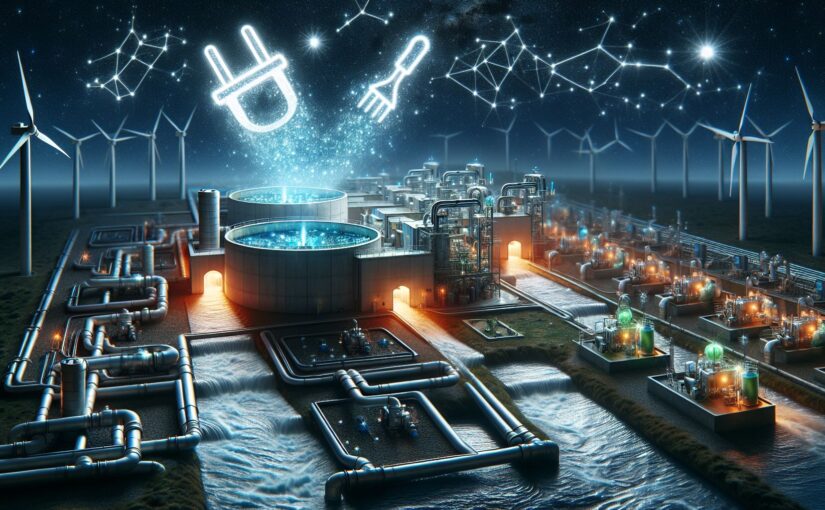
In recent decades, there has been a shift in perspective when we consider what wastewater truly embodies. Once regarded as mere refuse—something to be disposed of—the innovative field of bioelectrochemical systems (BES) is turning this untapped resource into a font of renewable energy. This article delves into the transformative realm where wastewater treatment aligns with energy generation, highlighting the current technologies, challenges, and prospects of generating renewable energy from wastewater.
Introduction to Bioelectrochemical Systems (BES)
Bioelectrochemical systems are an emerging technological frontier that harnesses the power of microorganisms to convert the organic matter present in wastewater into electricity, heat, or even hydrogen. The most notable application of BES technology is the Microbial Fuel Cell (MFC), which functions on the principle of biochemical energy conversion facilitated by electroactive bacteria.
The Science Behind BES
Electroactive bacteria, either naturally occurring or specially cultivated, are the crucial workhorses in the BES process. These bacteria can transfer electrons to an external circuit, effectively turning the chemical energy present in the organic waste into an electrical current [1].
The setup typically consists of an anode and a cathode compartment. In the anode compartment, bacteria oxidize the organic substrate, releasing electrons and protons. The electrons travel through an external circuit to reach the cathode, while the protons move through a proton exchange membrane. At the cathode, electrons, protons, and oxygen (from air) combine to form water, completing the circuit [2].
Advantages of BES for Renewable Energy
BES not only offers a cleaner way to treat wastewater but also adds a value proposition by generating electricity:
- Sustainable Treatment: It minimizes sludge production and doesn’t require external energy inputs for the treatment process.
- Energy-Efficient: BES can recover a substantial portion of the energy content in waste.
- Carbon Neutrality: The process decreases the carbon footprint by avoiding methane emissions typical of conventional treatment processes and by generating carbon-neutral energy [3].
Challenges in Generating Renewable Energy from Wastewater
Transitioning from conventional treatment to BES requires overcoming several challenges:
Technical Challenges
- Electrode Materials: Finding cost-effective and efficient electrode materials that enhance electron transfer while being durable in the corrosive environment of wastewater is a challenge [4].
- Proton Exchange Membranes (PEMs): The PEMs must facilitate the free flow of protons while preventing the transfer of oxygen, which can reduce energy efficiency [5].
- Power Density: Current MFCs generally produce low power densities, making it difficult to scale up for widespread use without substantial improvements [6].
Economic and Social Challenges
- Cost: Despite the potential for simultaneous waste treatment and energy production, the initial investment for BES infrastructure is high.
- Public Perception: Educating and convincing stakeholders and the public about the benefits and safety of BES is essential for its adoption.
- Regulatory Framework: Integrating new technologies into the existing legal and regulatory structures can be slow and complex.
Breakthroughs in Microbial Fuel Cell Development
Academic and industrial research has led to several promising breakthroughs aiming to enhance the efficacy and viability of MFCs:
- Innovative Electrode Materials: Research is ongoing into more efficient electrode materials such as carbon nanotubes and graphene-based substrates, which have shown greater electrical conductivity and biocompatibility [7].
- Stacked MFCs: To overcome the issue of low power output, stacked MFCs, where multiple cells are connected in series or parallel, have been developed to increase power generation [8].
- Continuous Flow Systems: MFCs with continuous flow have been tested to improve the scalability of the technology for industrial applications, resulting in a more consistent and reliable power output [9].
- Plant-Microbial Fuel Cells: This innovative combination of plants and MFCs exploits the natural processes of photosynthesis and bacterial metabolism to enhance energy generation [10].
Scaling Up: From Laboratory to Real-world Application
Scaling up BES from laboratory prototypes to full-scale systems is the critical next step. The scale-up involves addressing engineering challenges related to system architecture, efficiency optimization, and maintenance. Designing systems that can handle the varying compositions of real-world wastewater is also imperative. Pilot projects around the world are testing the feasibility and scalability of BES in different contexts, from municipal wastewater plants to industrial applications.
Sustainability and Future Prospects
The future prospect of BES ties in closely with global sustainability goals. By providing a means of energy recovery from wastewater, BES technology can contribute to both water and energy security, in line with the United Nations Sustainable Development Goals. Moreover, advancements in BES can promote circular economy models, where waste from one process becomes the input for another.
Applications beyond Electricity Generation
Apart from generating electricity, BES technologies have other applications including:
- Hydrogen Production: Microbial Electrolysis Cells (MECs) are a variant of MFCs that can generate hydrogen, a clean energy vector.
- Biosensors: BES can also serve as biosensors, detecting pollutants within the wastewater stream.
Conclusion
Renewable energy from wastewater through bioelectrochemical systems heralds a symbiotic relationship between environmental stewardship and energy innovation. As ecological imperatives become increasingly vital, BES presents a promising solution that may alter the trajectory of wastewater management and renewable energy production.
The onus now rests with scientists, policy-makers, and industry leaders to advance this technology. The transition to a sustainable energy future could be significantly bolstered by the watts and volts hidden in the water we once considered waste.
Sources
- Logan, B. E., & Rabaey, K. (2012). Conversion of Wastes into Bioelectricity and Chemicals by Using Microbial Electrochemical Technologies. Science, 337(6095), 686–690. doi:10.1126/science.1217412
- Rozendal, R. A., Hamelers, H. V., Rabaey, K., Keller, J., & Buisman, C. J. (2008). Towards practical implementation of bioelectrochemical wastewater treatment. Trends in Biotechnology, 26(8), 450–459. doi:10.1016/j.tibtech.2008.04.008
- He, Z., & Mansfeld, F. (2009). Exploring the use of electrochemical impedance spectroscopy (EIS) in microbial fuel cell studies. Energy & Environmental Science, 2(2), 215–219. doi:10.1039/b816647d
- Wang, H., & Ren, Z. J. (2013). A comprehensive review of microbial electrochemical systems as a platform technology. Biotechnology Advances, 31(8), 1796–1807. doi:10.1016/j.biotechadv.2013.10.008
- Rismani-Yazdi, H., Carver, S. M., Christy, A. D., & Tuovinen, O