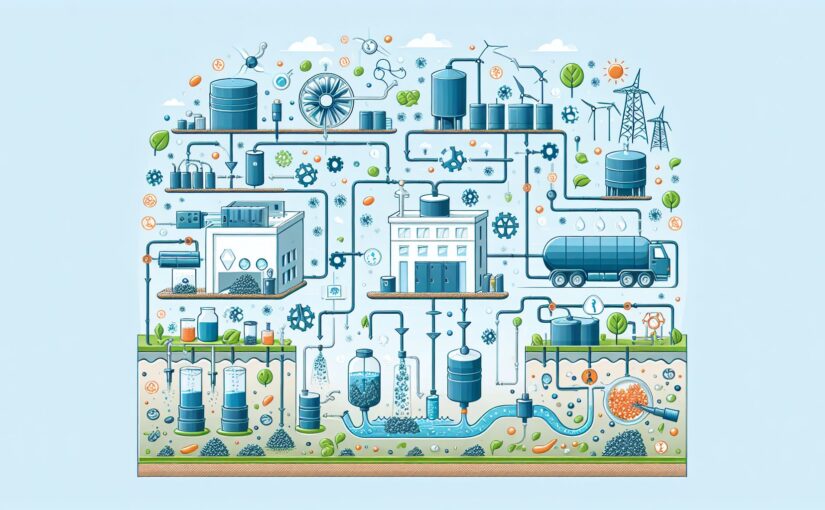
In the effort to find sustainable solutions for both energy production and waste management, a synergistic approach has emerged in the recent decades which is not only innovative but also eco-friendly. This solution revolves around extracting renewable energy from something which every human society produces in abundance: wastewater. By tapping into the biochemical energy of wastewater, we can both treat the waste and produce energy, a win-win situation for the environment and the economy. In this article, we will explore the underpinnings of renewable energy generation from wastewater, focusing on the technologies involved, their benefits, challenges, and the potential they hold for a sustainable future.
Introduction to Wastewater as a Source of Renewable Energy
Wastewater is full of organic matter that, traditionally, has been viewed merely as waste to be disposed of. However, this organic matter contains chemical energy that can be converted into electrical energy through specific bioelectrochemical processes. This transformation is made possible primarily through the use of Microbial Fuel Cells (MFCs), which harness the metabolism of microorganisms to break down organic matter and produce electricity.
The Role of Microbial Fuel Cells (MFCs)
MFCs are devices that use bacteria as the catalysts to oxidize organic and inorganic matter and generate current. In an MFC, wastewater acts as the substrate for microorganisms. As these microorganisms consume organic material in the wastewater, they produce electrons and protons as byproducts. These electrons can be captured and directed through an external circuit to generate electricity, while the protons pass through a proton exchange membrane to the cathode side, completing the circuit.
How MFCs Work
An MFC typically comprises an anode and a cathode, separated by a proton exchange membrane. The bacteria reside in the anode chamber where they process the organic compounds in the wastewater. During this metabolic process, the electrons are transferred to the anode via several methods, including direct contact or through electron shuttles.
Electron Transfer Mechanisms
- Direct transfer: Some bacteria, known as exoelectrogens, can directly transfer electrons to the anode.
- Mediated transfer: In some MFCs, artificial mediators are introduced to facilitate the transfer of electrons from bacteria to the anode.
- Conductive nanowires: Certain bacteria produce pilus-like structures that function like nanowires and conduct electrons to the anode.
The Proton Exchange Membrane (PEM)
The PEM is critical in maintaining the ionic balance between the anode and cathode chambers and allowing protons to pass while electrons are forced through the external circuit to reach the cathode. The efficiency of the PEM determines, to a large extent, the overall efficiency of the MFC.
Power Generation and Efficiency
Electricity production in an MFC is directly related to the organic load of the wastewater and the efficiency of the microorganisms in breaking it down. The efficiency of an MFC is often quantified through two key metrics:
- Power Density: The power output per unit area of the electrode. The greater the power density, the more efficient the MFC.
- Coulombic Efficiency: The percentage of electrons recovered as current from the total electrons available in the substrates.
Benefits of Using Wastewater for Energy Production
- Dual-purpose technology: Simultaneous wastewater treatment and energy generation.
- Reduction in biomass sludge: MFCs can reduce the amount of solid waste produced during the wastewater treatment process.
- Carbon-neutral process: The use of MFCs does not contribute additional CO2 into the atmosphere, making it a sustainable solution.
- Energy efficiency: MFCs can recapture some of the energy used in traditional wastewater treatment processes.
Challenges and Potential
Despite the clear benefits of MFCs for energy generation from wastewater, several challenges must be addressed for the technology to be scaled up and widely adopted:
- Cost of Materials: High cost of electrode materials and proton exchange membranes.
- Scaling up: Translating successful lab-scale models to industrial scale operations.
- Energy Output: Increasing the power density to make the process commercially viable.
- Public Acceptance: Gaining widespread acceptance of the technology by demonstrating its safety, efficiency, and economic benefits.
Advanced Research and the Road Ahead
To address these challenges, ongoing research is focusing on improving MFC designs, identifying more efficient strains of bacteria, exploring cheaper and more durable materials for electrodes and membranes, and optimizing the systems for various types of wastewater.
Electrode Material Innovations
- Carbon-Based Electrodes: Research is being pursued into various forms of carbon, such as carbon nanotubes, carbon cloth, and graphene, which offer excellent conductivity and biocompatibility.
- Catalyst-Coated Electrodes: The addition of catalysts like platinum or metal oxides can enhance electron transfer rates.
The Future Scope
The concept of creating renewable energy from wastewater has the potential to revolutionize both waste management and energy production. With urbanization increasing worldwide, the adoption of MFC technologies can lead to more sustainable cities with closed-loop systems that turn waste into a valuable resource.
Conclusion
Tapping into the chemical energy contained within wastewater represents an exciting frontier in the quest for sustainable and renewable energy sources. The continued development of MFC technology could provide significant benefits in terms of energy conservation, reduction of greenhouse gas emissions, and efficient waste management. As the technology matures, it holds the promise of a cleaner, more sustainable future.
To realize the full potential of this technology, industry professionals, researchers, policy-makers, and educators must collaborate to overcome the challenges and build a robust understanding of the processes involved. The continued exploration of renewable energy from wastewater could very well play a pivotal role in meeting the energy needs of our growing global population while also protecting our environment.
Sources
- Logan, B. E. (2008). Microbial Fuel Cells. John Wiley & Sons, Ltd. [ISBN: 9780470239483].
- Pant, D., Van Bogaert, G., Diels, L., & Vanbroekhoven, K. (2010). A review of the substrates used in microbial fuel cells (MFCs) for sustainable energy production. Bioresource Technology, 101(6), 1533–1543. [doi:10.1016/j.biortech.2009.10.017].
- He, Z., & Mansfeld, F. (2009). Exploring the use of electrochemical impedance spectroscopy (EIS) in microbial fuel cell studies. Energy & Environmental Science, 2(2), 215–219. [doi:10.1039/B816647A].