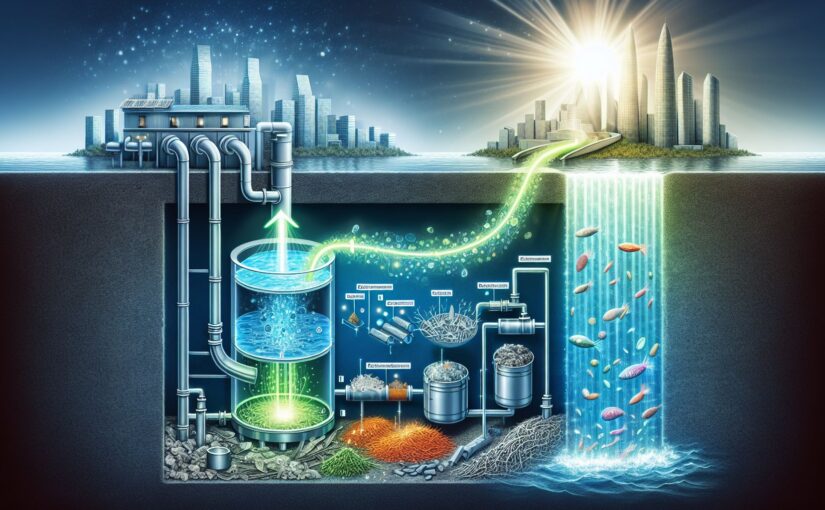
As the world battles with the escalating energy crises and environmental pollution, finding sustainable solutions to address these challenges has become crucial. One promising technology that stands at the intersection of renewable energy and wastewater treatment is the Microbial Fuel Cell (MFC). This innovative system offers the possibility of generating renewable energy from wastewater while simultaneously treating it. In this article, we will explore the potential of harnessing renewable energy from wastewater and dive into the science and practical applications of these bioelectrochemical systems.
Introduction to Wastewater as a Resource
Traditionally, wastewater has been viewed as a waste product to be treated and disposed of as efficiently as possible. However, with the development of new technologies, this perspective is shifting towards seeing wastewater as a resource.
Wastewater is comprised of organic matter that microorganisms can utilize, releasing electrons in the process. This organic content could be converted into a valuable stream of renewable energy if harvested effectively. This is where MFCs come into play as a transformative solution.
What are Microbial Fuel Cells (MFCs)?
Microbial Fuel Cells are a type of bioelectrochemical system that leverage the metabolic processes of microorganisms to convert organic compounds in wastewater into electrical energy. Essentially, bacteria in the MFCs feed on the organic waste, and through biochemical reactions, generate electrons that flow to produce an electric current.
The Components of a Microbial Fuel Cell
An MFC typically includes:
- Anode chamber: where the wastewater is introduced and the electroactive bacteria oxidize the organic matter.
- Cathode chamber: where the reduction reaction takes place, often requiring an electron acceptor like oxygen.
These two chambers are separated by a proton exchange membrane or a salt bridge that allows protons to move from the anode to the cathode while keeping the solutions separate.
How MFCs Generate Renewable Energy from Wastewater
The process involves several steps:
- Organic matter degradation: Electrogenic bacteria consume organic matter present in the wastewater.
- Electron generation: During the metabolic process, electrons are released.
- Electron transfer: Electrons are transferred to the anode, and from there through an external circuit to the cathode, generating an electric current.
- Proton migration: Meanwhile, protons also produced in the anode chamber migrate through the proton exchange membrane to the cathode chamber.
- Reduction reaction: At the cathode, the electrons, protons, and an electron acceptor (usually oxygen) combine to form water or other byproducts.
The Benefits of Using MFCs for Energy Production and Wastewater Treatment
- Renewable energy generation: As long as there is wastewater, MFCs can continue to produce energy.
- Waste reduction: MFCs significantly reduce the organic content in wastewater, thus aiding in waste treatment.
- Low operational cost: They can operate at ambient temperatures and pressures and thus, have lower energy inputs.
- Environmentally friendly: The process greatly minimizes greenhouse gas emissions compared to conventional wastewater treatment processes.
Challenges in Harnessing Renewable Energy from Wastewater
Despite the obvious benefits, there are some challenges when it comes to mainstream application of MFCs:
- Scaling Up: Laboratory-scale MFCs show promise, but scaling up to industrial applications is complicated and requires more research.
- Power Density: The power output of current MFCs needs to be increased to be commercially viable.
- Cost-effective Materials: The proton exchange membranes and electrodes can be expensive, and finding affordable, efficient alternatives is critical.
Research and Development in MFCs
Innovations in materials science, biotechnology, and engineering are driving the evolution of MFCs. For instance, researchers are finding new electroactive bacteria strains that increase the efficiency of electron transfer. Additionally, advanced electrode materials that enhance electricity generation while reducing costs are being discovered.
Moreover, there’s a growing interest in the use of alternative materials such as biochar or carbon nanotubes for electrodes, which could make MFCs more affordable and sustainable.
Notable Research and Applications
- Bioremediation Using Wastewater MFCs: MFC technology has also demonstrated capacity for bioremediation, where harmful pollutants are broken down in addition to energy production (Arends, J.B., & Verstraete, W., 2012).
- Scaling Up Wastewater MFCs: Studies have looked into the architecture and materials of MFCs to optimize the scale-up process (Logan, B.E., 2010).
- Continuous Flow Wastewater MFCs for Enhanced Treatment: Continuous flow systems have been developed to enhance the practical applications of MFCs in treating wastewater.
Present and Future Applications
Here are some of the applications where renewable energy from wastewater is making an impact:
- Small-scale Wastewater Treatment: MFCs are ideal for remote or rural areas where traditional infrastructure is cost-prohibitive.
- Sensors: Utilizing the principles of MFCs, biosensors are being developed for monitoring water quality in real-time.
- Biorefineries: MFCs could become a staple in future biorefineries, where waste is converted into various valuable products, including energy.
- Desalination: Microbial desalination cells (MDCs) are an offshoot of MFCs designed to generate electricity and desalinate water simultaneously.
Conclusion
The prospect of generating renewable energy from wastewater by using Microbial Fuel Cells presents a revolutionary approach to waste management and energy production. While there are still challenges to overcome, the multidisciplinary research and development in this field provide a positive outlook.
To ensure the sustainable progress of MFCs, continued innovation in design, scale-up strategies, and cost-effective materials are essential. By tapping into the vast potential of renewable energy hidden in wastewater, we can take significant strides towards a more sustainable and energy-secure future.
References
- Arends, J.B., & Verstraete, W. (2012). 100 years of microbial electricity production: three concepts for the future. Microbial Biotechnology, 5(3), 333-346.
- Logan, B.E. (2010). Scaling up microbial fuel cells and other bioelectrochemical systems. Applied Microbiology and Biotechnology, 85(6), 1665-1671.
- European Union’s Horizon 2020 research and innovation programme (2019). The power of poo: Euronews reports on how microbes can turn sewage into clean water – and electricity. [online] Available at: https://www.euronews.com/2019/11/25/the-power-of-poo-euronews-reports-on-how-microbes-can-turn-sewage-into-clean-water-and-ele [Accessed 28 Mar. 2023].
This article serves as an introductory guide for readers looking to understand the potential of utilizing wastewater as a source for renewable energy through Microbial Fuel Cells. With ongoing research and technological improvements, MFCs have the potential to play a pivotal role in sustainable water management and clean energy generation.