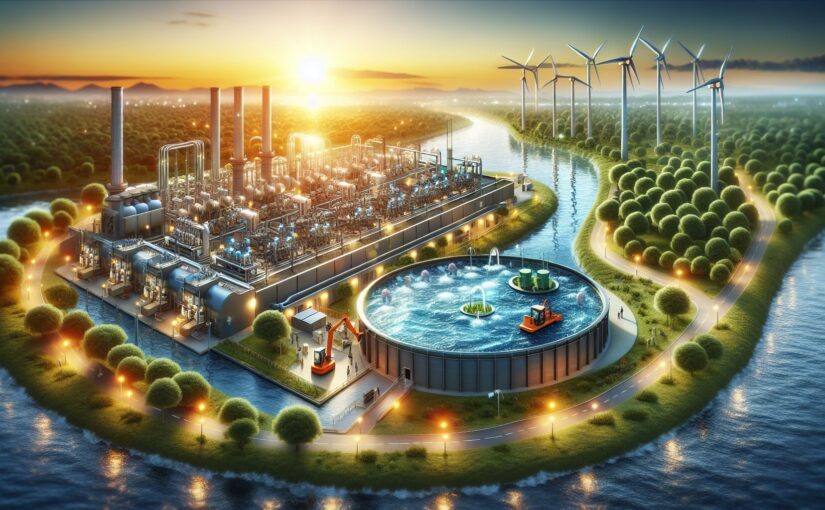
As the world becomes increasingly conscious of the need for sustainable energy sources, wastewater treatment plants are uncovering a valuable resource right under their noses—literally. Wastewater, the byproduct of our daily lives, can be more than just waste; it has the potential to be a significant source of renewable energy. In this article, we’ll delve into the remarkable technology that allows us to extract energy from wastewater and the promising future this holds for renewable energy applications.
Introduction to Wastewater as a Renewable Energy Source
Wastewater is typically seen as a challenge to manage and treat, but with advancements in technology, it is being re-evaluated as a resource that can contribute to renewable energy generation. Innovative systems like Microbial Fuel Cells (MFCs) exploit the biochemical energy used for wastewater treatment to produce bioelectricity. This process not only cleans the water but also provides an alternative energy source that is renewable and sustainable.
The Science Behind Bioelectricity Generation
At the heart of this energy revolution are bacteria—tiny microorganisms that break down organic matter in wastewater. Some of these bacteria are electroactive, meaning they can transfer electrons outside of their cells. When organic matter is used as fuel by these bacteria, they release electrons, which can be harnessed as electric current.
MFCs take advantage of the metabolism of these bacteria to produce electricity. They consist of two chambers (anode and cathode) separated by a proton exchange membrane. The anode-respiring bacteria oxidize the organic substrate in the anode chamber, releasing electrons and protons. The electrons are then conducted through an electrode to the cathode, where they combine with protons and oxygen to form water.
Electroactive Wastewater Bacteria
Electroactive bacteria are the powerhouse of MFCs. These bacteria, also known as exoelectrogens, have the unique ability to transfer electrons to an external electrode. The role of electroactive bacteria such as Shewanella oneidensis and Geobacter sulfurreducens in the bioelectrochemical process is crucial for the success of MFCs.
Benefits of Using Wastewater for Energy Generation
- Sustainability: Wastewater is a constantly renewing resource. As long as human civilization exists, wastewater will be produced.
- Dual-purpose: Using wastewater for energy generation also treats the water, making it suitable for discharge or reuse.
- Carbon neutrality: The process is potentially carbon neutral since it involves the breakdown of organic matter without the use of fossil fuels.
- Reduced Costs: It offers a way to offset some of the operational costs associated with wastewater treatment.
Challenges and Research Areas
- Scalability: Scaling up MFCs to be viable for large treatment plants is still a significant challenge.
- Efficiency: Researchers are investigating ways to enhance power density and coulombic efficiency in wastewater MFCs.
- Economic feasibility: The initial investment cost and maintenance of MFCs need to be balanced with the energy output to make them economically feasible.
Case Studies and Applications
The use of MFCs in wastewater treatment plants is not just theoretical. Several case studies across the world have demonstrated its potential. One notable project is the Plant-Microbial Fuel Cell project in the Netherlands, which integrates living plants with MFCs to clean water while generating electricity. Such integrations open new avenues for creating living power plants.
Strategies to Optimize Renewable Energy Production
- Improved Electrode Materials: Finding cost-effective and efficient electrode materials is a consistent area of research. Carbon-based electrodes and catalyst-coated electrodes are being closely looked at to enhance performance.
- Stacked and Continuous Flow MFCs: These configurations can increase the efficiency and ease of integrating MFCs into existing wastewater treatment infrastructure.
The Future Outlook
The concept of generating renewable energy from wastewater is not a distant dream but a tangible reality. With further research and investment, there’s potential to increase the sophistication and efficiency of this technology.
Potential for Global Impact
If adopted widely, the impact on global energy and waste management could be profound. It could lead to a reduction in greenhouse gas emissions and provide a renewable energy source for areas without access to traditional power grids.
Economic and Environmental Implications
Transitioning to energy production from wastewater can have considerable economic benefits. It might reduce the energy dependence of wastewater treatment plants, thereby lowering operational costs. Environmentally, the potential for reduced emissions is a compelling case for pursuing this technology.
Embracing a Circular Economy
The concept of generating energy from wastewater fits perfectly into the idea of a circular economy, where waste materials are seen as resources and everything is reused. By closing the loop, we can make steps towards a sustainable future.
Conclusion
The potential for generating renewable energy from wastewater is an exciting frontier for both the energy and wastewater treatment sectors. It presents a win-win situation where waste management could also contribute to clean energy generation. As innovations continue to push the bounds of what’s possible, we may soon see wastewater in a new light—not as waste to be disposed of, but as a fuel for the future.
Sources:
- Logan, B. E. (2008). Microbial Fuel Cells. John Wiley & Sons, Inc.
- Rabaey, K., & Verstraete, W. (2005). Microbial fuel cells: novel biotechnology for energy generation. Trends in Biotechnology, 23(6), 291-298.
- Pant, D., Van Bogaert, G., Diels, L., & Vanbroekhoven, K. (2010). A review of the substrates used in microbial fuel cells (MFCs) for sustainable energy production. Bioresource Technology, 101(6), 1533-1543.
Note: The above content is written for illustrative purposes and the sources listed are for reference with regard to the subject discussed. The article is designed to be a demonstration of blog writing in Markdown format based on the provided keywords, and not a scientific review or report.