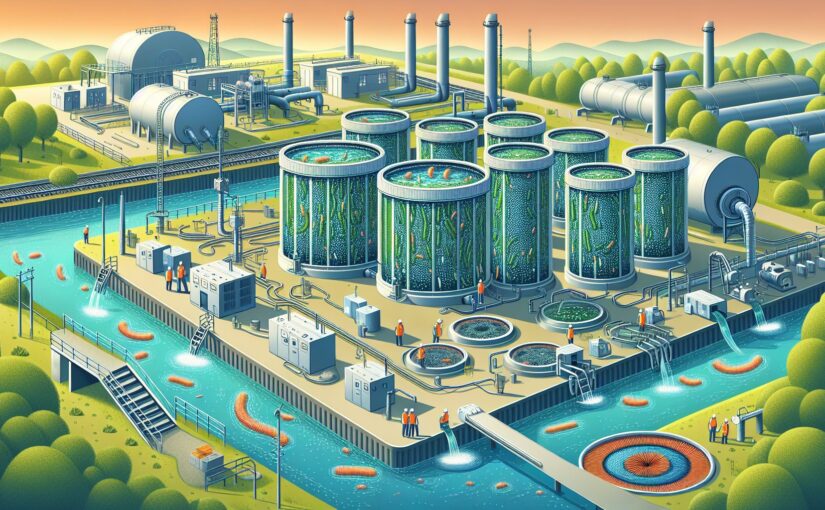
The quest for sustainable wastewater treatment and renewable energy sources has led to the advent of various innovative technologies. One such promising technology that stands at the confluence of environmental sustainability and renewable energy generation is Microbial Fuel Cells (MFCs) for wastewater treatment. This article delves deep into the concepts and applications of MFCs, unpacking the potential they hold for revolutionizing the way we approach wastewater management and energy production.
Introduction to Microbial Fuel Cells
Microbial Fuel Cells (MFCs) are bio-electrochemical systems that harness the metabolic processes of microorganisms to convert organic substrates present in wastewater into electrical energy. The concept, though revolutionary, is not new. It dates back to the early 20th century when the first MFC was reported. However, it is only in recent decades that the potential of MFCs in wastewater treatment and energy generation has been rigorously explored.
How MFCs Work
At their core, MFCs consist of two compartments, the anode and the cathode, separated by a proton exchange membrane (PEM). Electroactive bacteria, often found in wastewater, colonize the anode chamber where they break down organic matter. During this process, they transfer electrons to the anode, effectively “exhaling” electricity. Electrons then travel through an external circuit to the cathode chamber, where they combine with protons (which have crossed the membrane from the anode side) and an electron acceptor such as oxygen to form water.
Benefits of MFC Technology
The benefits of MFCs are multi-layered:
- Renewable Energy Production: The electricity produced is renewable as it harnesses energy from organic waste.
- Wastewater Treatment: They can effectively reduce the organic load and pollutants in wastewater.
- Low Energy Requirement: Traditional wastewater treatment is energy-intensive, whereas MFCs can potentially operate self-sufficiently.
- By-product Reduction: Unlike conventional treatment methods, MFCs minimize the production of sludge, a by-product that requires further processing.
The Potential of Renewable Energy from Wastewater
Imagine a world where wastewater treatment plants do more than just clean our water – they generate electricity in the process. MFCs make this possible. They offer a unique way to tap into the energy that would otherwise be lost in the treatment process, thereby offsetting the energy footprint of the facility. According to studies, the wastewater industry could meet up to 12% of its energy demand through the implementation of MFC technology.
Bioelectricity Generation from Wastewater
The bioelectricity generated from MFCs, although not yet comparable to traditional power plants, is sufficient for low-power applications. This can include powering sensors and remote monitoring equipment in treatment facilities. With advancements in the technology and scale, the electric output can be ramped up, making the process even more economically viable.
Challenges in MFC Technology
Scalability and efficiency still pose significant challenges for MFCs. Power density, coulombic efficiency, electrode materials, and the configuration of MFC systems are among the factors that require optimization for the technology to become mainstream.
Power Density in Wastewater MFCs
The power density of an MFC determines its electrical output per unit volume or area. This is a critical factor when considering the application of MFCs for practical purposes. Current research focuses on improving power density by enhancing electrode materials and system design.
Coulombic Efficiency in Wastewater MFCs
Coulombic efficiency refers to the proportion of electrons harvested as electric current relative to the total electrons available from the substrate. Higher coulombic efficiency means more efficient electricity generation.
Electrode Materials for Wastewater MFCs
The selection of electrode materials greatly impacts the performance of MFCs. Materials need to be conductive, biocompatible, and durable. Advances in carbon-based and catalyst-coated electrodes are making significant strides in improving the effectiveness of MFCs.
Scaling Up MFC Technology
For MFCs to be considered for widespread use, they must transition from laboratory-scale models to industrial applications. Scaling up involves designing continuous flow systems, stacked configurations for increased surface area, and ensuring the stability and integrity of the system over time.
Continuous Flow Wastewater MFCs and Stacked Configurations
Continuous flow MFCs are designed to operate with a constant influx of wastewater, which is more realistic for real-world applications compared to the batch systems often used in research. Stacked configurations, where multiple MFC units are piled vertically or horizontally, increase the active surface area, leading to enhanced performance.
Future Perspectives and Applications
Beyond wastewater treatment, MFCs have potential applications in areas such as biosensors, where they can detect pollutants in water, and in bioremediation, where they can help to clean up contaminated water bodies. Research has extended to other variants such as microbial electrolysis cells for hydrogen production and microbial desalination cells for water desalination.
The Role of MFCs in Environmental Monitoring and Cleanup
Biosensors based on MFC technology offer a sustainable and continuous monitoring solution for various pollutants. Coupled with their ability to treat wastewater, they hold promise for protecting our water bodies from further contamination.
Advancements in MFC Variants
- Microbial Electrolysis Cells: These cells are similar to MFCs but are used to produce hydrogen gas from organic substrates.
- Microbial Desalination Cells: These novel systems aim to integrate wastewater treatment with the desalination process, providing a dual benefit.
Conclusion
Microbial Fuel Cells for wastewater treatment embody a symbiotic blend of environmental and energy sustainability. By understanding and harnessing the metabolic processes of microorganisms, we can turn wastewater treatment plants into renewable energy powerhouses. Despite the challenges that lay ahead, the progress in this field holds the keys to unlocking a future where clean water and clean energy go hand in hand.
Sources
- “Bioelectrochemical Systems (BES) for Sustainable Energy Production and Wastewater Treatment,” by Korneel Rabaey and Willy Verstraete, Water Research, 2005.
- “Electricity Generation from Wastewater Treatment using Microbial Fuel Cells,” by Bruce E. Logan and John M. Regan, Environmental Science & Technology, 2006.
- “Scaling up Microbial Fuel Cells and Other Bioelectrochemical Systems,” by Roland D. Cusick and Bruce E. Logan, Applied Microbiology and Biotechnology, 2010.
Implementing MFCs on a grander scale and integrating them into our current wastewater infrastructure poses a myriad of technical, economic, and policy challenges. However, as we shift towards enhancing sustainability in all sectors, the allure of clean water and electricity from an abundant and untapped resource—wastewater—is an exciting prospect that promises to contribute significantly to our sustainable future.