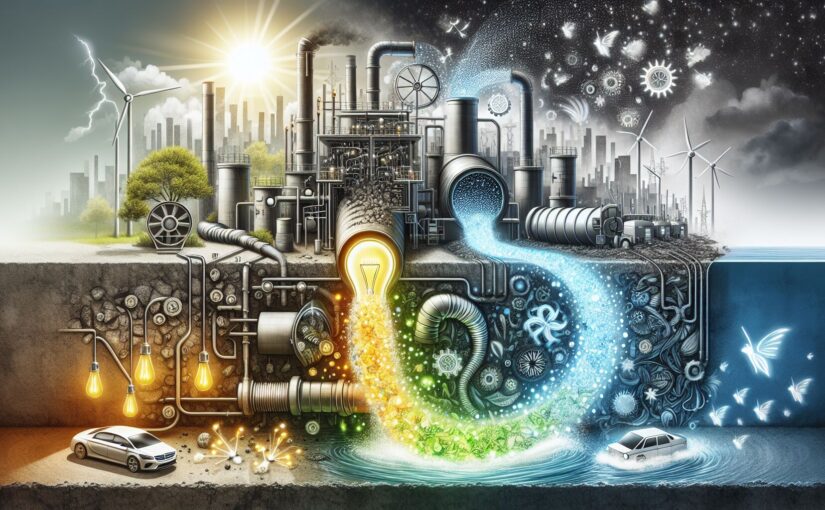
The connection between wastewater management and renewable energy may not be immediately apparent, but innovative technologies have started to bridge these two crucial sectors. One of the most promising developments in this field is the extraction of renewable energy from wastewater. This concept not only represents a significant leap towards sustainable energy but also offers a unique solution to the management of wastewater.
Introduction
In the face of global energy demands and environmental concerns, renewable energy has risen as a key player in the quest for sustainable sources. Wastewater – an inevitable byproduct of human activity, rich in organic substances – has been identified as a potential goldmine for renewable energy. How do we transform what has traditionally been a waste disposal challenge into a renewable energy resource? This article delves into the technology, processes, and potentials of generating renewable energy from wastewater.
The Potential of Wastewater as a Renewable Energy Source
Wastewater contains organic matter that can be broken down and converted into energy. While traditional methods of wastewater treatment focus on removing harmful substances to produce clean water, new approaches aim at harnessing the embedded energy during this process. The anaerobic digestion of sludge, for example, produces biogas, which can be used for heating, electricity generation, or as a vehicle fuel. Furthermore, advancements in microbial fuel cell technology now allow for the direct conversion of the chemical energy present in wastewater into electrical energy, with fewer intermediate steps.
Microbial Fuel Cells: A Core Technology
Microbial Fuel Cells (MFCs) represent a promising technology for directly harvesting electrical energy from wastewater. MFCs utilize electroactive bacteria to oxidize organic compounds, releasing electrons in the process. These electrons travel through a circuit, generating an electric current. The process is not only cleaner compared to combustion but also occurs at ambient temperatures, making it energy-efficient and environmentally-friendly.
Working Principle of MFCs
The basic components of an MFC include an anode, cathode, proton exchange membrane (PEM), and an external circuit. At the anode, electroactive bacteria – often termed exoelectrogens – break down the organic matter in wastewater. The electrons released from this process are transferred to the anode, travel through the external circuitry, and reach the cathode, where they participate in reactions that often combine these electrons with protons and oxygen to form water. The movement of electrons from anode to cathode generates electrical current, harnessing the chemical energy from the wastewater.
Benefits and Challenges of MFCs
MFCs offer the dual benefits of wastewater treatment and electricity generation, making them a significant step towards sustainable wastewater management. However, they are not without challenges. MFCs currently face technological limitations such as lower power densities compared to traditional power sources and difficulties in scaling up designs for practical, large-scale applications.
Advances in MFC Technology
Recent research is focused on improving the efficiency and scalability of MFCs. New materials for electrodes, such as carbon nanotubes and graphene, have shown to improve electricity conduction and durability. Developments in biocatalyst research have identified more efficient strains of electroactive bacteria. All these advances aim to optimize the electron transfer mechanisms and boost the overall energy output of MFCs.
Capturing Biogas from Anaerobic Digestion
Apart from MFCs, anaerobic digestion (AD) is another well-established process that contributes to renewable energy generation from wastewater. During AD, complex organic compounds in wastewater are converted into biogas by the action of a microbial consortium in the absence of oxygen. The biogas, primarily methane, can be captured and used to generate electricity or heat.
Efficiency and Sustainability of AD
The AD process is quite efficient in terms of energy recovery and has a smaller carbon footprint compared to traditional wastewater treatment methods. The sludge left over from the process is also rich in nutrients and can be used as a fertilizer, exemplifying a circular approach to waste and energy management.
Integration with Other Renewable Energy Systems
To further maximize energy recovery from wastewater, biogas and MFC technologies can be integrated with other renewable energy systems, such as wind and solar power. This synergy could lead to more robust and reliable energy generation systems that can provide clean energy even in off-grid circumstances or during fluctuations in other renewable sources.
Future Directions
The field of renewable energy from wastewater is rapidly evolving, and future research is likely to bring more breakthroughs. Areas such as genetic engineering of electroactive bacteria, advanced reactor designs for larger-scale operations, and improved MFC constructions offer potential pathways for enhancing the feasibility and efficiency of these systems.
Conclusion
Transforming wastewater into a source of renewable energy is an exciting and innovative approach to energy generation and waste management. Through technologies like MFCs and AD, we have the potential to tap into an abundant and untapped energy source, while simultaneously addressing the global need for clean water and sanitation. The pursuit of renewable energy from wastewater is an epitome of sustainability, elegantly turning an environmental challenge into a resource that can drive our economies in a green, circular direction.
Sources
-
Logan, B. E., Hamelers, B., Rozendal, R., Schroder, U., Keller, J., Freguia, S., … & Rabaey, K. (2006). Microbial fuel cells: methodology and technology. Environmental Science & Technology, 40(17), 5181-5192. doi: 10.1021/es0605016.
-
Rittmann, B. E., Lee, H. S., Zhang, H., Alder, J., Banaszak, J., & Lopez, R. (2008). Full-scale and pilot-scale anaerobic digestion of municipal sludge: comparison of performance, kinetics, and energy recovery. Water Environment Research, 80(4), 297-306. doi: 10.2175/106143007X221469.
-
Sleutels, T. H. J. A., Ter Heijne, A., Buisman, C. J. N., & Hamelers, H. V. M. (2009). Bioelectrochemical systems: An outlook for practical applications. ChemSusChem, 2(6), 397-405. doi: 10.1002/cssc.200900036.