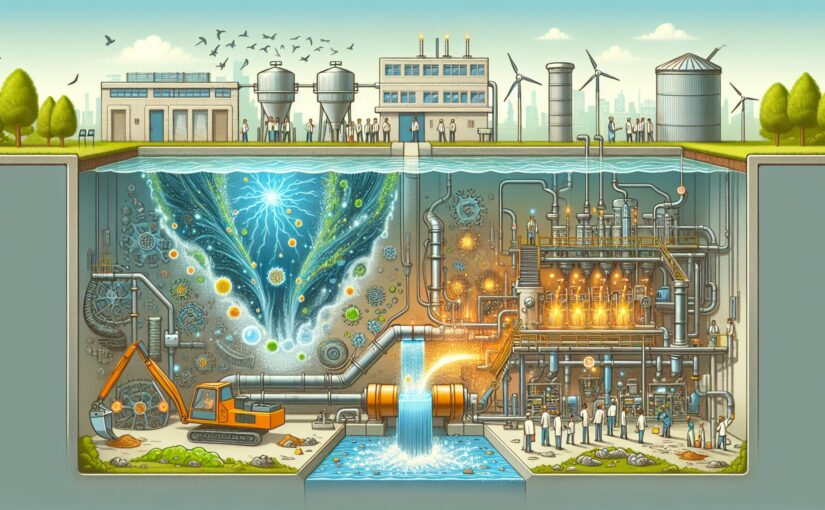
The increasing worry about energy security, climate change, and pollution levels worldwide has drawn significant attention towards seeking more sustainable and eco-friendly energy sources. Amidst the various renewable energy sources, a relatively more recent and cutting-edge one is bioelectricity generated from wastewater – yes, turning waste into watts!
Bioelectricity generated from wastewater, typically through Microbial Fuel Cells (MFCs), offers a promising approach to treat wastewater and concurrently generate electricity. In simpler words, MFCs covert chemical energy available in the wastewater directly into electrical energy through the metabolic activities of microorganisms [^1^].
How does this process work?
The process makes use of special kinds of bacteria known as electroactive bacteria, which have the ability to transfer electrons to an electrode under anaerobic conditions. These bacteria typically oxidize organic matter in the wastewater, and in the process, generates electrons. These electrons are then transferred to an anode, which flows through an external circuit to a cathode, thereby generating an electric current [^2^].
Why is the process significant?
Given the increasing quantum of wastewater generated and the growing concerns over its treatment and disposal, the technology offers a win-win solution. It combines wastewater treatment, which is otherwise a power-consuming process, with power generation – a truly sustainable way to manage our resources. Moreover, the generation of bioelectricity does not rely on climatic conditions, unlike wind and solar power [^3^].
Moving forward, one of the crucial tasks at hand is to scale up this technology so it can be incorporated into existing wastewater treatment facilities. Also, the development of more efficient MFCs is a promising research area, which calls for the collaboration of microbiologists, material scientists, and engineers.
Bioelectricity generation from wastewater is indeed a step towards a more sustainable and eco-friendly future!
For more detailed information, these resources are exceptionally helpful:
[^1^]: Pham, H. T., Regan, J. M., & Logan, B. E. (2006). Electron donators derived from the decomposition of organic matter in anode solution of microbial fuel cells. Water Research, 40(12), 2367-2375.
[^2^]: Liu, H., Grot, S., & Logan, B. E. (2005). Electrochemically assisted microbial production of hydrogen from acetate. Environmental science & technology, 39(11), 4317-4320.
[^3^]: Aelterman, P., Versichele, M., Marzorati, M., Boon, N., & Verstraete, W. (2008). Loading rate and external resistance control the electricity generation of microbial fuel cells with different three-dimensional anodes. Bioresource technology, 99(18), 8895-8902.