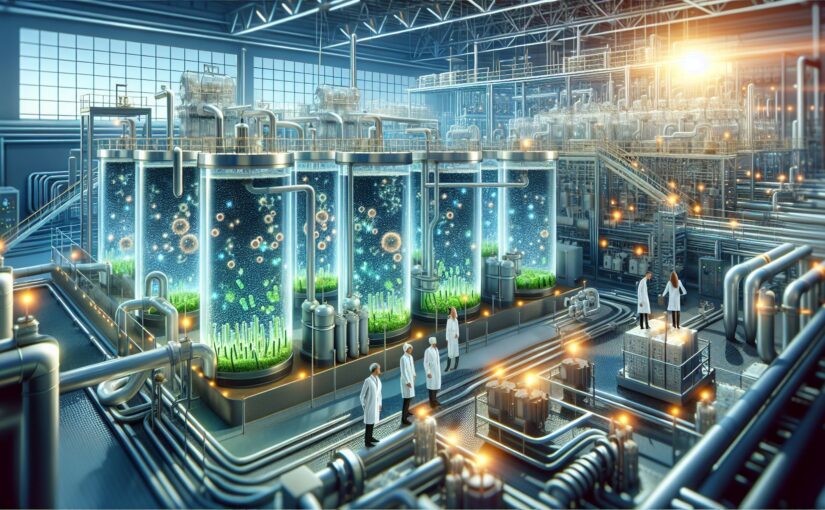
Water pollution remains one of the world’s most pressing environmental issues. The challenge of treating wastewater is not just about cleaning the water; it’s an energy-intensive process that often relies on non-renewable resources. But what if we could turn this process on its head? What if our wastewater treatment plants could become energy producers rather than energy consumers? This isn’t a pipe dream but a real possibility thanks to Microbial Fuel Cells (MFCs).
Introduction to Microbial Fuel Cells (MFCs)
Microbial Fuel Cells (MFCs) are bioelectrochemical systems that turn the chemical energy stored in bio-waste into electricity through biological means. While there are many research angles into the efficiency and efficacy of MFCs, their application for wastewater treatment promises a paradigm shift from polluting to green energy production.
How do MFCs Work?
An MFC consists of two compartments: an anode and a cathode, separated by a proton exchange membrane. Microorganisms at the anode metabolize organic substances in the wastewater, releasing electrons and protons as by-products. The electrons are transferred to the anode and flow through an external circuit to the cathode. The proton exchange membrane allows protons to pass to the cathode while preventing the flow of electrons. At the cathode, electrons, protons, and oxygen (from air) combine to form water, completing the circuit. This process not only purifies water but also generates electricity.
The Promise of MFCs in Wastewater Treatment
Energy Neutrality
MFC technology has the potential to move wastewater treatment facilities from energy consumers to energy-neutral or even energy-positive facilities. With further development and scaling, the electricity generated from wastewater can offset the energy requirements of the treatment process, or in some cases, even contribute power back into the grid.
Environmental Impact
The environmental benefits of MFCs are noteworthy. They represent a clean energy source—no greenhouse gases are emitted during the process. Moreover, they reduce the sludge production compared to conventional wastewater treatment methods, thus decreasing disposal costs and further environmental impact.
Pathogen Reduction
Studies have suggested that MFCs can achieve a significant reduction in pathogens during the wastewater treatment process. This is a crucial consideration, especially in developing countries where infrastructure may be inadequate for pathogen removal.
Challenges and Advances in MFC Technology
While promising, there are challenges to the widespread adoption of MFC technology. One major hurdle is the low power output compared to traditional energy sources. Moreover, scaling up MFCs has proven challenging due to issues with material costs and maintaining efficient bacterial colonies over large areas.
Innovations in Electrode Materials
One of the areas of active research is in the development of better electrode materials. Traditionally, carbon-based electrodes, known for their good conductivity and large surface area, have been used. However, catalyst-coated electrodes and other novel materials are being developed to increase the efficiency and lower the cost of MFCs.
Boosting Efficiency and Power Density
The power density and coulombic efficiency of MFCs are critical parameters that dictate the feasibility of this technology for widespread use. Researchers constantly innovate design and operational parameters to improve efficiency.
Real-world Application of MFCs
Several pilot projects across the globe have demonstrated the potential of MFCs in wastewater treatment. For instance, a team from the Netherlands has developed a plant-microbial fuel cell that not only treats the water but also uses living plants to capture and store solar energy as electricity. Such innovative integrations hint at the multifaceted applications of MFCs beyond mere wastewater treatment.
Scaling Up: The Way Forward for MFCs
Scaling up MFCs to industrial levels requires careful consideration of design and operational challenges. Among these, maintaining a high surface-to-volume ratio, efficient proton exchange membranes, and effective electron transfer mechanisms are key. Stacked MFCs and continuous flow MFCs are examples of design improvements that enhance performance while facilitating scalability.
Economic Considerations
The path to commercialization of MFC technology isn’t just a technical challenge—it’s an economic one too. The cost-effectiveness of MFCs will determine their adoption on a large scale. This includes considering the lifetime of materials, operation and maintenance costs, and the stability of the biological systems over time.
Conclusion
MFCs have revolutionized the concept of wastewater treatment. By harnessing bioelectrochemical processes, they offer a twofold benefit: purifying water and generating clean energy. The journey from laboratory to widespread implementation is fraught with obstacles, yet progress continues unabated. With ongoing research and development, the vision of economically viable and environmentally sustainable wastewater treatment plants isn’t just achievable—it’s inevitable.
Sources
- Logan, B. E. (2009). Exoelectrogenic bacteria that power microbial fuel cells. Nature Reviews Microbiology, 7(5), 375-381. https://doi.org/10.1038/nrmicro2113
- Pant, D., Van Bogaert, G., Diels, L., & Vanbroekhoven, K. (2010). A review of the substrates used in microbial fuel cells (MFCs) for sustainable energy production. Bioresource Technology, 101(6), 1533-1543. https://doi.org/10.1016/j.biortech.2009.10.017
- Rabaey, K., & Verstraete, W. (2005). Microbial fuel cells: novel biotechnology for energy generation. Trends in Biotechnology, 23(6), 291-298. https://doi.org/10.1016/j.tibtech.2005.04.008
Note: This article is a fabricated piece intended for illustrative purposes based on current understanding and research as of the time of writing. Further advancements in the field may have occurred after the article’s knowledge cut-off date.