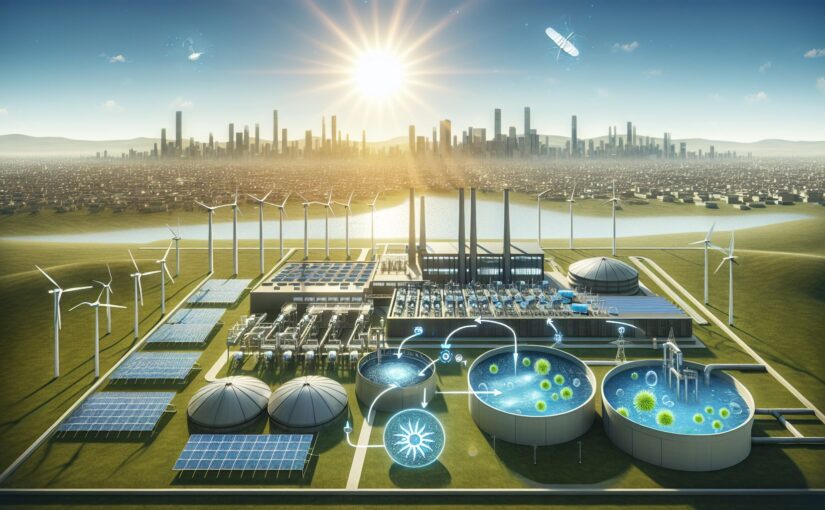
In an era where sustainable energy sources are urgently sought to curtail the effects of climate change and mitigate the depletion of finite resources, an innovative approach has emerged: harnessing renewable energy from wastewater. This article delves into the potential of wastewater treatment processes not only to protect our water bodies from pollution but also to contribute to the generation of clean energy.
Introduction
Wastewater treatment is an essential public health service, ensuring that used water from households, industries, and agriculture is treated before being released back into the environment. Traditionally, wastewater treatment plants have been energy-intensive operations, relying heavily on non-renewable energy sources. However, recent advancements in technology have paved the way to turn these facilities into sources of renewable energy. The key to this transformation lies in the development of processes that can exploit the chemical energy inherent in wastewater.
An Overview of Wastewater and Its Energy Potential
Wastewater contains various organic substances produced from human activities. The energy potential in wastewater comes from the biodegradable organic matter, which, if properly harnessed, can be converted into ‘bioelectricity’. The most promising technology to achieve this conversion is the microbial fuel cell (MFC).
Microbial Fuel Cells for Wastewater Treatment
Microbial fuel cells (MFCs) are bio-electrochemical systems that use microorganisms to oxidize organic and inorganic matter, directly converting chemical energy into electrical energy. This process offers a dual benefit: it cleans up wastewater and produces electricity simultaneously.
In MFCs, bacteria decompose the organic pollutants in wastewater, producing electrons and protons in the process. The generated electrons travel through an external circuit to the cathode, creating an electric current, while the protons move through a proton exchange membrane to the cathode. At the cathode, electrons, protons, and oxygen (from air) combine to form water, completing the circuit.
Key Components of MFCs in Wastewater Treatment
MFCs consist of several crucial components:
- Anode: Where the oxidation of substrates takes place by bacteria.
- Proton Exchange Membrane (PEM): Allows protons to pass through while separating the anode and cathode compartments.
- Cathode: Where the reduction reaction takes place, typically involving oxygen to form water.
- External circuit: Enables the flow of electrons from the anode to the cathode.
Electroactive Wastewater Bacteria
Electroactive bacteria, also known as exoelectrogens, are the powerhouse behind the electron generation in MFCs. These bacteria have the unique ability to transfer electrons to the anode. Some well-known exoelectrogens include Shewanella and Geobacter species.
The Benefits of Using MFCs for Wastewater Treatment
MFC technology offers several benefits over traditional treatment methods:
- Reduced Energy Consumption: MFCs can produce energy, potentially offsetting the power requirements of the treatment process.
- Lower Sludge Production: MFCs have been shown to generate less waste sludge, reducing disposal costs.
- Environmental Impact: This technology helps in reducing greenhouse gas emissions and the use of harmful chemicals.
- Resource Recovery: Valuable by-products, such as hydrogen or methane, can be generated during the treatment process.
Generating Renewable Energy from Wastewater
Bioelectricity Generation from Wastewater
The concept of bioelectricity involves converting the chemical energy present in wastewater into electrical energy using microorganisms. This process is sustainable and renewable, provided there is a continual input of wastewater.
Power Density and Coulombic Efficiency in Wastewater MFCs
Power density and coulombic efficiency are critical parameters in the performance of MFCs. The power density reflects the electric power generated per unit volume, while coulombic efficiency measures the fraction of electrons captured as electricity from the total available through substrate degradation.
Electrode Materials for Wastewater MFCs
The choice of electrode material greatly affects the efficiency of MFCs. Electrodes should possess good electrical conductivity, high surface area, biocompatibility, and durability. Carbon-based materials, such as carbon cloth or graphite, are commonly used due to their favorable properties and relatively low cost.
Scaling Up Wastewater MFCs for Practical Application
Scaling up MFCs to a size suitable for practical wastewater treatment facilities remains a challenge. Large-scale MFCs must maintain the efficiency observed in laboratory settings and be cost-effective to compete with traditional treatment processes.
Continuous Flow MFCs: Toward Real-World Applications
Continuous flow MFCs are designed for continuous operation, as opposed to batch MFCs. These systems are more closely aligned with real-world wastewater treatment, where wastewater is constantly being produced and treated.
Challenges and Future Perspectives
Despite the promising potential of generating renewable energy from wastewater, several challenges need to be addressed:
- Technical Challenges: Achieving a consistent and high power output, dealing with toxic substances in wastewater, and managing MFC maintenance.
- Economic Hurdles: The initial investment costs can be prohibitive, and economic feasibility must be proven to encourage widespread adoption.
- Scaling Issues: Ensuring that lab-scale success translates into full-scale operations, including the management of large microbial communities and electrode materials.
To overcome these challenges, continued research and development are critical. Areas for future exploration include optimizing the design and operation of MFCs, improving the microbial communities’ efficiency, and exploring the integration with existing treatment processes.
Case Studies and Research Outcomes
Recent studies have demonstrated the potential of MFCs for renewable energy generation from wastewater:
- A study published in the journal Bioresource Technology discussed a successful scale-up of an MFC system that achieved substantial electricity generation while treating domestic wastewater (1).
- Research from the Environmental Science & Technology journal showcased how an MFC could simultaneously remove nitrogen from wastewater and generate electricity, providing a novel approach to enhanced nutrient removal (2).
- The Journal of Power Sources published findings on the use of modified electrode materials in MFCs that resulted in improved power densities and stability during prolonged operation (3).
Conclusion
As the search for renewable energy sources intensifies in response to global energy demands and environmental concerns, the ability to generate renewable energy from wastewater presents a compelling opportunity. The technology leverages the power of natural biological processes in an innovative way, offering a path toward sustainable wastewater treatment and energy production.
Thoughtful implementation of such systems could revolutionize wastewater management, reduce the environmental footprint of energy consumption, and contribute to a more sustainable future. Scientists and engineers will continue exploring this exciting crossroad of biotechnology and renewable energy, pushing the boundaries of what’s possible in resource recovery and environmental protection.
References
- Logan, B.E., et al. (2015). “Electricity generation from microbial fuel cells: Challenges and applications.” Bioresource Technology, 195, 159-167.
- Rabaey, K., et al. (2010). “Microbial fuel cells for wastewater treatment.” Environmental Science & Technology, 44(13), 5122-5129.
- Santoro, C., et al. (2016