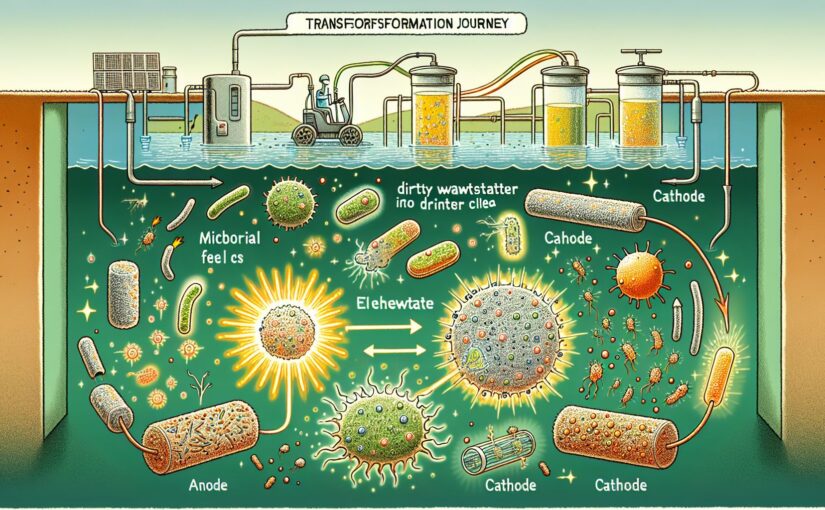
In the quest for sustainable development, the integration of waste management and renewable energy generation has gained significant attention. Among the various technologies, Microbial Fuel Cells (MFCs) have emerged as a promising solution, offering a dual benefit of wastewater treatment along with the production of bioelectricity. Utilizing the vast potential of electroactive bacteria, these systems are paving the way for a greener and more energy-efficient future.
Understanding the Basics of MFCs
MFCs are bio-electrochemical systems that harness the power of microorganisms to convert organic compounds in wastewater into electrical energy. This process is achieved through the metabolic activities of bacteria, which break down organic matter and release electrons as a byproduct.
The MFC technology functions on the principles of redox reactions, where an electron flow is generated from the oxidation of substrates. An MFC typically comprises two chambers, the anode and cathode, separated by a proton exchange membrane. Electroactive bacteria are often found in the anode chamber, where they oxidize the organic substances, releasing protons and electrons. The electrons travel through an external circuit towards the cathode, generating electrical current, while the protons pass through the membrane to combine with the electrons and a final electron acceptor (often oxygen) at the cathode to form water or other byproducts.
Potential of Renewable Energy from Wastewater
Wastewater, unfortunately, is often associated with negative connotations, regarded as a problem needing disposal. However, with the advent of MFC technology, wastewater is now being recognized as a valuable resource for renewable energy production.
The concept of generating electricity while treating wastewater offers multiple benefits:
-
Energy Efficiency: Traditional wastewater treatment processes consume a significant amount of energy. MFCs, in contrast, operate at ambient temperature and pressure, thus reducing energy consumption.
-
Reduction in Greenhouse Gas Emissions: By producing bioelectricity, MFCs can offset the use of fossil fuels and subsequently decrease CO2 emissions.
-
Sustainable Waste Management: MFCs provide an eco-friendly approach to treat organic pollutants in wastewater, ensuring environmental protection and water conservation.
-
Resource Recovery: Besides electricity, MFCs enable the recovery of valuable byproducts, such as metals or biogas, thus adding to their economic viability.
The Role of Electroactive Bacteria
The heart of an MFC lies in the activity of electroactive bacteria, also known as exoelectrogens. These specialized microbes have the unique ability to transfer electrons outside of their cell membranes to an external electron acceptor (the anode in the case of MFCs). Electroactive bacteria such as Shewanella or Geobacter species are commonly identified in MFCs.
The mechanism of electron transfer can be direct, through cell membrane-associated proteins and conductive pili known as nanowires, or indirect, involving soluble electron shuttles called mediators. Direct electron transfer is more desirable as it facilitates higher efficiency and avoids the need for adding synthetic mediators, which can be costly and toxic.
Limits and Opportunities for MFCs
Despite their promising potential, several challenges exist in the path towards the broad application of MFCs:
-
Low Power Output: Currently, the power density achieved by MFCs is relatively low when compared to conventional energy sources. This requires further research into optimizing design and operational parameters.
-
Scaling Up: Operational challenges such as substrate complexity and electrode clogging pose hindrances when transitioning from laboratory-scale to full-scale systems.
-
Cost of Materials: The proton exchange membrane and electrode materials can be expensive, although efforts are being made to identify cost-effective alternatives.
-
Public Perception: Acceptance of technology is crucial. Public and institutional awareness must be raised regarding the benefits and practicality of MFCs.
Advances in MFC Development
Research in the realm of MFCs is dynamic, with several noteworthy advancements aimed at improving performance and scalability:
-
Electrode Materials: The exploration of carbon-based and catalyst-coated electrodes has increased the conductivity and surface area for microbial attachment, enhancing electricity generation.
-
Stacked MFCs: Connecting multiple MFC units in series or parallel configurations can amplify voltage and current, respectively, making the technology more applicable for real-world use.
-
Continuous Flow MFCs: The development of systems that allow for a continuous flow of wastewater through the MFC has improved the practicality of the technology for continuous power generation and uninterrupted wastewater treatment.
-
Microbial Electrolysis Cells (MECs): An evolution of MFCs, MECs can produce hydrogen gas as a byproduct, opening doors to another form of clean energy.
Conclusion: The Road Ahead for MFCs and Sustainable Development
Microbial Fuel Cells present a compelling solution for sustainable wastewater management and the generation of renewable energy. The technology stands as a testimony to human ingenuity in harnessing the power of nature to create cleaner and more sustainable systems.
While challenges persist, ongoing research and development are propelling MFCs closer to wide-scale adoption. Partnerships among academic institutions, industry, and governments are critical for propelling MFC technology from the laboratory to the real world.
To bring this vision to fruition, it is crucial for stakeholders to support the continued research, development, and pilot testing of MFC systems. Public education and policy incentives can accelerate the adoption of this green technology, ultimately contributing to the global goals of sustainability and energy independence.