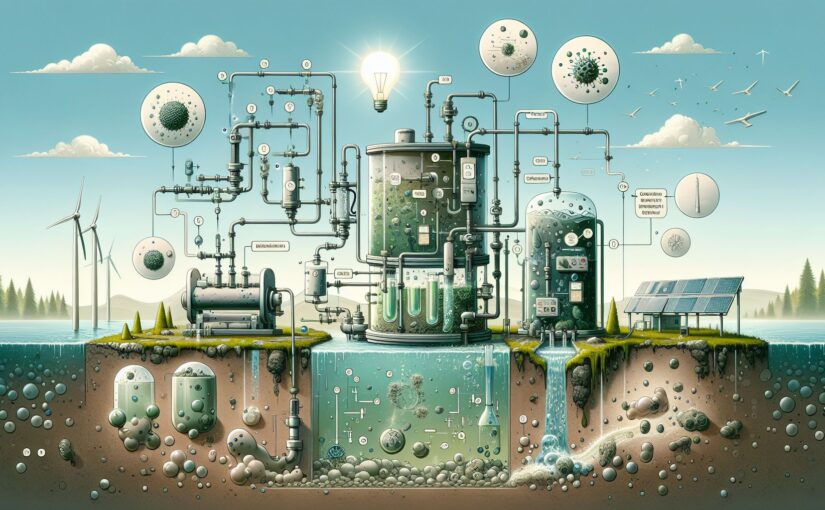
In the quest for sustainable and renewable energy sources, a lesser-known candidate has been making waves in the scientific community: wastewater. Unbeknownst to many, the waste we generate and the water we aim to purify hold significant potential for both renewable energy production and environmental conservation. This potential is harnessed by technologies known as Bioelectrochemical Wastewater Systems (BEWS). In this article, we delve into the science behind renewable energy generation from wastewater treatment processes, and we explore the promise and challenges of turning our waste into watts.
Understanding Wastewater’s Energy Potential
Wastewater contains a substantial amount of organic matter, which, traditionally, is considered a pollutant needing removal before the water is released back into the environment. However, these organic compounds are actually a form of stored energy – chemical energy that can be converted into electricity through biological processes.
The Role of Microbial Fuel Cells (MFCs)
One of the primary technologies enabling the conversion of wastewater to energy is the Microbial Fuel Cell (MFC). MFCs are bioelectrochemical systems that leverage bacteria to break down organic matter in wastewater. During this process, electrons are released and captured, creating an electric current.
Here’s a simple breakdown of how an MFC works:
-
The Anode Chamber: Wastewater is fed into the anode chamber where electroactive bacteria, known as exoelectrogens, decompose the organic matter. This process frees electrons and protons as part of their metabolic pathways.
-
The Circuit: Electrons are transferred to an electrode (the anode) and flow through an external circuit to a second electrode (the cathode), generating an electrical current.
-
The Cathode Chamber: In the cathode chamber, electrons combine with protons and an electron acceptor (often oxygen) to form water or other compounds, completing the circuit.
-
Proton Exchange: Meanwhile, protons (H+) produced at the anode pass through a Proton Exchange Membrane (PEM) to the cathode chamber, maintaining a balance of charge across the system.
-
Clean Water and Renewable Energy: The final outputs are cleaner water, since much of the organic matter has been consumed, and renewable electricity.
Electroactive Wastewater Bacteria: The Heart of MFCs
At the core of MFCs are the bacteria capable of transferring electrons to an electrode. These microorganisms are highly unique as they can perform extracellular electron transfer (EET), meaning they pass electrons out of their cells to external acceptors. Some bacteria transfer electrons directly through structures called ‘nanowires’ or through cell appendages known as ‘pili’, while others use self-produced molecules as mediators to shuttle electrons to the anode.
Exoelectrogens in Wastewater
Geobacter and Shewanella are examples of exoelectrogenic bacteria that are commonly found in wastewater and have been extensively studied for their electron transfer abilities. Harnessing these and other similar bacteria effectively can significantly enhance the performance of MFCs.
Mediator-less and Mediator-based Wastewater MFCs
MFCs come in two flavors: mediator-less and mediator-based systems. As their names suggest, mediator-less MFCs rely solely on the intrinsic ability of microbes to transfer electrons directly to an electrode, while mediator-based systems use added chemicals to facilitate or speed up electron transfer.
Studies suggest that mediator-less systems are more desirable for sustainable wastewater treatment due to lower maintenance and the absence of additional chemicals that might need to be removed later.
The Promise of Bioelectricity Generation from Wastewater
The prospect of extracting energy from wastewater treatment not only addresses waste management concerns but also adds significant value to what is mostly seen as a resource-draining process. Here are some potential benefits:
- Sustainability: MFCs offer a clear path towards more sustainable wastewater treatment by reducing energy consumption and simultaneously generating electricity.
- Carbon Footprint Reduction: By turning organic pollutants into electricity, MFCs can help lower greenhouse gas emissions from wastewater treatment processes.
- Energy Neutrality or Positivity: Treatment facilities equipped with MFCs could reach energy neutrality or even become energy-positive entities, contributing power back to the grid.
- Resource Recovery: Besides energy, MFCs can aid in the recovery of other valuable resources from wastewater, like clean water and certain metals.
Challenges and Considerations for Scaling Up
Although the benefits are promising, the transition towards widespread adoption of MFC technology for wastewater treatment faces several hurdles:
- Scaling Up: Research and development are mostly conducted at the lab scale. Scaling up to the full operational scale of wastewater treatment plants presents technical and economic challenges.
- Power Density and Efficiency: Currently, the power densities achieved by MFCs are not yet competitive with conventional power sources. Improving the efficiency of electron transfer and energy capture is a critical area of research.
- Materials: The choice of materials for electrodes, PEMs, and other system components significantly affects performance and cost. There’s a need for cheaper yet efficient materials that can withstand the harsh conditions of wastewater.
- Public Perception and Regulatory Approval: Transitioning to a new technology requires public acceptance and will have to navigate regulations that may not be updated to accommodate such advancements.
Future Perspective: Stacked and Continuous Flow MFCs
Despite the challenges, there’s optimism for the future. Concepts like stacked MFCs, which involve connecting multiple cells to boost voltage and current, and continuous flow MFCs, designed to handle the continual influx of wastewater, are under investigation to address volume and efficiency issues.
Moreover, advancements in computational modeling and big data analytics are likely to contribute to more optimized and purpose-driven designs for large-scale systems.
Conclusion
Wastewater treatment is due for a revolution and the integration of Microbial Fuel Cells offers an exciting opportunity. The dual benefit of treating water while generating renewable energy could transform how we deal with waste on a global scale.
With continued research, innovation in materials science, and the scaling of the bioelectrochemical systems, the vision of energy-positive wastewater treatment facilities is not just a mere possibility—it’s within reach.
Sources
- Logan, B. E. (2008). Microbial Fuel Cells. John Wiley & Sons, Inc. [DOI: 10.1002/9780470259482]
- Rabaey, K., & Rozendal, R. A. (2010). Microbial electrosynthesis—revisiting the electrical route for microbial production. Nature Reviews Microbiology, 8(10), 706-716. [DOI: 10.1038/nrmicro2422]
- Pant, D., Van Bogaert, G., Diels, L., & Vanbroekhoven, K. (2010). A review of the substrates used in microbial fuel cells (MFCs) for sustainable energy production. Bioresource Technology, 101(6), 1533-1543. [DOI: 10.1016/j.biortech.2009.10.017]