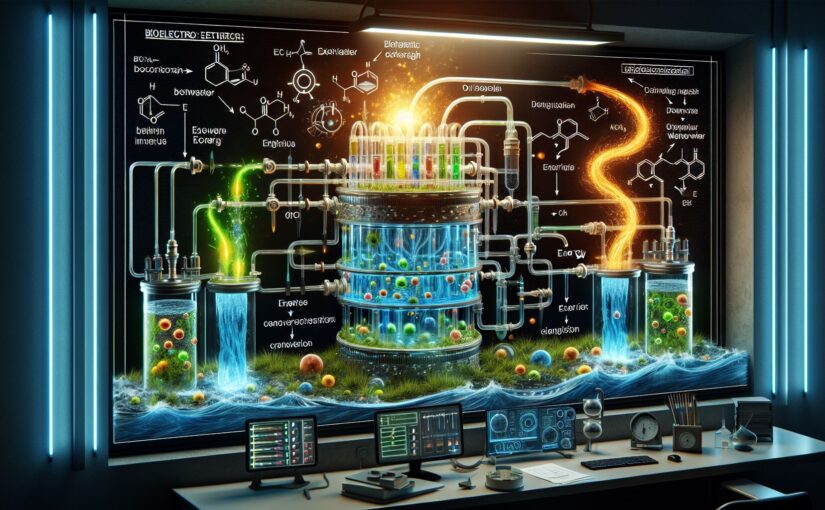
In the quest for sustainability, renewable energy sources have become increasingly important. While solar, wind, and hydropower are well-known green energy options, there’s a lesser-known source that holds immense potential: wastewater. By tapping into bioelectrochemical wastewater systems, we can transform waste into a valuable resource for generating electricity. This article delves into the fascinating world of renewable energy from wastewater, exploring how this innovation not only helps in treating wastewater but also contributes to our energy needs.
Introduction to Bioelectrochemical Wastewater Systems
Bioelectrochemical systems (BES) are cutting-edge technologies that use microorganisms to convert organic matter in wastewater into electrical energy. These systems rely on the metabolic processes of electroactive bacteria, which are capable of transferring electrons to an electrode as part of their energy generation cycle. In the context of wastewater treatment, the two main types of BES are Microbial Fuel Cells (MFCs) and Microbial Electrolysis Cells (MECs).
Microbial Fuel Cells for Wastewater Treatment
MFCs are devices that leverage the biochemical energy produced by microorganisms when they break down organic materials. In the process, electrons are transferred to an anode and flow through an external circuit to a cathode, generating an electric current. This process not only generates electricity but also cleans the wastewater, effectively killing two birds with one stone.
Advantages of MFCs in Wastewater Treatment:
- Production of renewable energy
- Reduction of greenhouse gas emissions
- Cost-effective treatment process
- Minimal sludge production
Microbial Electrolysis Cells for Hydrogen Production
MECs are similar to MFCs; however, they differ in that they require a small amount of additional voltage to drive the reaction forward. MECs can produce hydrogen gas, a clean fuel, from the organic content of wastewater, presenting another avenue for renewable energy generation.
Harnessing Wastewater as a Renewable Energy Source
Wastewater contains a significant amount of chemical energy in the form of organic compounds. Typical wastewater treatment processes focus on removing these compounds to prevent pollution when the treated water is released into the environment. However, through bioelectrochemical systems, these organic compounds can be converted directly into usable energy.
The Role of Electroactive Wastewater Bacteria
Key players in BES are the electroactive bacteria. These microorganisms are capable of extracellular electron transfer, meaning they can shuttle electrons to the electrodes in an electrochemical system. Some of the most studied electroactive bacteria include members of the genera Shewanella and Geobacter. These bacteria not only help treat wastewater by breaking down organic pollutants but also facilitate electricity generation.
Electron Transfer Mechanisms in Wastewater
Understanding how electrons are transferred from bacteria to electrodes is crucial for improving the efficiency of BES. There are two main types of electron transfer systems:
-
Direct Electron Transfer (DET): Here, the bacteria attach directly to the electrode and transfer electrons through structures like c-type cytochromes or conductive pili known as nanowires.
-
Indirect Electron Transfer (IET): In this case, electrons are transferred through soluble mediators or redox shuttles that ferry the electrons between the bacteria and electrode.
Power Density and Coulombic Efficiency in Wastewater MFCs
The effectiveness of MFCs is often measured in terms of power density and coulombic efficiency:
-
Power Density: This metric represents the amount of electrical power generated per unit volume or area of the MFC and is usually expressed in watts per cubic meter (W/m³) or watts per square meter (W/m²).
-
Coulombic Efficiency: This is the ratio of electrons captured as electrical current to the total electrons available from the substrate (organic matter being degraded). Higher coulombic efficiency means more of the substrate’s potential energy is converted into electricity.
Challenges and Developments in Scaling Up Wastewater BES
One of the main challenges in utilizing BES for wastewater treatment and renewable energy generation is scale. To be practical for widespread application, these systems must be scaled up efficiently.
Electrode Materials and Design
The choice of electrode materials greatly influences the efficiency of MFCs. Carbon-based electrodes and catalyst-coated electrodes are among the most common due to their high conductivity and affinity for bacterial attachment.
Carbon-Based Electrodes:
-
Pros: Low cost, high electrical conductivity, and chemical stability
-
Cons: Degradation over time, potential for biofouling
Catalyst-Coated Electrodes:
-
Pros: Increased catalytic activity, enhanced electron transfer rates
-
Cons: Often more expensive, may involve precious metals like platinum
System Configurations for Enhanced Performance
To maximize the potential of BES, different system configurations are being explored:
-
Stacked MFCs: Connecting multiple MFC units in series or parallel to increase energy output.
-
Continuous Flow MFCs: A setup where wastewater continuously flows through the MFC, increasing the treatment rate and energy production.
-
Plant-Microbial Fuel Cells: Systems that incorporate plants to assist in wastewater treatment and can generate electricity from the photosynthesis byproducts.
Addressing Economic and Technical Barriers
While technical advances have been made, there are still economic and operational challenges that need addressing before BES can be deployed on a large scale:
- High initial capital costs
- Need for improved robustness and longevity of systems
- Optimization of system design for different wastewater streams
Future of Wastewater-Based Renewable Energy
Research and development in bioelectrochemical systems for wastewater treatment are progressing at a rapid pace. There’s potential for significant advancements in efficiency and economic viability, paving the way for these systems to become a common fixture in sustainable energy and waste management strategies.
References
- Logan, B. E. (2008). Microbial Fuel Cells. John Wiley & Sons.
- Rabaey, K., & Rozendal, R. A. (2010). Microbial electrosynthesis — revisiting the electrical route for microbial production. Nature Reviews Microbiology, 8(10), 706–716. DOI:10.1038/nrmicro2422
- Pant, D., Van Bogaert, G., Diels, L., & Vanbroekhoven, K. (2010). A review of the substrates used in microbial fuel cells (MFCs) for sustainable energy production. Bioresource Technology, 101(6), 1533–1543. DOI:10.1016/j.biortech.2009.10.017
By investigating and optimizing the components and operational parameters of bioelectrochemical systems, the possibility of widespread adoption of wastewater treatment coupled with renewable energy generation becomes increasingly realistic. With further financial investment and research efforts, the future could see wastewater not as an environmental burden, but as a valuable source of green energy, contributing to a more sustainable and energy-efficient world.