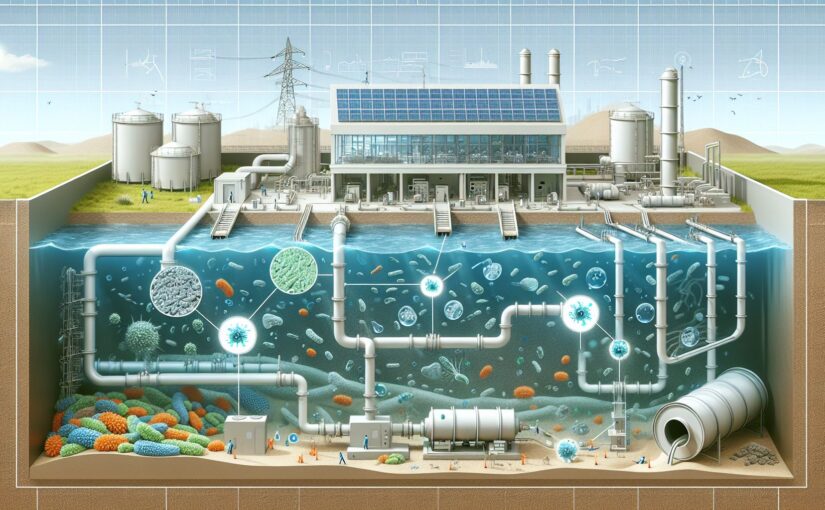
The need for sustainable and eco-friendly energy sources has never been more pressing than it is today. With climate change casting a long shadow over our planet’s future, scientists and engineers are turning to innovative solutions to generate clean energy and treat waste simultaneously. One such promising technology is the utilization of microbial fuel cells (MFCs) to extract renewable energy from wastewater. This remarkable process not only provides a beacon of hope for sustainable energy but also revolutionizes the way we approach wastewater treatment.
What Are Microbial Fuel Cells (MFCs)?
Microbial fuel cells are bio-electrochemical systems that exploit the natural process of bacterial metabolism to convert organic compounds in wastewater into electric power. This occurs through the direct transfer of electrons from these electroactive bacteria to an electrode during the degradation of organic matter. In this article, we will dive deep into the science of MFCs, explore their potential, and investigate how they are transforming waste into renewable power.
The Science Behind MFCs
Microbial fuel cells work thanks to the activity of specific bacteria known as exoelectrogens or electroactive bacteria. These microorganisms are capable of external electron transfer, meaning they release electrons to an external source—the anode—as part of their respiratory process, instead of using oxygen or other electron acceptors commonly found in nature.
Components of an MFC
- Anode: This is the electrode where oxidation occurs. Electroactive bacteria attach to this anode and convert the organic matter in wastewater into electrons, protons, and carbon dioxide.
- Proton Exchange Membrane (PEM): This semi-permeable membrane allows only protons to pass through to the cathode side, preventing the transfer of bacteria or oxygen.
- Cathode: At the cathode, the electrons and protons generated at the anode combine with oxygen to form water—this is the reduction process.
The flow of electrons from anode to cathode through an external circuit generates electricity, while the movement of protons across the PEM maintains electrical neutrality.
The Potential of MFCs
The power generated by microbial fuel cells, while not massive, is significant enough to fuel small devices and sensors, potentially leading to the development of self-powered wastewater treatment systems. The allure of converting waste into energy is complemented by the environmental benefits MFCs offer:
- Reduced greenhouse gas emissions: Less reliance on fossil-fueled power plants.
- Lower energy consumption for wastewater treatment: Conventional wastewater treatment plants are energy-intensive, whereas MFCs may operate on the energy extracted from the wastewater itself.
- Minimal sludge production: MFCs may produce less waste sludge compared to traditional treatment methods, decreasing disposal problems.
- Detoxification of wastewater: Some harmful substances can be broken down by specialized bacteria in MFCs, resulting in cleaner effluent.
Challenges to Overcome
While the benefits are clear, there are still hurdles to clear before MFCs can be implemented on a large scale:
- Power density: Current MFCs produce less electricity per volume than desired for widespread use.
- Cost: The materials and construction of efficient MFCs can be expensive.
- Durability: The lifespan of MFCs needs to be extended for them to be commercially viable.
Innovations and Advances
Research into MFCs is addressing these challenges head-on:
- Electrode material research: Scientists are investigating high-surface-area and cost-effective materials like carbon nanotubes and conductive polymers to enhance electron transfer efficiency.
- Architectural improvements: Stacked and continuous flow MFC designs are being tested for better scalability and continuous power output.
Wastewater Treatment Reimagined
The integration of MFCs in wastewater treatment facilities presents a paradigm shift. By combining the processes of waste decomposition and energy generation, wastewater treatment plants could evolve into bioenergy centers, adding an entirely new dimension to the water-energy nexus.
Case Studies and Current Application
Several pilot projects around the world are demonstrating the feasibility of MFCs in practical settings. For example:
- The United States Office of Naval Research: Funded a project deploying MFC-powered buoys, showcasing their utility in remote applications.
- Spain’s Leitat Technological Center: Developed a MFC prototype that treats urine and produces enough power to charge a smartphone.
The Future of MFCs and Renewable Energy
Continued advances in MFC technology could see these systems being used to power remote sensors, small electronic devices, and even contribute to the electrical grid. The synergy between renewable energy production and wastewater treatment has the potential to revolutionize how we handle waste and meet our energy needs.
Conclusion
Renewable energy from wastewater through MFCs exemplifies the innovative spirit of contemporary environmental engineering. While challenges remain, the search for sustainable energy solutions is pushing MFC technology ever closer to the mainstream. As our understanding and methods improve, we may soon live in a world where our most stubborn waste problems are also our most valuable energy assets.
References
- Logan, B.E. (2008). Microbial Fuel Cells. John Wiley & Sons.
- Rabaey, K., & Rozendal, R.A. (2010). Microbial electrosynthesis — revisiting the electrical route for microbial production. Nature Reviews Microbiology, 8(10), 706-716.
- He, Z., & Mansfeld, F. (2009). Exploring the use of electroactive bacteria for microbial fuel cell applications. Process Biochemistry, 44(2), 205-215.
This article is for educational purposes and does not substitute for professional advice. Always consult a professional for specific concerns.