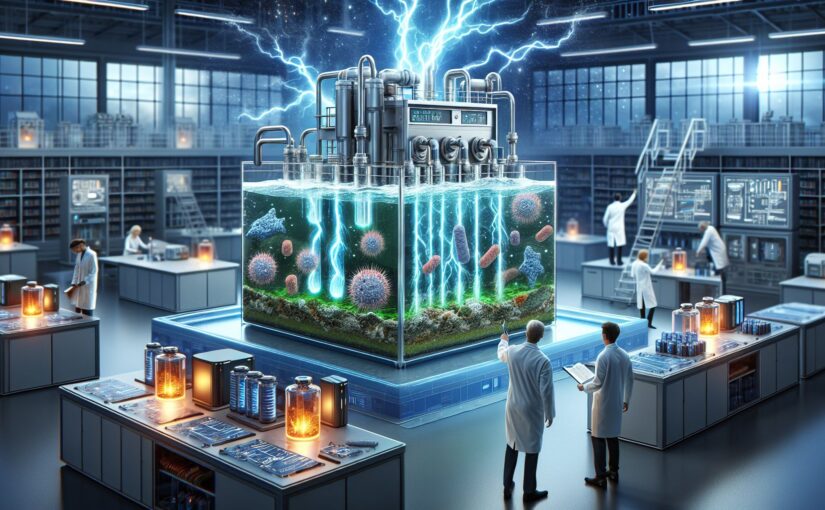
As the global population expands and the demand for clean water intensifies, the management and treatment of wastewater emerge as a critical element in ensuring sustainability and environmental protection. One innovative approach to wastewater treatment that has gained significant attention is the generation of renewable energy through microbial fuel cells (MFCs). This promising technology not only presents a potential solution for water treatment but also contributes to the generation of bioelectricity, thus transforming waste into wealth.
What are Microbial Fuel Cells (MFCs)?
Microbial fuel cells are bioelectrochemical systems that exploit the natural metabolic processes of electroactive bacteria to convert organic and inorganic matter found in wastewater into electrical energy. These bacteria, known as exoelectrogens, are capable of transferring electrons outside of their cells to an electrode, thus generating an electric current. MFCs typically consist of two chambers, an anode and a cathode, separated by a proton exchange membrane.
The Science behind MFCs
The transformation of wastewater into renewable energy through MFCs involves a complex interplay of biological and chemical reactions. In the anode chamber, electroactive bacteria oxidize the organic matter in the wastewater, which results in the release of electrons and protons. The electrons travel towards the anode, while the protons migrate through the proton exchange membrane to the cathode chamber.
In the cathode chamber, electrons from the external circuit join the protons and react with oxygen, forming water. This flow of electrons from the anode to the cathode through an external circuit is what generates electrical current, which can be harnessed for powering electronic devices or contributing to the electrical grid.
Advantages of Using MFCs in Wastewater Treatment
The integration of microbial fuel cells into wastewater treatment plants offers several advantageous outcomes:
- Sustainable Energy Production: MFCs generate bioelectricity from the organic pollutants in wastewater, thus contributing to the renewable energy landscape.
- Reduction of Environmental Impact: By converting waste into usable energy, MFCs minimize the ecological footprint of wastewater treatment.
- Cost-Effectiveness: Compared to conventional wastewater treatment methods, MFCs have the potential to reduce operational costs due to lower energy requirements and the generation of an energy byproduct.
- Resource Recovery: Besides electricity, MFCs also facilitate the recovery of valuable byproducts, such as hydrogen and clean water.
Challenges and Future Perspectives
Despite the potential benefits, the implementation of MFC technology on a larger scale faces several challenges:
- Limited Power Output: The power density and coulombic efficiency of current MFC designs are relatively low, necessitating further research to enhance their energy output and efficiency.
- Material Costs: The proton exchange membrane and electrode materials can be expensive, making the technology currently less economically viable for widespread adoption.
- Scaling Up: The transition from laboratory-scale models to full-scale wastewater treatment facilities remains a significant hurdle, requiring innovative designs and engineering solutions.
Conclusion
The application of microbial fuel cells in wastewater treatment represents an exciting convergence of environmental sustainability and renewable energy generation. By harnessing the natural processes of electroactive bacteria, MFCs provide a transformative approach to managing wastewater while also contributing to the renewable energy matrix. While technical and economic challenges persist, the ongoing research and development in this field offer a glimpse into a future where wastewater treatment plants not only safeguard our water resources but also serve as renewable energy powerhouses.
Sources
-
Logan, B. E., & Rabaey, K. (2012). Conversion of Wastes into Bioelectricity and Chemicals by Using Microbial Electrochemical Technologies. Science, 337(6095), 686-690. DOI: 10.1126/science.1217412
-
Pant, D., Van Bogaert, G., Diels, L., & Vanbroekhoven, K. (2010). A review of the substrates used in microbial fuel cells (MFCs) for sustainable energy production. Bioresource Technology, 101(6), 1533-1543. DOI: 10.1016/j.biortech.2009.10.017
-
He, Z., Minteer, S. D., & Angenent, L. T. (2005). Electricity Generation from Artificial Wastewater Using an Upflow Microbial Fuel Cell. Environmental Science & Technology, 39(14), 5262-5267. DOI: 10.1021/es0502876