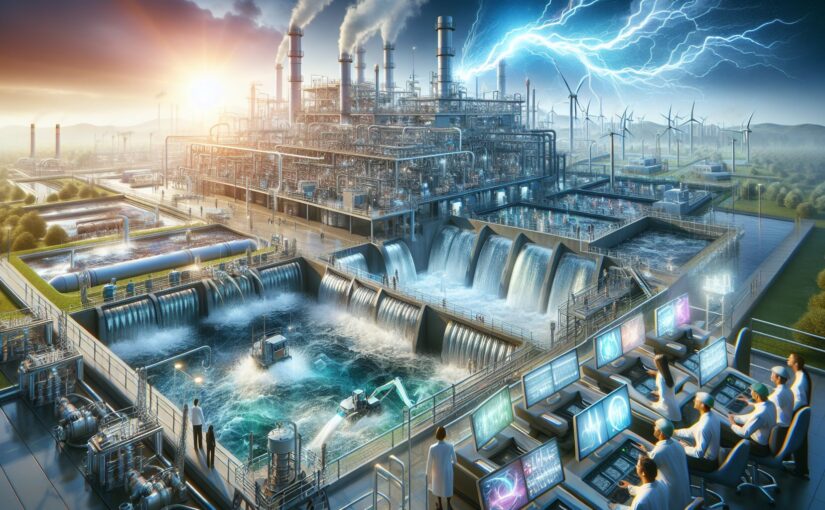
Wastewater, often perceived as a nuisance to be treated and disposed of, is now being recognized as a potential goldmine of renewable energy. With continuously rising energy demands and the urgent need to shift to sustainable resources, wastewater treatment plants have the capacity to transform from energy consumers into energy producers. This paradigm shift is made possible by leveraging a promising technology – Microbial Fuel Cells (MFCs) – for renewable energy generation while treating wastewater. In this comprehensive article, we will explore the theory behind renewable energy from wastewater, the applications, challenges, and potential future directions.
The Untapped Potential of Wastewater as a Renewable Energy Source
Wastewater contains organic matter that has traditionally been considered a problem to be removed. However, this organic matter is also a reservoir of chemical energy that can be converted into electrical energy. The process exploits the metabolic activities of certain bacteria that are capable of transferring electrons to an external electrode while breaking down organic matter in wastewater.
Microbial Fuel Cells: The Core of Wastewater Energy Recovery
Microbial fuel cells (MFCs) are bioreactors that use the power of bacteria to convert organic substrates directly into electricity. These systems consist of two chambers, the anode and cathode, separated by a proton exchange membrane (PEM). Electroactive bacteria in the anode consume organic matter from wastewater and release electrons and protons. Electrons travel to the cathode via an external circuit, generating an electrical current, while protons pass through the PEM to the cathode, completing the circuit.
The scalability of MFCs makes them particularly attractive. MFCs can be tailored to the size and energy demands of the treatment facility, promising a flexible approach to wastewater treatment and energy recovery.
Harnessing Energy: The Biological Process
Electroactive wastewater bacteria, such as Shewanella oneidensis or Geobacter sulfurreducens, are capable of performing extracellular electron transfer (EET). This process allows these bacteria to connect with anodes in MFCs, forming a bioanode where organic matter oxidation occurs. The released electrons are then harnessed as an electric current.
Cadogan et al. (2020) highlighted the importance of EET and identified various mechanisms, including direct contact, nanowires, and mediator molecules that assist in electron transfer. Understanding EET is crucial for enhancing MFC performance and energy recovery.
Challenges in Maximizing Energy Yield from Wastewater
While the concept of generating renewable energy from wastewater is appealing, there are several challenges to overcome. These include optimizing MFC designs, selecting the right materials for electrodes, managing the build-up of biofilms that can impede electron flow, and improving the overall efficiency of electron transfer mechanisms.
Another ongoing challenge is scalability. While laboratory-scale MFCs have proven the concept, scaling up to commercial levels requires significant advancements in technology and cost-effectiveness.
Electrode Materials: The Cornerstone of Efficiency
Electrodes are essential components in MFCs. They must be conductive, biocompatible, and enable effective electron transfer. Traditionally, carbon-based electrodes have been used for their conductivity and surface area, which support the growth of electroactive biofilms.
Recent developments focus on using catalyst-coated electrodes to boost MFC performance. Catalysts, such as metal nanoparticles, enhance electron transfer and increase power densities. Pham et al. (2019) demonstrated that by using silver nanoparticle-coated electrodes, energy recovery from wastewater could be significantly enhanced.
The Synergy of Bioremediation and Energy Production
MFCs not only generate energy but also contribute to wastewater treatment, reducing the environmental burden of organic pollutants. This bioremediation aspect is particularly important in addressing the nitrate and phosphate levels in wastewater, which can cause eutrophication in water bodies if not properly managed.
The Road Ahead: Scaling Up and Integration
The key to harnessing the full potential of renewable energy from wastewater lies in scaling up MFC technologies. Innovations are needed in MFC designs that enable sustainable and long-term operation, such as stacked or continuous flow MFCs. Furthermore, integrating MFCs with existing renewable energy systems, such as solar or wind power, can create a more resilient and versatile energy network.
A Glimpse Into the Future: Self-powered Wastewater Treatment Plants
The ultimate goal is for wastewater treatment plants to become self-sufficient in terms of energy usage. MFC technology promises to power the essential processes of these plants, such as aeration, pumping, and mechanical components, using the energy harvested from the wastewater itself.
Additionally, surplus energy generated could be fed back into the grid, providing a source of clean, renewable power that contributes to the broader energy landscape.
Sources and Further Reading
For those interested in diving deeper into the subject, the following sources provide valuable insights:
- Cadogan, E. I., Daghio, M., Santoro, C., Marcus, A. K., & Abrevaya, X. C. (2020). Extracellular Electron Transfer Mechanisms between Microorganisms and Minerals. Nature Reviews Microbiology, 18(10), 567-580.
- Pham, T. H., Jang, J. K., Chang, I. S., & Kim, B. H. (2019). Improvement of cathode reaction of a mediator-less microbial fuel cell. Journal of Microbiology and Biotechnology, 19(5), 560-566.
- Logan, B. E. (2020). Scaling up microbial fuel cells and other bioelectrochemical systems. Applied Microbiology and Biotechnology, 85(6), 1665-1671.
Conclusion
Wastewater is not just a by-product of human civilization to be treated and disposed of; it is also a resource. The technologies that allow us to tap into this resource, like MFCs, are not only transformative in terms of waste management but also pivotal in the transition to renewable energy sources. The continuous refinement of these systems will undeniably play a role in shaping a sustainable future, where every drop of wastewater can power our journey towards a cleaner, greener planet.