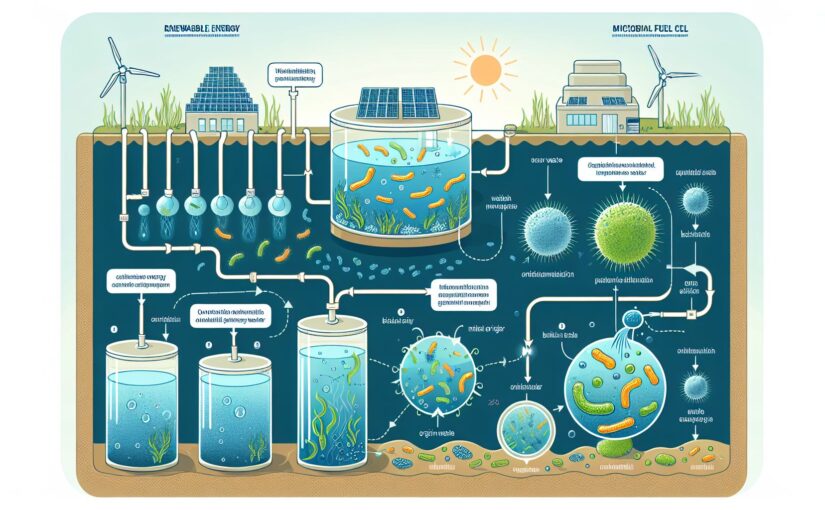
The world is in a constant pursuit of sustainable and clean energy sources. While solar and wind power have become emblematic of renewable energy, a less heraldly but equally promising technology is emerging from our very sinks and toilets – the generation of renewable energy from wastewater. This article will explore microbial fuel cells (MFCs) for wastewater treatment, a technology that harnesses the seemingly unlikely resource of wastewater to generate bioelectricity, cleanse the water, and offer insights into a future where waste disposal contributes to the energy matrix.
The Convergence of Waste and Energy
The need to efficiently treat wastewater is driven by environmental and public health concerns, while the quest for renewable energy is fueled by the necessity to alleviate the world’s dependence on fossil fuels. Microbial fuel cells represent a convergence of these two imperatives.
What are Microbial Fuel Cells?
Microbial fuel cells (MFCs) are bioelectrochemical systems that use bacteria to convert organic substrates directly into electrical energy. Through this process, the potential chemical energy in organic matter – such as that found in wastewater – is harvested by bacteria, which then transfer electrons to an anode, thus initiating an electric current.^(1)^
How Do MFCs Work?
MFCs have a relatively simple structure, comprising:
- Anode Chamber: This chamber houses the electroactive bacteria, which digest the organic matter in wastewater, releasing electrons and protons.
- Cathode Chamber: In aerobic MFCs, a cathode is exposed to oxygen. Here, electrons from the anode, oxygen, and protons combine to form water.
- Proton Exchange Membrane (PEM): This semi-permeable membrane separates the two chambers while allowing protons to pass through.
- External Circuit: Electrons flow from the anode to the cathode through an external circuit, producing electricity.
Benefits of Using MFCs for Wastewater Treatment
- Renewable Energy Generation: MFCs use the chemical energy stored in wastewater to generate electricity, contributing to a closed-loop economy.
- Reduction in Sludge Production: MFCs can significantly reduce the amount of residual sludge, lowering the costs and environmental footprint of waste management.
- Pollutant Removal: MFCs effectively remove organic compounds and various pollutants from wastewater.
- Low-energy Requirement: The process does not require costly aeration as in traditional wastewater treatment plants.
Case Studies: MFCs in Action
Several studies have documented the success of MFCs in treating various types of wastewater while generating energy.
- A study at the Pennsylvania State University demonstrated the utility of MFCs in treating domestic wastewater, revealing that MFCs could recover approximately 80% of the potential energy in the form of electricity.^(2)^
- Another investigation showed MFCs’ potential to treat brewery wastewater, suggesting that this technology could be particularly beneficial for industries with high-strength wastewater.^(3)^
The Sustainability Potential
The dual capability of MFCs – treatment of wastewater and generation of electricity – offers a compelling advantage in terms of sustainability. By creating an opportunity to extract value from waste, MFCs could redefine wastewater plants from energy consumers to energy producers.
Technological Challenges
Despite the considerable potential, there are substantial technical and economic barriers to the widespread adoption of MFCs.
- Scaling up: While MCFs work well in laboratory settings, scaling them up for industrial applications poses significant challenges due to material and engineering constraints.
- Power Density: Current MFCs have a relatively low power density compared to traditional energy sources, limiting their application.
- Cost Efficiency: The cost of building and maintaining MFCs can be prohibitive, though ongoing research is focused on reducing these costs.
- Electrode Materials: The development of cost-effective, high-performance electrode materials is critical to the economic feasibility of MFCs.
The Future of Wastewater Treatment and Energy Production
Innovations on the Horizon
To overcome the challenges and harness the full potential of MFCs, researchers are pursuing several innovative strategies:
- New Electrode Materials: Research is ongoing to find more efficient and less expensive electrode materials, with a focus on carbon-based and catalyst-coated electrodes.
- Genetically Engineered Bacteria: Strains of bacteria that can transfer electrons more efficiently are being developed to enhance the power output of MFCs.
- Integrated Systems: Combining MFCs with other treatment processes can maximize efficiency and resource recovery.
Policy and the Role of Governments
The successful integration of MFCs into the mainstream will likely require supportive policies, investment in research and development, and incentives for early adopters. Governments around the world can propel this technology forward by funding pilot projects and creating regulatory frameworks that encourage innovation in wastewater treatment and renewable energy.
Conclusion
Microbial fuel cells offer a promising and innovative approach to managing wastewater and producing renewable energy. As technology advances and the world gravitates towards more sustainable practices, MFCs could play a significant role in the energy and waste sectors. While challenges remain, the continual improvement of MFCs and their increasing feasibility point to a brighter, cleaner future where even wastewater contributes to the grid.
References
- Logan, B. E. (2010). Scaling up microbial fuel cells and other bioelectrochemical systems. Applied Microbiology and Biotechnology, 85(6), 1665–1671. https://doi.org/10.1007/s00253-009-2378-9
- Liu, H., Ramnarayanan, R., & Logan, B. E. (2004). Production of Electricity during Wastewater Treatment Using a Single Chamber Microbial Fuel Cell. Environmental Science & Technology, 38(7), 2281–2285. https://doi.org/10.1021/es034923g
- Min, B., & Logan, B. E. (2004). Continuous Electricity Generation from Domestic Wastewater and Organic Substrates in a Flat Plate Microbial Fuel Cell. Environmental Science & Technology, 38(21), 5809-5814. https://doi.org/10.1021/es0491026