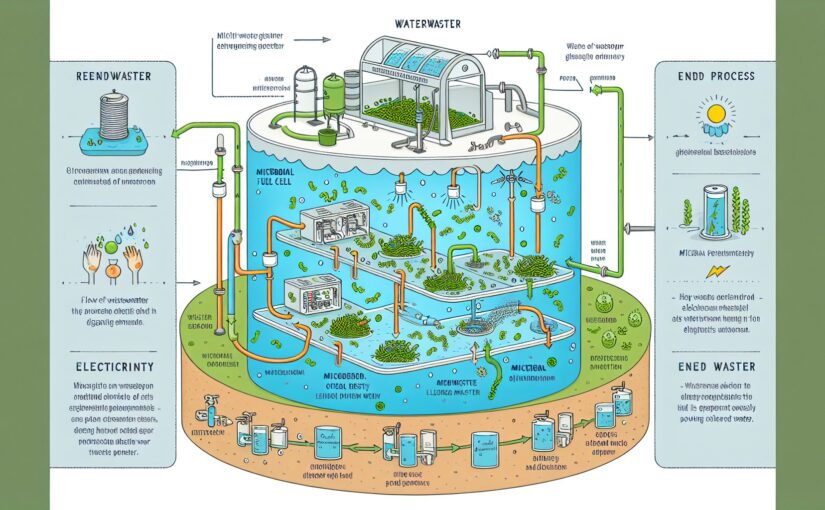
In the quest for sustainable energy sources, one innovative technology merges renewable energy production with wastewater treatment—Microbial Fuel Cells (MFCs). This article unpacks the potential of microbial fuel cells for tapping the energy within wastewater, exploring the science behind this promising technology, and considering its place in the future of renewable energy and waste management.
Introduction
Across the world, energy consumption has been steadily increasing. With the growing population and industrialization, we are constantly searching for new, sustainable ways to meet our energy demands. Concurrently, wastewater management represents a significant environmental challenge. What if we could tackle both these issues in one fell swoop?
Enter Microbial Fuel Cells (MFCs), a technology that offers a glimmer of hope. By harnessing the biochemical energy from organic waste found in wastewater, MFCs produce electricity—a process that simultaneously treats wastewater. This green technology represents a transformative approach to energy production and waste treatment. Let’s delve into the mechanics of MFCs, their benefits, challenges, and the future prospects in the field of renewable energy.
The Basics of Microbial Fuel Cells
A microbial fuel cell is a bio-electrochemical system that drives a current by mimicking bacterial interactions found in nature. In the context of wastewater treatment, microorganisms metabolize organic matter in the water, and in the process, transfer electrons to an anode. The electrons then travel through an external circuit to a cathode, producing electricity.
Structure of MFCs
Typically, an MFC consists of an anode and a cathode compartment separated by a proton exchange membrane. The anode compartment contains electroactive bacteria that consume organic compounds from wastewater.
Electroactive Wastewater Bacteria
The real stars of MFCs are the electrogenic, or electroactive, bacteria. These specialized bacteria are capable of transferring electrons outside of their cell membranes as part of their metabolic process. Species like Shewanella and Geobacter have proven to be particularly effective in MFCs.
Electron Transfer Mechanisms
Electron transfer in MFCs can occur through several mechanisms:
- Direct Transfer: Bacteria directly interface with the anode to transfer electrons.
- Mediator-based Transfer: Bacteria require soluble redox mediators to shuttle electrons to the anode.
- Nanowire Transfer: Some species transmit electrons via conductive hair-like appendages known as nanowires.
Benefits of Using MFCs for Wastewater Treatment
Energy Recovery
The most attractive feature of MFCs is their ability to generate electricity while degrading organic pollutants. Although the current power output of individual MFCs is modest, the technology holds great promise for improvement and scale.
Reduction of Sludge
Treating wastewater often produces large quantities of sludge, which is expensive and environmentally taxing to dispose of. Since MFCs can enhance the breakdown of organic matter, they can consequently reduce the amount of generated sludge.
Low Energy Requirement
Unlike conventional wastewater treatment processes that are energy-intensive—especially for aeration—MFCs require substantially less energy to operate, potentially even achieving energy-neutral wastewater treatment.
Challenges in MFC Technology
Scale-Up
While MFCs have been effective on a laboratory scale, upscaling them for industrial use presents challenges in maintaining efficiency and system stability.
Power Density and Efficiency
Power density, which refers to the amount of power generated per unit volume of an MFC, has limitations in MFCs, often due to slow electron transfer and high internal resistance. Improving power density and coulombic efficiency, the measure of how efficiently electrons are transferred from the substrate to electricity, are key areas of development.
Electrode and Membrane Materials
The choice of electrode and membrane materials greatly affects the efficiency and cost of MFCs. High-quality materials that facilitate electron transfer are often expensive, making commercial viability a challenge.
The Future of Renewable Energy from Wastewater
Research and Development
Current research is focusing on optimizing MFC design and operation to improve performance indicators. Innovations in electrode materials, like carbon-based or catalyst-coated electrodes, are paving the way for enhancements in power density and treatment efficiencies.
Environmental Impact
The environmental benefits of MFCs extend beyond treating wastewater and generating energy. They offer a reduction in greenhouse gases, owing to less energy consumption and a smaller carbon footprint compared to conventional wastewater treatment methods.
Economic Considerations
For widespread adoption, MFC technology must be economically competitive. Advances in low-cost, high-efficiency materials and system design are needed to make MFCs a viable alternative to traditional power sources.
Conclusion
MFC technology offers a compelling solution to two of society’s pressing challenges: sustainable energy generation and effective wastewater treatment. By embracing the potential of renewable energy from wastewater, we can move towards a more sustainable, efficient future for both energy and our water resources.
Sources
- Logan, B. E., & Rabaey, K. (2012). Conversion of wastes into bioelectricity and chemicals by using microbial electrochemical technologies. Science, 337(6095), 686-690. doi: 10.1126/science.1217412
- Heidrich, E. S., Edwards, S. R., Dolfing, J., Cotterill, S. E., & Curtis, T. P. (2018). Performance of a pilot scale microbial fuel cell fed on domestic wastewater at ambient temperatures for a 12-month period. Bioresource Technology, 250, 606-614. doi: 10.1016/j.biortech.2017.11.080
- Pant, D., Van Bogaert, G., Diels, L., & Vanbroekhoven, K. (2010). A review of the substrates used in microbial fuel cells (MFCs) for sustainable energy production. Bioresource Technology, 101(6), 1533-1543. doi: 10.1016/j.biortech.2009.10.017
Harnessing the power within wastewater could well be the next frontier in sustainable energy and waste management. As researchers and engineers continue to optimize MFC technology, we edge closer to integrating this remarkable system into our everyday lives, fulfilling our energy needs while preserving the planet’s most valuable resources.