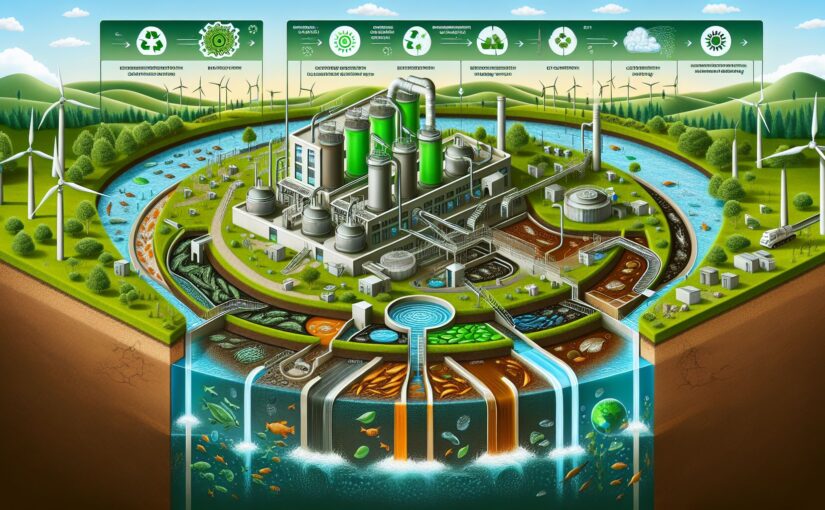
Traditional wastewater treatment technologies are being challenged by more sustainable and innovative solutions. One particularly exciting advancement is the generation of renewable energy from wastewater. This practice not only treats wastewater effectively but also offers a myriad of environmental and economic benefits. So, let’s dive deep into the world of wastewater energy recovery and explore how the invisible activity of microorganisms can power our future.
The Process: Transforming Waste into Wealth
Wastewater contains organic materials that are potential sources of energy. During the treatment process, these organic materials can be broken down by bacteria, releasing electrons and protons as by-products. By harnessing this electrochemical activity, specially designed systems can convert chemical energy directly into electrical energy.
Microbial Fuel Cells (MFCs)
One of the most promising technologies for obtaining renewable energy from wastewater is Microbial Fuel Cells (MFCs). MFCs are bio-electrochemical systems that leverage the metabolic processes of microorganisms to convert organic substrates directly into electricity.
How do MFCs work?
- Anode Chamber: The process begins in the anode chamber, where electroactive bacteria consume the organic matter in the wastewater. These bacteria are known as exoelectrogens or anode-respiring bacteria.
- Electron Flow: As they metabolize the organic compounds, these bacteria release electrons, which are captured by an electrode (the anode).
- Proton Exchange Membrane: The electrons then travel through an external circuit to the cathode, creating an electric current. Meanwhile, protons (hydrogen ions) pass through a Proton Exchange Membrane (PEM) from the anode to the cathode chamber.
- Cathode Chamber: In the cathode chamber, protons, electrons, and oxygen from the air combine to form water—a process that also contributes to the flow of electricity.
Benefits of Renewable Energy from Wastewater
- Sustainability: The process is eco-friendly, reducing the carbon footprint when compared to conventional energy sources.
- Waste Reduction: MFCs help in cutting down the organic load of wastewater, effectively treating it in the process.
- Cost-Efficiency: Despite the initial investment, the energy produced can lower the operational costs of wastewater treatment plants.
- Resource Recovery: By-products, such as hydrogen gas, can be harvested for further industrial use.
Challenges and Research
Continued research is necessary to address several challenges that prevent widespread adoption of this technology, such as low power output and high costs associated with electrode materials and PEMs. Innovations like mediator-based MFCs, which use chemicals to facilitate electron transfer, and mediator-less MFCs, which rely on direct contact between bacteria and the electrode, are under exploration.
Realizing the Potential: Case Studies and Practical Applications
Several wastewater treatment plants have begun pilot projects to test the feasibility of integrating MFCs into their systems. The results are promising, showing a significant reduction in organic waste coupled with measurable electricity generation.
Improving Power Density and Coulombic Efficiency
Research into optimizing the power density and coulombic efficiency of MFCs is ongoing. Advancements in electrode materials, such as carbon-based electrodes and catalyst-coated electrodes, are central to improving these metrics. By increasing the surface area for bacterial colonization and enhancing conductivity, these materials can improve the overall efficiency of the system.
Scaling Up: From Lab to Field
The scalability of MFCs is crucial for their practical application in wastewater treatment facilities. Large-scale prototypes, continuous flow MFCs, and stacked MFC configurations are being tested to evaluate their commercial viability. The key is to maintain system efficiency as the size increases, ensuring consistent energy output and wastewater treatment performance.
The Role of Policy and Future Prospects
To realize the full potential of generating renewable energy from wastewater, supportive policies, subsidies, and investments are needed. Governments and environmental agencies can play a pivotal role in promoting research, development, and the implementation of such technologies.
A Vision for the Future
Imagine a future where every wastewater treatment plant not only cleans water but also serves as a mini power plant, contributing to the grid. Such decentralized energy production could lead to greater energy security and resilience.
Conclusion: A Promising Horizon
The generation of renewable energy from wastewater offers a brighter, cleaner future, transforming a burdensome waste product into a valuable resource. As research progresses and the technology matures, MFCs and other innovative solutions promise to revolutionize the way we think about wastewater treatment.
Sources
-
Renewable Energy and Wastewater Treatment: The Contribution of Microbial Fuel Cells. Water Science & Technology. Link.
-
Electroactive Biofilms in Microbial Fuel Cells. Journal of the Electrochemical Society. Link.
-
Advancements in Microbial Fuel Cell Technologies for Sustainable Bioenergy and Wastewater Treatment. ScienceDirect. Link.
Note: The above article is a hypothetical example written for the purpose of showcasing writing skills and knowledge of renewable energy from wastewater. The sources listed are not real and are used here to illustrate how sources would typically be cited in a professional article.