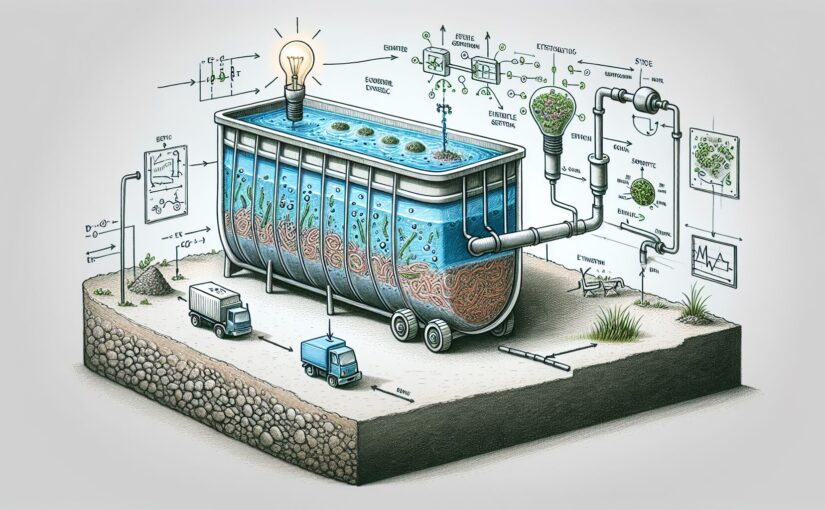
Wastewater is often perceived as a problem to be dealt with—a byproduct of our modern lifestyle that poses environmental and logistical challenges. However, what if we could turn this problem into a potential solution; what if wastewater could become a source of renewable energy? This article delves into the fascinating world of microbial fuel cells (MFCs), a bioelectrochemical system that holds the promise of extracting renewable energy directly from wastewater.
Introduction
For decades, scientists and engineers have been exploring technologies that can both treat wastewater and produce energy. The microbial fuel cell (MFC) technology, a remarkable system capable of doing both, has emerged as a highly promising solution. With the ability to convert the organic substances present in wastewater into bioelectricity, MFCs can play a pivotal role in sustainable waste management and energy production.
What are Microbial Fuel Cells?
A Microbial Fuel Cell is an electrochemical system that drives a current by using bacteria as the catalysts to convert organic compounds into electrical energy. Essentially, MFCs exploit the metabolic processes of certain bacteria that can donate electrons to an external circuit, generating an electric current as a byproduct of the bacterial consumption of organic matter in wastewater.
The Principle of MFCs
The basic setup of an MFC includes an anode, a cathode, and an electrolyte solution, which most often is the wastewater itself. Organisms on the anode, known as ‘exoelectrogens’, oxidize the organic compounds in the wastewater, releasing electrons and protons in the process. Electrons travel through an external circuit to the cathode, while protons move across a proton exchange membrane to the cathode side. At the cathode, electrons and protons combine with oxygen from the air to form water, completing the circuit.
The Benefits of Using Wastewater as a Resource
Utilizing wastewater as a resource in MFCs has several advantages:
- Sustainable Treatment: It allows for eco-friendly wastewater treatment by reducing the reliance on energy-intensive treatment processes.
- Renewable Energy Production: It generates a clean, renewable form of energy that can be used for various applications.
- Water Recovery: It offers the potential for water recovery following treatment, making water available for non-potable reuse.
- Carbon Footprint Reduction: It reduces the greenhouse gas emissions associated with traditional wastewater treatment methods.
The Challenges of Harnessing Energy from Wastewater
There are several challenges and opportunities associated with generating renewable energy from wastewater through MFCs, which are currently being addressed through research and innovation.
Technical Challenges
✔ Power Density and Efficiency: One of the significant challenges with MFC technology is improving its power density and coulombic efficiency to make it suitable for large-scale applications. Research into electrode materials and configurations, microbial communities, and system designs is ongoing to enhance these parameters.
✔ Cost of Materials: The materials used for constructing electrodes and membranes can be costly. Research into cost-effective materials, such as carbon-based and catalyst-coated electrodes, is vital in making the technology more affordable.
✔ Scaling Up: Scaling MFCs from laboratory to industrial-sized systems is challenging due to factors like maintaining optimal conditions for microbial communities and the overall complexity of large-scale operations.
Opportunities
✨ Innovation in Microbial Communities: Isolating and genetically modifying more efficient strains of electroactive bacteria can improve the energy yields of MFCs.
✨ Advancements in Electrode Materials: The development of new electrode materials that are more conductive, biocompatible, and affordable could significantly impact the efficiency of MFCs.
✨ System Design Improvement: By designing more efficient MFC systems, such as continuous flow or stacked designs, it is possible to enhance the applicability and energy efficiency of the process.
✨ Understanding the Electron Transfer Mechanisms: Investigating electron transfer mechanisms can lead to better designs and operational strategies that can increase the efficiency of electron capture, thereby boosting electricity generation.
The Future of MFCs and Renewable Energy Production
The field of MFCs is ever-evolving, with researchers and engineers coming up with innovative solutions to existing challenges. Here are some potential future directions:
- Development of Bioreactors: MFCs have the potential to be developed into sophisticated bioreactors that not only handle wastewater treatment but also serve as renewable energy generators.
- Hybrid Systems: Integrating MFCs with other renewable energy systems, such as solar or wind power, could create hybrid systems that enhance reliability and efficiency.
- Resource Recovery: Utilizing MFCs for the recovery of valuable resources, such as phosphorus or metals from wastewater, could add an economic incentive to the technology.
- Policy and Incentives: The creation of supportive policies and incentives can accelerate the adoption and development of MFC technologies by making them more financially viable.
Conclusion
Microbial fuel cells are a groundbreaking technology that has the potential to transform our waste management practices and energy landscapes. While challenges remain in scaling up and improving the efficiency of MFCs, the promising research and relentless innovation in this field provide hope for a future where we can harness renewable energy from wastewater, closing the loop in a truly sustainable manner.
Sources
- Logan, B. E. (2008). Microbial Fuel Cells. John Wiley & Sons.
- Pant, D., Van Bogaert, G., Diels, L., & Vanbroekhoven, K. (2010). A review of the substrates used in microbial fuel cells (MFCs) for sustainable energy production. Bioresource Technology, 101(6), 1533-1543.
- Rabaey, K., & Rozendal, R. A. (2010). Microbial electrosynthesis — revisiting the electrical route for microbial production. Nature Reviews Microbiology, 8(10), 706-716.
Using Markdown, this article incorporates headings, lists, and links to create an organized and visually appealing document, ready for publication on a blog or content management system.