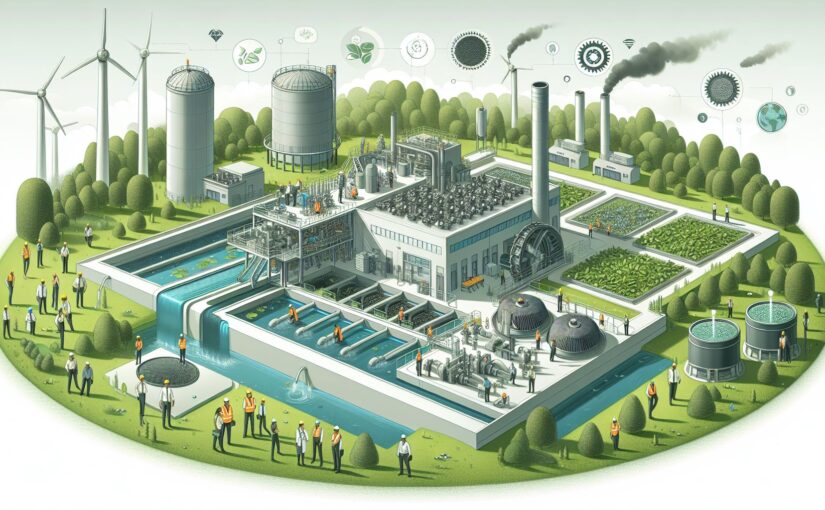
Wastewater, typically seen as a disposal challenge, harbors an untapped resource that could revolutionize the way we approach energy generation and environmental conservation. One of the most promising areas in this regard is the potential for renewable energy from wastewater. Exploring this innovative solution, we delve into the mechanisms behind this energy transformation, the benefits, the challenges, and the steps being taken to optimize and scale up this technology to make a real-world impact.
The Energy Potential in Wastewater
Human activities generate a vast amount of wastewater every day. This wastewater is rich in organic matter that microorganisms can decompose, a process which can be harnessed to produce bioenergy. The treatment of wastewater is typically an energy-intensive process; however, by utilizing certain technologies, it’s possible to not only treat the wastewater but also to extract energy from it, effectively turning waste treatment plants into power generators.
How Renewable Energy is Harnessed from Wastewater
One of the most advanced methods of extracting energy from wastewater is through the use of Microbial Fuel Cells (MFCs). MFCs are devices that use bacteria to convert the chemical energy in organic compounds directly into electrical energy. This bioelectrochemical process happens through the metabolic activities of electroactive bacteria.
These bacteria attach themselves to the anode, a component of the MFC, and as they consume the organic matter in the wastewater, they release electrons. These electrons travel through an external circuit to the cathode, thus generating an electric current. The process also generates protons that pass through a Proton Exchange Membrane (PEM) and combine with the electrons and oxygen at the cathode to form water, thus completing the circuit.
Benefits of Generating Renewable Energy from Wastewater
Environmental Conservation
Utilizing wastewater as a source of renewable energy significantly reduces the environmental footprint of waste treatment processes. It offers:
– A decrease in greenhouse gas emissions, as less energy from fossil fuels is needed.
– Reductions in sludge production, which decreases the volume of waste to be managed.
Energy Recovery
Energy recovery from wastewater can help in:
– Reducing the energy demands of wastewater treatment plants, which are typically among the largest energy consumers at the municipal level.
– Possibly providing surplus energy that can be fed back into the power grid or used to power other essential services.
Economic Advantages
The conversion of waste to energy can yield economic benefits by reducing operational costs associated with wastewater treatment, and it could provide a return on investment through the generation of electricity.
Challenges in Renewable Energy Recovery from Wastewater
While the benefits are clear, there are significant challenges that need to be overcome to increase the viability of this technology:
– Scaling Up: While MFCs work in a laboratory setting, scaling them up for industrial wastewater treatment applications is complex.
– Technological Innovation: The need for advanced materials that can enhance the efficiency of bioelectricity generation.
– Cost: The initial setup costs can be high, and more cost-effective methods of constructing and maintaining these cells are required.
– Public Perception: Gaining acceptance of this technology for large-scale application requires public and political support.
Optimization and Scale-Up of the Technology
Widespread adoption of this technology depends on resolving technical and economic challenges. Researchers and engineers are developing:
– More effective electrode materials, such as carbon-based electrodes and catalyst-coated electrodes, to improve the power output and durability of MFCs.
– New designs of MFCs like stacked and continuous flow configurations to enhance the process efficiency.
– Methods to increase the power density and coulombic efficiency of MFCs for better overall performance.
A Look Ahead: The Future of Renewable Energy from Wastewater
The current research and pilot projects are promising and highlight the potential for significant advancements in the field of renewable energy from wastewater. Ongoing efforts include:
– Integrating MFCs with existing renewable energy systems to create a more resilient and diversified energy grid.
– Exploring the use of MFCs in conjunction with other processes like microbial electrolysis cells for enhanced resource recovery.
– Developing guidelines and policies to support the growth of this technology in public and private sectors.
Conclusion
Renewable energy from wastewater represents a sustainable and innovative opportunity that has the potential to transform wastewater treatment plants from cost centers into energy-producing assets. Although challenges remain, the benefits to the environment, economy, and society make it a compelling solution that merits further exploration and investment.
Sources
- Logan, B. E., & Regan, J. M. (2006). Electricity-producing bacterial communities in microbial fuel cells. Trends in microbiology, 14(12), 512-518.
- Rabaey, K., & Verstraete, W. (2005). Microbial fuel cells: novel biotechnology for energy generation. Trends in biotechnology, 23(6), 291-298.
- Heidrich, E. S., Dolfing, J., Scott, K., Edwards, S. R., Jones, C., & Curtis, T. P. (2018). Production of hydrogen from domestic wastewater in a pilot-scale microbial electrolysis cell. Applied Energy, 222, 770-778.
Using this knowledge and innovative spirit, we possess the key to unlock an environmentally friendly, economically sound future that efficiently manages one of our most challenging by-products—wastewater. With the technologies improving and the concept slowly gaining ground, renewable energy from wastewater could soon become a cornerstone of both our energy and waste management strategies.