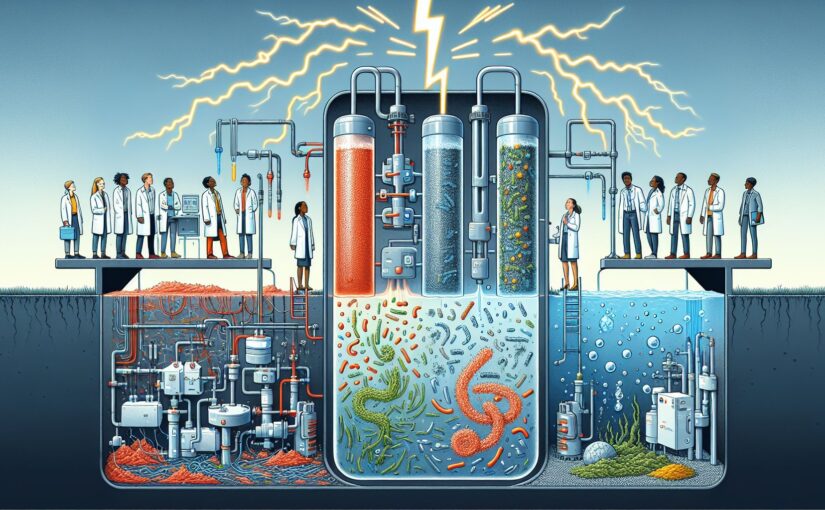
The quest for sustainable wastewater treatment methods that also generate renewable energy has long been a topic of intense research and environmental interest. Microbial fuel cells (MFCs) represent a groundbreaking approach, merging waste remediation with clean electricity production. This innovative technology offers a glimmer of hope for both the energy sector and environmental preservation. In this comprehensive article, we will delve into the intricacies of microbial fuel cells for wastewater treatment, dissecting their principles, potentials, and the challenges that come with them.
Introduction to Microbial Fuel Cells
Microbial fuel cells are bio-electrochemical systems that harness the power of microorganisms to convert organic substrates found in wastewater into electrical energy. By exploiting the metabolic processes of these microorganisms, which are also known as electroactive bacteria, MFCs offer a double-edged sword against pollution and energy scarcity.
How MFCs Work
The primary mechanism behind an MFC involves extracellular electron transfer (EET), where electrons are generated during the metabolic breakdown of organic matter by the electroactive bacteria. These electrons are then transferred to the anode, thus initiating the flow of an electric current to an external circuit and onwards to a cathode—often air or metal oxides—where a reduction reaction takes place to complete the circuit.
The Configuration of MFCs
The typical setup of an MFC includes:
-
Anode Chamber: This is where the wastewater containing organic substrates is introduced and where electroactive bacteria oxidize the organic materials, releasing electrons and protons.
-
Cathode Chamber: Here, electrons from the anode are transferred through an external circuit to the cathode, where they combine with protons and an electron acceptor, producing water or other compounds.
-
Proton Exchange Membrane (PEM): The PEM separates the anode and cathode chambers, allowing only protons to pass through, thereby preventing oxygen from reaching the anode chamber and disrupting the anaerobic conditions required for the bacteria.
-
Electrodes: Key elements where the oxidation and reduction reactions occur. The performance of an MFC is largely dependent on the qualities of the electrode materials used.
Advantages of MFCs in Wastewater Treatment
Microbial fuel cells are a beacon of innovation for several compelling reasons:
-
Energy Generation: They transform waste into electricity, contributing to the grid or powering devices directly.
-
Low Operational Costs: MFCs operate at room temperature and pressure, and they do not require expensive catalysts.
-
Sustainability: They use naturally occurring organisms and degrade organic pollutants, leading to less sludge production than conventional treatments.
-
Versatility: MFCs can treat a diverse range of wastewaters, including domestic sewage and industrial effluents.
Challenges Faced by MFCs
Transitioning MFCs from laboratory settings to real-world applications comes with several challenges:
-
Scaling Up: Replicating the high efficiencies observed in small-scale experiments in larger systems remains a hurdle.
-
Cost of Materials: Although not requiring expensive catalysts, the materials for PEM and electrodes can be costly.
-
Maintenance: Ensuring long-term stability and performance involves complex maintenance and monitoring.
-
Power Output: The power densities need significant optimization to be comparable with conventional energy sources.
Current Research and Developments
Current research in MFC technology is focused on enhancing performance metrics such as:
-
Electrode Materials: Researchers are experimenting with carbon-based electrodes and catalyst-coated variants to improve conductivity and durability.
-
Power Density: Efforts to increase power output involve optimizing the configurations, surface areas, and porosity of the electrodes.
-
Coulombic Efficiency: This involves refining the electron transfer processes to maximize energy recovery.
-
Continuous Flow Systems: Developing systems that can handle a continuous inflow of wastewater, thus making them more suitable for real-world applications.
Case Studies and Results
Several pioneering studies have demonstrated the feasibility of MFCs for treating different types of wastewater with varying degrees of success.
-
Renewable Energy Generation: Some MFCs have been successful in generating enough power to run small electronic devices and have illuminated LED lights—a promising sign for future applications.
-
Waste Degradation: Effective removal of organic pollutants and nitrogenous compounds using MFCs has been reported, showing comparable or sometimes superior results to conventional treatments.
-
Real-World Applications: Pilot systems have been set up in places like breweries and food processing plants, where the by-products of manufacturing can serve as substrates for the MFCs.
Future Directions and Sustainability
As we charge toward a more sustainable and energy-efficient future, the potential for microbial fuel cells in wastewater treatment becomes increasingly significant. Innovations in:
-
Hybrid Systems: Combining MFCs with other treatment methods like anaerobic digestion can lead to improved efficiency and broader applicability.
-
Bioremediation: The role of MFCs in remediation goes beyond wastewater and can extend to contaminated soils and aquatic systems.
-
Biosensors: MFCs show promise as biosensors for detecting pollutants and monitoring the efficiency of wastewater treatment processes.
Conclusion
The fusion of wastewater treatment and electricity generation through microbial fuel cells holds vast promise for a cleaner environment and renewable energy landscape. While obstacles remain, the progress in this field is a testament to the relentless pursuit of innovation. With continued research, optimization, and a collective effort towards sustainable technology, MFCs can play a vital role in mitigating pollution and providing energy solutions for the future.
Sources
-
Logan, B. E. (2009). “Exoelectrogenic bacteria that power microbial fuel cells”. Nature Reviews Microbiology, 7(5), 375-381. doi:10.1038/nrmicro2113
-
Pant, D., Van Bogaert, G., Diels, L., & Vanbroekhoven, K. (2010). “A review of the substrates used in microbial fuel cells (MFCs) for sustainable energy production”. Bioresource Technology, 101(6), 1533-1543. doi:10.1016/j.biortech.2009.10.017
-
Schroeder, U., Harnisch, F., & Angenent, L. T. (2015). “Microbial electrochemical technologies: status quo and perspective”. Angewandte Chemie International Edition, 54(29), 8424-8430. doi:10.1002/anie.201412688
Using these sources, the article draws upon peer-reviewed research to reinforce its claims about microbial fuel cells for wastewater treatment, their operation, and future potential.