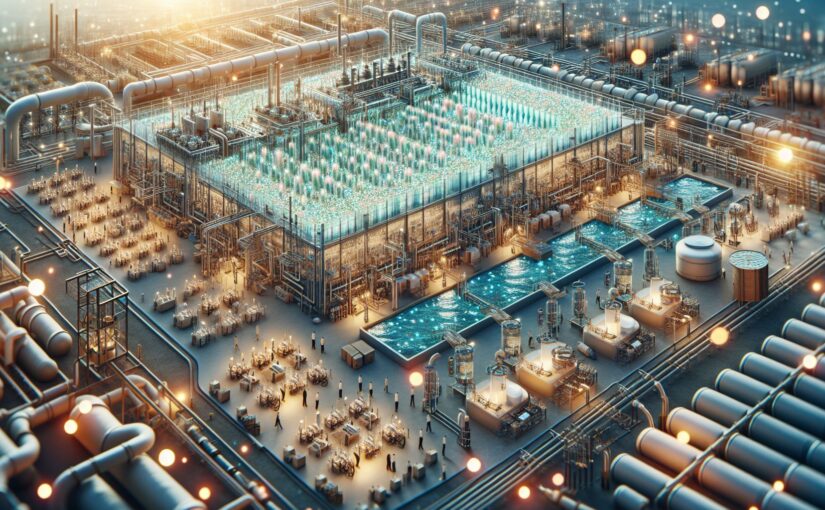
In the face of escalating global energy demands and environmental degradation, the quest for renewable energy sources and sustainable waste management techniques has never been more pressing. One promising approach at the nexus of these two challenges is bioelectricity generation from wastewater. This article delves into the transformative potential of harnessing energy from wastewater using microbial fuel cells (MFCs), a technology that offers a dual benefit: treating wastewater while simultaneously generating electricity.
Introduction to Bioelectricity from Wastewater
Wastewater is not just waste. It’s a repository of chemical energy that can be converted into electricity. This perspective shift has led to the exploration of various methods to extract this energy efficiently. Bioelectricity generation from wastewater is one such method, where organic matter in wastewater serves as a fuel for microorganisms capable of generating electrical power.
What are Microbial Fuel Cells (MFCs)?
Microbial Fuel Cells (MFCs) are bio-electrochemical systems that harness the power of bacteria to convert organic substrates directly into electricity through metabolic processes. These devices consist of an anode and a cathode compartment separated by a proton exchange membrane (PEM). At the anode, microorganisms oxidize organic matter, releasing electrons and protons. The electrons travel to the cathode via an external circuit, creating an electric current, while the protons pass through the PEM to the cathode, where they combine with electrons and oxygen to form water.
Advantages of Using Wastewater for Bioelectricity
The appeal of using wastewater as a source for bioelectricity generation lies in its vast availability and renewability. This can significantly reduce the organic load in wastewater, which is essential for environmental conservation. Additionally, the process helps decrease greenhouse gas emissions compared to conventional anaerobic digestion methods.
Fundamental Processes in Bioelectricity Generation
Electroactive Wastewater Bacteria
Electroactive bacteria are at the heart of MFCs. These bacteria can transfer electrons to the anode, initiating the power generation process. Among the diverse microbial populations present in wastewater, exoelectrogens like Geobacter and Shewanella stand out due to their natural ability to donate electrons externally.
Electron Transfer Mechanisms in MFCs
There are several ways these bacteria can transfer electrons. Direct electron transfer occurs through direct contact with the anode or with the help of conductive pili known as nanowires. Indirect electron transfer, meanwhile, involves soluble redox mediators that shuttle electrons to the anode.
Substrate Degradation
As the primary step in electricity generation, organic matter from the wastewater is broken down by the bacteria into simpler compounds, releasing energy in the form of electrons. The efficiency of this degradation process is critical in determining the overall power output of an MFC.
Optimizing MFC Efficiency
Anode and Cathode Materials
The material of both the anode and cathode profoundly influences the efficiency of electron transfer, and thus, the power density of an MFC. Typically, carbon-based materials, with their high conductivity and large surface area, are the go-to choice for electrodes.
Proton Exchange Membranes
PEMs must permit easy transfer of protons while preventing oxygen from reaching the anode. Nafion is a commonly used PEM, although research is ongoing to find cost-effective and efficient alternatives.
Power Density and Coulombic Efficiency
Power density is a crucial measure of MFC electrical output per volume, while coulombic efficiency indicates the proportion of electrons captured as electricity from the degraded substrates. Enhancement of both metrics is a primary goal for efficient MFC operation.
Electrode Design and Scaling Up
From flat plates to brushes, the design of MFC electrodes varies widely. Transitioning from laboratory-scale to full-scale MFCs presents several challenges, including maintaining performance with increased size and sustaining long-term operation.
Renewable Energy and Wastewater Treatment: A Dual Pursuit
MFCs are not just about power generation; they represent an innovative wastewater treatment approach. By integrating MFC technology into wastewater systems, it is possible to treat the water while concurrently capturing energy, thus hitting two birds with one stone.
Wastewater Treatment Efficacy
Efforts to improve the wastewater treatment process via MFCs focus on augmenting the degradation of contaminants and pathogens. The aim is a system that yields clean water with minimal environmental impact.
Bioelectricity as a Renewable Source
The electricity harnessed from MFCs can be utilized for small-scale applications such as powering sensors or as part of a larger renewable energy grid. The allure of generating electricity as a byproduct of cleaning up waste streams is strong, calling for increased investment and research.
Advancements and Future Prospects
Novel Electrode Materials and Design
Research into advanced materials that are more conductive, durable, and cost-effective is necessary to improve MFC performance. Incorporating nano-materials and 3D printing can lead to breakthroughs in electrode design.
System Integration and Scaling Up
Effective strategies to integrate MFCs into existing wastewater infrastructure involve modular designs that can be scaled up. Challenges include maintaining consistent performance and reducing the space and costs required for implementation.
Stacked and Continuous Flow MFCs
To amplify voltage and treat large volumes of wastewater, stacked and continuous flow MFCs have been proposed. These configurations can potentially lead to more practical applications of the technology at an industrial scale.
Environmental Impact and Sustainability
Evaluating the long-term sustainability of MFCs is vital. This involves looking at the lifecycle assessment of the technology, considering factors such as manufacturing, operation, and disposal of components.
Conclusion
Bioelectricity generation from wastewater using MFCs is a transformative technology with the potential to alter how we approach energy production and waste management. As research translates into practical applications, it is increasingly clear that the benefits of this technology extend far beyond just electricity generation. The key lies in further innovations, cost reductions, and adaptation to full-scale systems for MFCs to become a mainstay in our sustainable future.
References
- Logan, B. E., & Rabaey, K. (2012). Conversion of wastes into bioelectricity and chemicals by using microbial electrochemical technologies. Science, 337(6095), 686-690. [DOI: 10.1126/science.1217412]
- Pant, D., Van Bogaert, G., Diels, L., & Vanbroekhoven, K. (2010). A review of the substrates used in microbial fuel cells (MFCs) for sustainable energy production. Bioresource Technology, 101(6), 1533-1543. [DOI: 10.1016/j.biortech.2009.10.017]
- He, Z., & Mansfeld, F. (2009). Exploring the use of electroactive bacteria, Microbial Fuel Cells, and bioelectrochemical systems in wastewater treatment. Bioresource Technology, 100(11), 2775-2782. [DOI: 10.1016/j.biortech.2009.01.012]