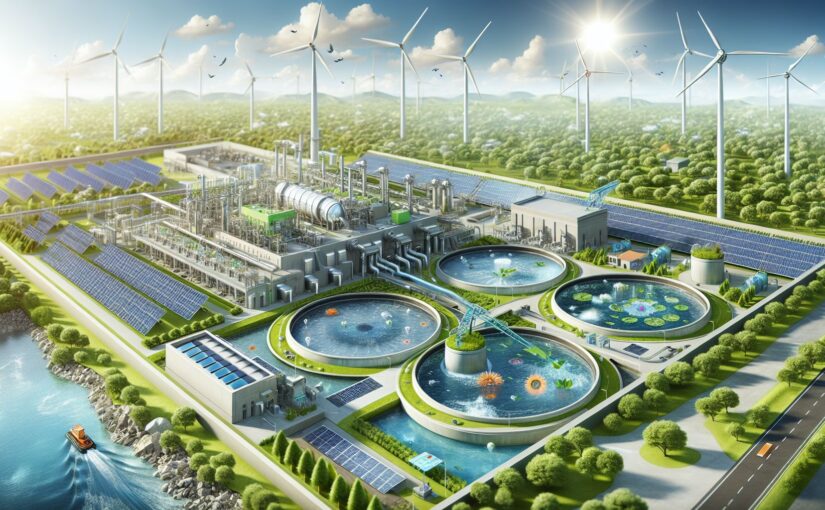
Wastewater is not typically the first thing that comes to mind when we think about renewable energy sources. However, the potential for harnessing energy from wastewater is significant and offers an innovative solution to both waste management and renewable energy generation. In this article, we will explore the concept of generating renewable energy from wastewater, focusing on the processes, technologies, and benefits that are associated with this sustainable approach.
Introduction to Wastewater as a Renewable Energy Source
Wastewater contains a substantial amount of organic matter, which can be broken down by bacteria to release energy. The process of treating wastewater, while traditionally energy-intensive, has undergone significant advancements with the emergence of technologies that can recover energy from waste. Among the most notable are microbial fuel cells (MFCs), which can convert the chemical energy stored in organic waste into electricity through biological processes.
The Potential of Microbial Fuel Cells (MFCs)
Microbial fuel cells are bioelectrochemical systems that directly convert the energy of organic matter into electricity through the metabolic activities of microorganisms. These devices have two electrodes: an anode and a cathode, separated by a proton exchange membrane.
At the anode, electroactive bacteria break down organic substrates, releasing electrons and protons. The electrons are transferred to the anode, travel through an external circuit to the cathode, generating an electrical current. The protons move through the proton exchange membrane to the cathode, where they combine with the electrons and an electron acceptor (often oxygen from the air) to form water.
Benefits of Generating Renewable Energy from Wastewater
There are several benefits to using wastewater as a source of renewable energy:
-
Waste Reduction: By extracting energy from wastewater, we decrease the volume of waste that needs to be processed or disposed of.
-
Energy-Efficient Treatment: Traditional wastewater treatment facilities are energy-intensive; MFCs offer a way to treat waste while simultaneously generating energy.
-
Reducing Greenhouse Gas Emissions: MFCs can help mitigate climate change by reducing reliance on fossil fuels for electricity generation and wastewater treatment processes.
-
Water Reclamation: The treated water can often be recycled for other purposes, creating a more sustainable water management system.
-
Economic Advantage: MFCs can reduce the operational costs of wastewater treatment plants due to their energy production capabilities.
Electroactive Wastewater Bacteria: Nature’s Powerhouses
The key to the success of MFCs lies in the electroactive bacteria that drive the bioelectrochemical processes. These microorganisms are capable of oxidizing the organic compounds found in wastewater and transferring the resulting electrons to the MFC’s anode, a process known as extracellular electron transfer (EET).
Exploring the Diversity of Electroactive Bacteria
Electroactive bacteria come from various genera, including Shewanella, Geobacter, and many more. These bacteria have adapted diverse mechanisms for EET, including conductive pili called nanowires, redox proteins embedded in their membranes, and soluble electron shuttles, that help in efficient electron transfer from the cell to the electrode surface.
Exoelectrogens in Wastewater: A Detailed Look
Exoelectrogens, a subset of electroactive bacteria, are particularly adept at transferring electrons outside of their cells. They play a pivotal role in the anodic reactions of MFCs, oxidizing the organic substrates and releasing electrons to the electrode. The performance of MFCs largely depends on the activity and viability of these bacteria.
Electron Transfer Mechanisms in Wastewater
To understand how renewable energy is harvested from wastewater, it’s essential to delve into the electron transfer mechanisms at play. Electrons are carried from the bacteria to the anode through several pathways:
-
Direct Electron Transfer (DET): Some bacteria can directly contact the electrode surface, forming biofilms, and transmit electrons through membrane-bound proteins or nanowires.
-
Indirect Electron Transfer (IET): Other bacteria secrete redox-active intermediates or use externally added compounds called mediators to facilitate electron transfer to the electrode.
-
Mediator-Less MFCs (ML-MFCs): Advances in MFC technology have enabled the creation of systems where no artificial mediators are needed, thus simplifying the process and reducing costs.
Harvesting Bioelectricity from Wastewater: The Operational Principles
MFC technology captures the power of bacteria to oxidize wastewater and generate a flow of electrons. But how does this translate into usable electricity?
The Role of the Proton Exchange Membrane
The proton exchange membrane (PEM) is a critical component of MFCs. It allows protons generated at the anode to pass through to the cathode compartment while preventing the passage of electrons directly. This maintains the separation necessary for an electrical potential to be established, effectively generating current.
Understanding the Power Density and Coulombic Efficiency of MFCs
Two key performance indicators for MFCs are the power density and coulombic efficiency:
-
Power Density: Measured in watts per square meter (W/m2), refers to the amount of electrical power generated per unit area of the electrode. It provides a metric for the MFC’s electrical performance.
-
Coulombic Efficiency: This is the ratio of the total charge extracted in the form of electricity to the total charge theoretically available from the organic substrate. It measures the effectiveness of the bacteria in converting organic matter into electricity.
The Technology Behind Wastewater MFCs: Components and Materials
To optimize the performance of MFCs, significant attention is given to the development of electrode materials and the design of MFCs.
Electrode Materials: From Carbon to Catalysts
The choice of electrode material is crucial for the efficiency of MFCs. Carbon-based electrodes are widely used due to their good conductivity and biocompatibility. However, there’s been a push towards developing catalyst-coated electrodes to enhance performance and lower overpotential.
Innovative Designs: Stacked and Continuous Flow MFCs
There are varied designs for MFCs, including stacked configurations which consist of multiple MFC units connected to increase voltage output. Continuous flow systems allow for the constant input of fresh wastewater and output of treated water, making the process more appropriate for real-world wastewater treatment applications.
Scaling Up: The Journey to Commercial Viability
One of the current challenges is scaling up MFCs for industrial or municipal use. This requires overcoming technical difficulties related to size, maintaining microbial communities, and achieving cost-effective operations.
Advancements in Scaling Up MFCs
Progress in materials science, biotechnology, and engineering has led to innovations like improved electroactive biofilms, and scaled-up systems designed for continuous operation in wastewater treatment facilities.
The Challenge of Economics and Infrastructure
The transition to using MFCs on a large scale necessitates investment in new infrastructure and a demonstration of the long-term economic benefits over traditional wastewater treatment methods.
Environmental and Social Implications: A Bright Future Ahead
The implementation of MFCs for wastewater treatment and energy generation has significant environmental and societal implications. Reduced environmental impact, lower costs, and an increase in sustainable energy practices could be