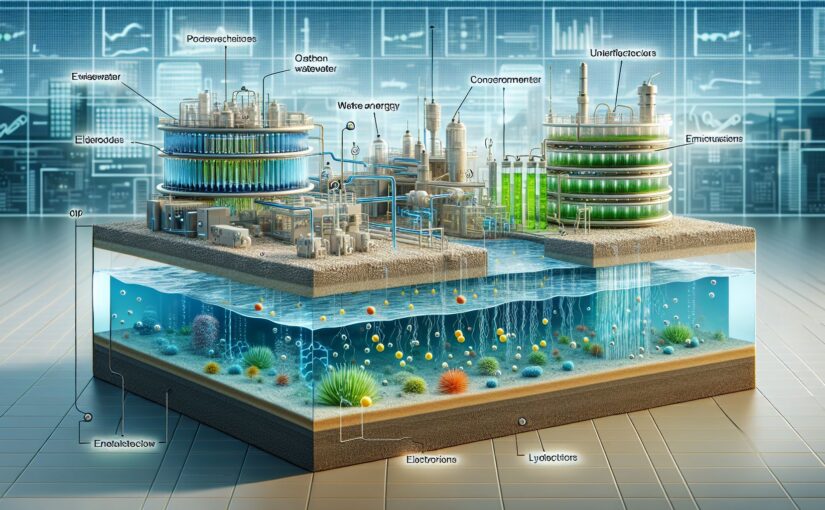
In a time where environmental sustainability is more crucial than ever, the quest for renewable energy sources continues to be a priority for researchers and industry professionals alike. One particularly fascinating area of study is the potential for converting wastewater into a valuable resource — not only cleaning it but also extracting bioelectricity in the process. This article will delve into the burgeoning field of bioelectrochemical systems, focusing specifically on the topic of generating renewable energy from wastewater.
What is Wastewater and Why Does it Matter?
Wastewater is the spent or used water from homes, businesses, and industries that has been contaminated with soluble and insoluble materials. Traditionally, the goal of wastewater treatment has been to remove harmful components and release the treated water back into the environment. However, wastewater also contains organic matter that, with the right technology, can be converted into energy.
The Power Potential of Wastewater
The intrinsic energy in wastewater comes from the biochemical potential of the organic compounds it contains. Through a process called bioelectrochemical wastewater treatment, these compounds can be broken down by microorganisms, and the resulting chemical energy can be converted into electrical power.
Understanding Bioelectrochemical Systems (BES)
Bioelectrochemical Systems (BES) are a type of technology that utilize the metabolic processes of microorganisms to generate an electrical current. They are made up of two main components:
- Anode: Where the bacteria oxidize the organic matter, releasing electrons.
- Cathode: Where electrons are transferred to an electron acceptor, often oxygen, reducing it to water.
This transfer of electrons generates an electric current that can then be harnessed as a form of renewable energy.
Microbial Fuel Cells (MFCs) for Wastewater Treatment
One of the most promising applications of BES is in the form of Microbial Fuel Cells (MFCs). MFCs use bacteria to convert the chemical energy in organic compounds of wastewater directly into electricity. This happens through the interaction of the bacteria with a specially designed anode in an anaerobic (oxygen-free) environment.
Components of MFCs:
- Anode Chamber: Here, electrogenic bacteria break down the organic matter in wastewater and release electrons.
- Cathode Chamber: The electrons flow to this chamber, where they combine with oxygen and protons to form water.
- Proton Exchange Membrane: This divides the two chambers, allowing protons to pass through but not the bacteria or organic matter.
- Electrodes: These are often made of carbon-based materials and are essential for the transfer of electrons.
The result is a system that not only treats wastewater but also produces electrical energy, reducing the treatment process’s overall energy consumption.
The Role of Electroactive Wastewater Bacteria
Electroactive bacteria are the heart of MFCs. These are special types of bacteria capable of transferring electrons to external surfaces. Typical bacteria involved in MFCs are from the genera Shewanella and Geobacter. The efficiency of electron transfer is a key factor determining the amount of electricity generated.
From Bench Scale to Real World: The Challenge of Scaling Up
While laboratory-scale MFCs have demonstrated the potential of this technology, scaling up to a level suitable for municipal or industrial wastewater treatment presents several challenges, including:
- Maintaining Efficient Microbial Communities: As systems scale, controlling the health and productivity of the bacteria becomes more complex.
- Cost-Effective Materials: Creating anodes, cathodes, and proton exchange membranes that are both efficient and affordable is essential for practical applications.
- System Design: Large-scale systems must be carefully designed to handle high flow rates, diverse contaminant loads, and variations in temperature and pH.
- Regulatory and Economic Considerations: For wide adoption, the technology must be both compliant with existing regulations and economically competitive with traditional wastewater treatment processes.
Looking Forward: The Future of Wastewater as a Renewable Resource
The potential benefits of using MFCs for wastewater treatment are significant. Not only do they offer a path to renewable energy generation, but they also promise to reduce the carbon footprint and energy use of a critical yet energy-intensive public service. However, much work remains to be done in terms of optimization and practical implementation.
As the technology matures, we can envision a future where wastewater treatment plants become power generation facilities, and the extensive energy used in the treatment process becomes a thing of the past.
Sources:
-
Logan, B. E. (2009). Exoelectrogenic bacteria that power microbial fuel cells. Nature Reviews Microbiology, 7(5), 375–381. https://doi.org/10.1038/nrmicro2113
-
Rabaey, K., & Rozendal, R. A. (2010). Microbial electrosynthesis — revisiting the electrical route for microbial production. Nature Reviews Microbiology, 8(10), 706–716. https://doi.org/10.1038/nrmicro2422
-
He, Z., & Mansfeld, F. (2009). Exploring the use of electrochemical impedance spectroscopy (EIS) in microbial fuel cell studies. Energy & Environmental Science, 2(2), 215. https://doi.org/10.1039/b816647g
As a burgeoning field, the integration of renewable energy practices within wastewater treatment contends not only with technological and biological hurdles but also with the necessity of wide-scale societal and industrial adaptation. The innovative marriage of environmental cleanup with renewable energy production through bioelectrochemical systems like MFCs presents a promising horizon in our continual pursuit of sustainability. However, it is incumbent upon researchers, policymakers, and industry innovators to collaboratively advance this technology from the bench to the broad landscapes of practical and economical use, where wastewater becomes not a costly byproduct of civilization but a golden wellspring of energy for tomorrow’s world.