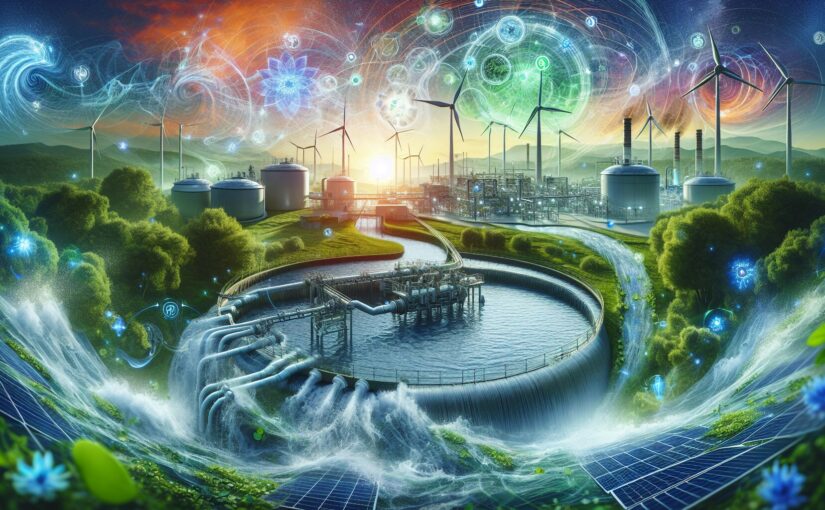
As the world grapples with the dual challenges of wastewater management and the urgent need for renewable energy sources, an innovative solution emerges from the confluence of biotechnology and environmental engineering: renewable energy from wastewater. This article delves into the transformative potential of harnessing wastewater as a resource to generate clean energy, reduce pollution, and contribute to sustainable development.
Introduction
Wastewater treatment has traditionally been a significant energy consumer and a source of environmental pollution. However, recent advancements in technology have revealed that wastewater is not merely a problem to be mitigated but a resource to be tapped. The concept of generating renewable energy from wastewater dovetails with the global movement towards sustainability and energy independence.
The Potential of Wastewater as an Energy Source
Wastewater is rich in organic material that, if properly harnessed, can be converted to bioelectricity through processes involving microbes. These bioelectrochemical systems (BES) are the cornerstone for the sustainable production of energy from wastewater.
Microbial Fuel Cells (MFCs) for Wastewater Treatment
One of the most promising technologies for extracting energy from wastewater is the Microbial Fuel Cell (MFC). MFCs utilize microorganisms to oxidize organic and inorganic matter in wastewater, producing electrons that flow through an external circuit, generating electricity (Logan, 2009).
Principle of MFCs
An MFC consists of two compartments, an anode and a cathode, separated by a proton exchange membrane. Wastewater is introduced into the anode compartment, where electroactive bacteria break down the organic matter, releasing electrons and protons. The released electrons travel via an external circuit to the cathode, generating an electric current. Meanwhile, the protons diffuse through the membrane to the cathode, where they recombine with electrons and an electron acceptor (often oxygen) to form water.
Electroactive Wastewater Bacteria
At the heart of the MFC technology are the electroactive bacteria. These microbes have the unique ability to transfer electrons outside their cell membranes to an external acceptor such as an anode (Rabaey et al., 2004). This process, known as extracellular electron transfer (EET), is the key to generating bioelectricity from wastewater.
Benefits of Renewable Energy from Wastewater
Extracting renewable energy from wastewater presents numerous benefits:
- Sustainable Energy Production: Energy generated is renewable, cutting down on fossil fuel dependency.
- Pollution Reduction: By treating wastewater and simultaneously generating energy, this approach reduces environmental pollution.
- Water Resource Management: Efficient wastewater treatment leads to water conservation and reuse.
- Cost-Effectiveness: MFCs could potentially lower the operational costs of wastewater treatment facilities.
- Carbon Footprint Mitigation: Greenhouse gas emissions from wastewater treatment can be significantly reduced.
Challenges and Future Directions
Although the idea of generating renewable energy from wastewater holds promise, there are challenges that need to be addressed:
- Scaling Up: Translating the success of lab-scale MFCs to full-scale wastewater treatment facilities.
- Economic Viability: Lowering costs and improving efficiency to compete with conventional energy sources.
- Technological Advancements: Continuous innovation in MFC design, materials, and processes is necessary.
Optimization of MFC Performance
Efficient electron transfer mechanisms and electrode materials are critical for enhanced MFC performance. Carbon-based electrodes and catalyst-coated electrodes are explored for their conductive and catalytic properties (Santoro et al., 2017).
Integration with Renewable Energy Systems
Wastewater MFCs could be integrated with other renewable energy systems such as solar or wind farms to provide a more consistent and robust power output.
Policy and Regulatory Frameworks
Supportive government policies and regulations are essential to encourage investment and research in renewable energy from wastewater.
Conclusion
The prospect of generating renewable energy from wastewater represents an exciting frontier in the quest for sustainable and clean energy sources. By exploiting the untapped potential of wastewater, we can address key environmental issues related to waste management and energy production. With continued research, development, and policy support, this innovative approach has the potential to revolutionize how we think of wastewater, transforming it from waste to wealth.
In conclusion, renewable energy from wastewater isn’t just a pipe dream but a tangible solution marrying environmental stewardship with pioneering technology. Microbial fuel cells are at the forefront of this revolution, with the promise of a cleaner, energy-independent future grounded on the principles of sustainability and innovation. As the technology matures and overcomes current limitations, it’s not hard to envision a world where every wastewater treatment plant not only protects our waterways but also contributes power to our electric grid.