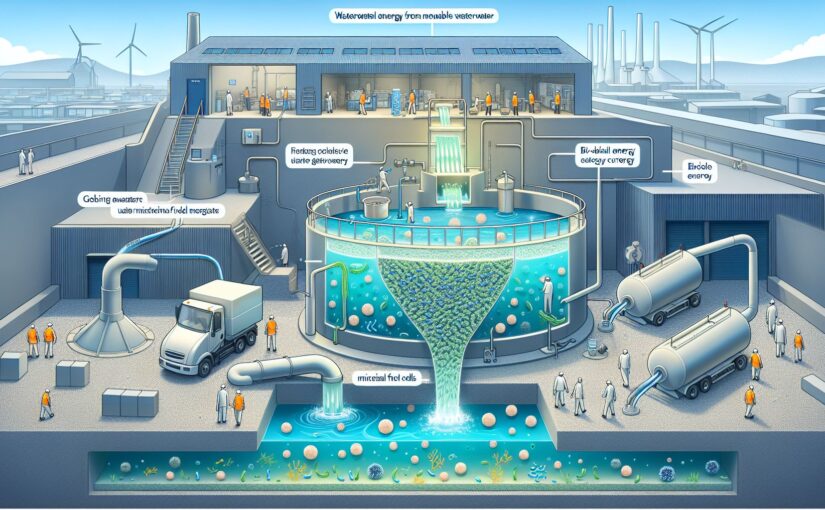
In our relentless quest for sustainability and green energy sources, wastewater treatment emerges as a surprising but fertile ground. The concept of deriving clean energy from wastewater, once a far-fetched dream, is now under the scientific spotlight, thanks to burgeoning technologies like Microbial Fuel Cells (MFCs). This article delves into the realm of renewable energy generation through the innovative use of microbial fuel cells, turning waste into wattage with a surprising twist.
Introduction
Wastewater treatment plants are typically energy-intensive facilities, consuming significant amounts of power to ensure that water is clean and safe for discharge or reuse. However, within this dirty water lies a potential goldmine of untapped energy. Microbial fuel cells (MFCs) present an elegant solution to recover this energy, transforming waste into valuable electricity.
MFC technology exploits the natural processes of certain microbes that can oxidize organic matter in wastewater, producing electrons as a by-product. These electrons, when properly harvested, can generate electricity, thus providing a sustainable energy source while simultaneously treating wastewater.
The Microbial Fuel Cell: An Overview
A microbial fuel cell is a bio-electrochemical system that drives a current by mimicking bacterial interactions found in nature. MFCs consist of an anode and a cathode, separated by a proton exchange membrane (PEM). The anode-respiring bacteria (ARB) oxidize the organic matter, releasing electrons and protons. Electrons flow through an external circuit to the cathode, while protons pass through the PEM, generating electric current.
Electroactive Wastewater Bacteria
Central to the functioning of MFCs are the electroactive bacteria that act as catalysts for substrate degradation. These bacteria, such as Shewanella and Geobacter species, are capable of transferring electrons obtained from the oxidation of organic matter directly to an electrode. This unique ability is critical because it eliminates the need for mediators—chemicals that transport electrons, which can be costly and potentially toxic.
Exoelectrogens in Wastewater
Exoelectrogens are a subset of electroactive bacteria that particularly excel at extracellular electron transfer (EET). They efficiently export electrons out of their cell membranes, contributing significantly to the overall electricity generation in an MFC. Understanding and optimizing the conditions that favor the growth and activity of exoelectrogens is a crucial aspect of enhancing MFC performance.
Renewable Energy from Wastewater
The renewable aspect of MFCs arises from the constant influx of wastewater as fuel, containing organic compounds that bacteria metabolize. The bioelectrochemical process inside an MFC is carbon-neutral, assuming the organic matter processed is of biological origin. This translates to an energy-positive wastewater treatment process, potentially reducing the carbon footprint of treatment plants.
Technical Aspects of MFCs
To appreciate how MFCs can be a game-changer in wastewater management and renewable energy production, it’s essential to understand their technical components and the challenges faced in scaling them up.
Proton Exchange Membrane in Wastewater MFCs
The proton exchange membrane is a vital component of MFCs as it allows protons (H+) to pass from the anode to the cathode compartment while preventing the passage of electrons and bacteria. The efficiency of MFCs depends on the properties of the PEM, including its conductivity, selectivity, and durability. While Nafion is commonly used, research into alternative, cost-effective materials is ongoing.
The Electrode Materials
The choice of electrode materials is pivotal for the efficiency and economic viability of MFCs.
-
Carbon-Based Electrodes: Carbon materials are widely preferred due to their high conductivity, chemical stability, and relatively low cost. Options include carbon cloth, carbon fiber, and graphite.
-
Catalyst-Coated Electrodes: The anode may be coated with catalysts to enhance the bacteria-electrode interaction and improve electron transfer rates. These coatings can be made from precious metals like platinum or more sustainable alternatives like biochar or conductive polymers.
Electron Transfer Mechanisms in MFCs
Understanding how electrons are transferred from bacteria to the electrode is critical. Electron transfer can occur directly, through cell surface proteins known as cytochromes, or indirectly, using soluble redox mediators secreted by the bacteria. Enhancing this transfer is key to improving MFC efficiency.
Power Density and Coulombic Efficiency
-
Power Density: This refers to the amount of electrical power produced per unit volume of an MFC. High power densities are desirable for practical applications, and optimizing design parameters can help achieve this.
-
Coulombic Efficiency: Coulombic efficiency measures the proportion of electrons recovered as electrical current from the total available in the substrate. Higher coulombic efficiencies indicate a more effective system, but practical MFCs typically have a trade-off between power output and coulombic efficiency.
Polarization Curve in Wastewater MFCs
A polarization curve is a graphical representation of the MFC’s performance, showing the relationship between current density and cell voltage. It helps in understanding the losses in the system and the optimal operating conditions for maximum power output.
Scale-Up Challenges and Innovations
While the concept of MFCs is promising, there are numerous challenges to overcome before they can be implemented on a large scale.
Scaling Up MFCs
Scaling up MFCs to treat large volumes of wastewater remains challenging due to cost implications and maintaining performance efficiencies. Some of the strategies being explored include:
- Stacked MFCs: Multiple MFC units are connected in series or parallel to enhance the treatment capacity and energy recovery.
- Continuous Flow MFCs: Designing reactors where wastewater flows continuously through the MFC can increase efficiency and is more representative of real wastewater treatment processes.
- Sediment MFCs: These leverage natural sediments as the anode, potentially useful for remote areas with limited infrastructure.
Innovations in MFCs
Innovation is key to propelling MFC technology forward. One such innovative approach is the integration of MFCs with other biological processes to form hybrid systems, such as bioelectrochemical systems combined with anaerobic digestion. These hybrids can maximize energy recovery and minimize residual waste.
Environmental and Economic Implications
Bioremediation Using MFCs
MFCs can be employed not just for energy generation but also as a tool for bioremediation. They can break down pollutants, including recalcitrant organic compounds and heavy metals, thereby cleaning the environment while generating electricity.
Renewable Energy and Sustainability
The use of MFCs to treat wastewater aligns with sustainable development goals. It presents a circular approach to waste management, where waste products are converted into something valuable—clean water and electricity. The generation of bioelectricity from wastewater closes the loop, emphasizing the waste-to-energy concept.
Future Perspectives
The future of MFC technology in wastewater treatment looks bright, with ongoing research focused on improving efficiencies, reducing costs, and integrating these systems into existing infrastructure. Wastewater treatment plants equipped with MFC