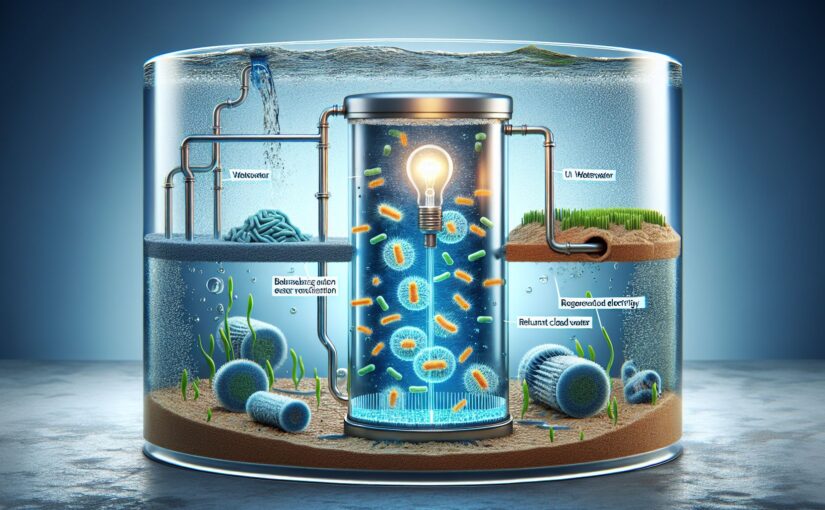
In an era where sustainability is more paramount than ever, the intersection of waste management and energy production represents a critical frontier in the quest for renewable energy sources. One particularly fascinating avenue is the conversion of wastewater into electricity using a technology known as microbial fuel cells (MFCs). This article delves into the world of renewable energy from wastewater, exploring how MFCs work, their benefits, challenges, and their potential in today’s energy landscape.
What are Microbial Fuel Cells?
Microbial fuel cells are bioelectrochemical systems that harness the power of bacteria to convert organic compounds in wastewater into electrical energy. Essentially, they operate on the principle that certain types of bacteria can oxidize organic matter and produce electrons as a byproduct. These electrons can then be captured and used as a clean energy source.
The MFC Process:
- Bacteria Oxidize Organic Matter: Electroactive bacteria break down the organic pollutants in wastewater, releasing electrons and protons in the process.
- Electron Flow: Electrons travel from the anode to the cathode through an external circuit, generating an electric current.
- Proton Exchange: Protons move towards the cathode across a proton exchange membrane.
- Water Formation: At the cathode, protons recombine with electrons and oxygen to form water.
The Potential for Renewable Energy
The concept of using wastewater as a source of energy is not entirely new, but MFC technology has reignited the interest in harnessing this seemingly inexhaustible and untapped energy source. The sustainable production of bioelectricity from wastewater could revolutionize how we think about waste treatment and energy generation.
Benefits of MFCs:
- Energy Efficiency: MFCs offer a method to extract energy from waste rather than consuming energy for its treatment.
- Carbon Neutrality: By reducing the reliance on fossil fuels for electricity production, MFCs contribute to lower carbon emissions.
- Resource Recovery: Potentially valuable byproducts, such as hydrogen or clean water, can be recovered through the MFC process.
- Scalability: MFCs can be scaled to fit various sizes, from small individual units to larger industrial systems.
Challenges Ahead
While the promise of MFCs is great, there are some hurdles to overcome before this technology becomes widespread.
Technical Hurdles:
- Efficiency: Despite progress, the power output of MFCs needs to be increased to be feasible for large-scale applications.
- Materials Cost: High-cost materials like platinum catalysts and proton exchange membranes can make MFCs expensive.
- Design Optimization: The architecture of MFCs, including electrode design and system configuration, requires further refinement for optimal performance.
Scaling Up:
Scaling MFCs from lab-scale to industrial and municipal levels presents engineering and economic challenges. Maintaining efficiency while upscaling is one of the primary obstacles.
Wastewater MFCs In Action
A variety of installations and projects around the world are demonstrating the practical potential of MFC technology.
Case Studies:
- Pilot Projects: Numerous pilot projects are underway globally, showcasing MFCs in treating domestic and industrial wastewater.
- Research Institutions: Universities and research centers are at the forefront of MFC innovation, focusing on performance optimization and cost reduction.
Looking Toward the Future
For renewable energy from wastewater to become a mainstay, research must continue to bridge the gap between theory and practical application. Collaborations between academia, industry, and governments can spur the development and adoption of MFC technologies.
Future Prospects:
- Innovation: Advanced materials and engineering solutions are likely to enhance the efficiency and decrease the costs of MFCs.
- Integration: MFCs could become a component of a hybrid renewable energy system, complementing wind and solar power.
- Policy Support: Policymakers could provide incentives for adopting wastewater-to-energy technologies, facilitating market penetration.
Conclusion
Renewable energy from wastewater via MFCs stands at the confluence of waste management and clean energy. Its potential environmental and economic benefits are significant, offering a sustainable path for both resource recovery and energy generation. With continued research and development, the dream of powering our world with this waste-derived energy could become a reality.
Sources
- Logan, B. E., & Regan, J. M. (2006). Electricity-producing bacterial communities in microbial fuel cells. Trends in Microbiology, 14(12), 512-518.
- Rabaey, K., & Verstraete, W. (2005). Microbial fuel cells: novel biotechnology for energy generation. Trends in Biotechnology, 23(6), 291-298.
- Pant, D., Van Bogaert, G., Diels, L., & Vanbroekhoven, K. (2010). A review of the substrates used in microbial fuel cells (MFCs) for sustainable energy production. Bioresource Technology, 101(6), 1533-1543.
Using the Markdown format, the article follows a structured approach, presenting a topic that is not only technically informative but also directly relevant to the pressing issue of sustainable energy. By addressing the operation of MFCs and focusing on the promise they hold for renewable energy, this article bridges scientific understanding and practical insight, appealing to a wide range of readers interested in the future of energy and the environment.