The intersection of renewable energy and wastewater treatment represents a field laden with potential for sustainable practices. Among the various technologies under investigation, Microbial Fuel Cells (MFCs) are emerging as a revolutionary approach not only for treating wastewater but also for generating bioelectricity. This article takes a deep dive into the principles and advancements of Microbial Fuel Cells for wastewater treatment, their ability to produce renewable energy, and the potential for integrating this technology into existing infrastructure.
What are Microbial Fuel Cells (MFCs)?
Microbial Fuel Cells (MFCs) are bioelectrochemical systems that harness the power of electroactive bacteria to convert organic matter in wastewater into electrical energy. They are composed of two half-cells, an anode and a cathode, separated by a proton exchange membrane. At the anode, bacteria oxidize the organic substrate, releasing electrons and protons in the process. Electrons flow through an external circuit to the cathode, generating electric current, while protons move through the membrane to the cathode compartment to recombine with electrons and a final electron acceptor, usually oxygen, to form water.
Principles of MFC Operations
-
Anode Respiring Bacteria: At the heart of this process are anode-respiring bacteria, which are capable of transferring electrons to the anode. These bacteria utilize various electron transfer mechanisms to accomplish this, including direct transfer via cytochromes and indirect transfer using mediators.
-
Proton Exchange Membrane: A critical component of MFCs, the proton exchange membrane allows protons to migrate while preventing the mixing of reactants in the anode and cathode compartments, which preserves the efficiency of the fuel cell.
-
Electron Transfer Mechanisms: The mechanisms of electron transfer within MFCs can be complex and varied. Extracellular electron transfer, as one such mechanism, allows bacteria to pass electrons directly or indirectly to the anode, initiating the electrochemical process.
The Benefits of Using MFCs in Wastewater Treatment
Microbial fuel cells offer several advantages over conventional wastewater treatment methods:
-
Energy Production: MFCs can, in principle, generate electricity while degrading organic pollutants, thereby transforming waste treatment plants from energy consumers into energy producers.
-
Reduced Sludge Production: They typically produce less sludge compared to other biological treatment methods, which translate into lower disposal costs.
-
Low Energy Input: MFCs operate at ambient temperature and atmospheric pressure, reducing the energy requirement for aeration and mixing.
-
Bioremediation: They can be used to remove a wide range of pollutants including nitrogen and phosphorus, heavy metals, and emerging contaminants.
Renewable Energy from Wastewater: The Potential of MFCs
The concept of generating electricity while treating wastewater opens doors to a new paradigm in sustainable energy and waste management:
-
Bioelectricity Generation from Wastewater: By harvesting the chemical energy in wastewater, MFCs can produce renewable energy in the form of bioelectricity. This could potentially be used on-site to power monitoring equipment or, if produced in sufficient quantities, could contribute to the energy grid.
-
Scaling Up MFCs: While MFCs have proven effective at laboratory scales, scaling up poses significant challenges. Current research focuses on optimizing design, materials, and operational conditions to make them financially and technically viable for larger-scale applications.
Design Specifications and Innovations in MFCs
A variety of designs and configurations can affect the output and efficiency of MFCs:
-
Electrode Materials: The performance of MFCs significantly depends on the materials used for the electrodes. While carbon-based electrodes are popular for their conductivity and biocompatibility, research into catalyst-coated electrodes aims at enhancing the power output.
-
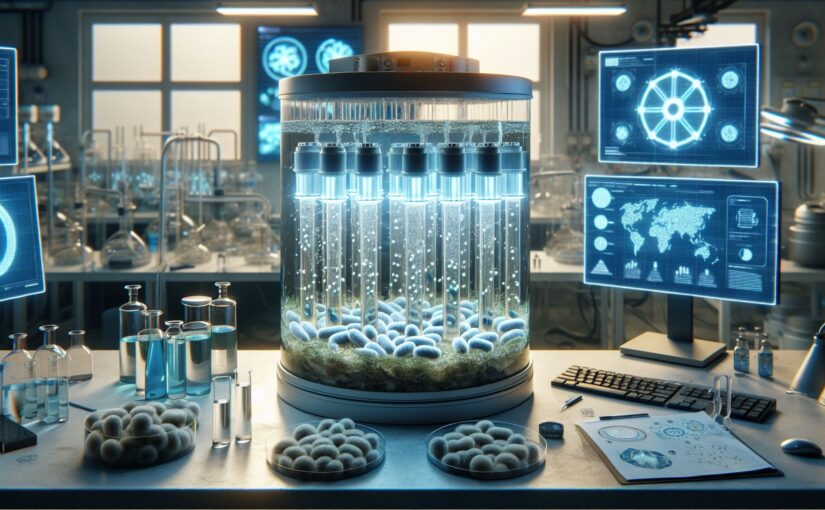
Stacked MFCs: Stacking multiple MFC units increases the surface area for biofilm formation and electron transfer, potentially amplifying the power output. Stacked configurations, however, require careful management to balance the resistance and other operational parameters.
-
Continuous Flow MFCs: A continuous flow design ensures a steady supply of nutrients to the microorganisms and the removal of byproducts, key factors in increasing efficiency and the practicality for real-world applications.
Challenges and Future Research Directions
While the potential of MFCs is considerable, the technology still faces several challenges:
-
Power Density and Coulombic Efficiency: Power density and Coulombic efficiency are critical measures of an MFC’s performance. Advances in biotechnology and materials science are needed to boost these metrics to feasible levels.
-
Sustainable Membrane Alternatives: Proton exchange membranes are costly and tend to be chemical-specific. Developing affordable and versatile membrane materials is a priority for making the technology more accessible.
-
Real-World Implementation: Integrating MFCs into existing wastewater infrastructure requires not just technological advancements but also regulatory acceptance and economic incentives.
Conclusion
Microbial Fuel Cells stand at the cutting edge of a wastewater treatment revolution, promising a future where our treatment facilities contribute to energy independence and sustainability. Combining the biological process of waste degradation with the generation of renewable energy, MFCs embody a multidisciplinary achievement with far-reaching impacts on both environmental stewardship and energy policy.
As we look towards a cleaner and more sustainable future, technologies like MFCs that straddle the line between waste management and renewable energy production will play a pivotal role. As research progresses, we can expect to see MFCs evolve to become a critical component of our energy and waste treatment infrastructures.
Sources:
- Logan, B. E. (2008). Microbial Fuel Cells. John Wiley & Sons.
- Rabaey, K., & Rozendal, R. A. (2010). Microbial electrosynthesis — revisiting the electrical route for microbial production. Nature Reviews Microbiology, 8(10), 706-716.
- The U.S. Department of Energy’s Office of Energy Efficiency and Renewable Energy (EERE) – Energy Basics. [https://www.energy.gov/eere/energybasics/energy-basics]