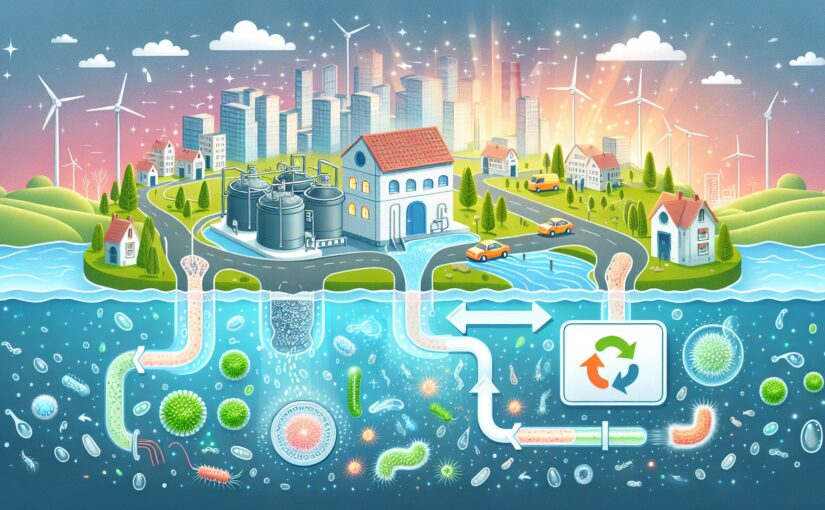
Wastewater treatment is a critical issue globally, as it involves the removal of harmful contaminants from water before it’s released back into the environment. Traditional wastewater treatment methods are energy-intensive and contribute significantly to greenhouse gas emissions. However, with increasing focus on sustainable solutions, there is a rising interest in alternative methods such as Microbial Fuel Cells (MFCs) for wastewater treatment. MFCs offer a promising approach to not only purify water but also generate renewable energy in the process. This article explores the potential of microbial fuel cells for wastewater treatment and how they can contribute to a more sustainable future.
What are Microbial Fuel Cells (MFCs)?
Microbial Fuel Cells are bio-electrochemical systems that leverage the natural process of bacterial metabolism to convert organic matter in wastewater directly into electrical energy. Through the activities of electroactive bacteria, these cells facilitate the transfer of electrons from the organic matter to an electrode, thereby generating electricity.
The Mechanism of MFCs in Wastewater Treatment
The process of wastewater treatment via MFCs hinges on the principle of extracellular electron transfer (EET). EET occurs when electroactive bacteria, also known as exoelectrogens, oxidize organic compounds and transfer the resulting electrons to the anode of the fuel cell. The electrons flow through an external circuit to the cathode, where they combine with protons and an electron acceptor (often oxygen) to form water. This electron flow constitutes an electrical current that can be harnessed for power.
The Role of Electroactive Wastewater Bacteria
Electroactive bacteria are the keystone species in MFCs that carry out EET. These bacteria are capable of using the anode as a terminal electron acceptor in the absence of oxygen, which is limited or absent in the anodic compartment of an MFC. The most well-studied genera of anode-respiring bacteria are Shewanella and Geobacter, both of which exhibit a remarkable ability to transfer electrons to solid surfaces outside of their cells.
Mediator-Less vs Mediator-Based Wastewater MFCs
MFC technology can be categorized into two types: mediator-less and mediator-based systems. Mediator-less MFCs rely on the direct contact of bacteria with the electrode or the use of bacterial nanowires for electron transfer. Mediator-based systems, on the other hand, use chemical compounds that shuttle electrons from bacteria to the electrode. While mediator-less systems are more sustainable and cost-effective due to the elimination of synthetic mediators, mediator-based systems can be useful in certain scenarios where direct bacterial contact is not feasible.
Key Components of an MFC
-
Anode – The anode is the site of oxidation where bacteria transfer electrons. Materials for anodes must be biocompatible, conductive, and provide a large surface area for microbial attachment. Carbon-based electrodes, such as graphite and carbon cloth, are commonly used.
-
Cathode – At the cathode, reduction reactions occur. Cathodes may be catalyst-coated to lower the activation energy required for the reduction of the electron acceptor.
-
Proton Exchange Membrane (PEM) – The PEM separates the anode and cathode compartments, allowing protons to transfer from the anode to the cathode while preventing oxygen from reaching the anode.
-
Electrolyte – A medium that facilitates ionic conductivity between the anode and cathode.
Performance Metrics of Wastewater MFCs
Several parameters are crucial in evaluating the performance of MFCs:
- Power Density – The amount of power produced per unit volume of the reactor or per unit surface area of the electrode.
- Coulombic Efficiency – The percentage of electrons from oxidized substrate that translates into current.
- Polarization Curve – A plot used to analyze the performance of MFCs, indicating the relationship between the current density and cell voltage.
Critical Factors Influencing MFC Efficiency
The success of an MFC in wastewater treatment is dictated by various factors:
- The nature and concentration of the wastewater substrate
- The characteristics of the microbial community
- The materials and configuration of the electrodes
- The design of the MFC, such as the use of stacked or continuous flow systems
- The operating conditions, including pH, temperature, and hydraulic retention time
Scaling Up MFC Technology
While MFCs have been successful on a laboratory scale, scaling up to practical applications poses significant challenges. These include ensuring consistent performance, lowering the costs of electrode and PEM materials, and integrating MFCs with existing wastewater treatment infrastructure. However, continuous flow and stacked MFCs offer pathways to increase the scalability and energy recovery efficiency of the technology.
The Path Forward for Renewable Energy from Wastewater
MFCs not only hold the promise for sustainable wastewater treatment but could also contribute as a renewable energy source with minimal environmental impact. By harnessing bioelectricity from wastewater, MFCs can offset the energy required for wastewater processing and lead us towards a net-zero energy wastewater treatment paradigm.
Conclusion
Microbial Fuel Cells represent an exciting frontier in both wastewater treatment and renewable energy generation. With continued research and development, the barriers to large-scale implementation may be overcome, leading to significant environmental and economic benefits. MFCs exemplify the type of clean technology that could transform our approach to managing waste and energy resources in the future.
References
-
Logan, B. E. (2009). Exoelectrogenic bacteria that power microbial fuel cells. Nature Reviews Microbiology, 7(5), 375-381. https://doi.org/10.1038/nrmicro2113
-
Rabaey, K., & Verstraete, W. (2005). Microbial fuel cells: novel biotechnology for energy generation. Trends in Biotechnology, 23(6), 291-298. https://doi.org/10.1016/j.tibtech.2005.04.008
-
He, Z., & Mansfeld, F. (2009). Exploring the use of electrochemical impedance spectroscopy (EIS) in microbial fuel cell studies. Energy & Environmental Science, 2(2), 215-219. https://doi.org/10.1039/B816647A