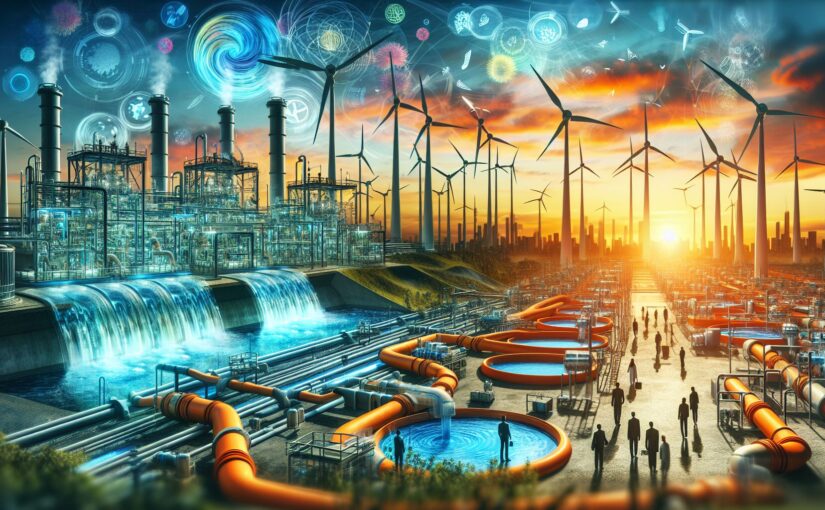
In recent years, the drive towards sustainable and renewable energy sources has become paramount. Amidst the plethora of alternatives to fossil fuels, an exciting and innovative approach stands out: renewable energy from wastewater. How can the wastewater that flows beneath our cities be a source of clean energy? This article dives deep into the technologies that enable this transformation and how they could revolutionize the way we think about waste, energy, and sustainability.
Table of Contents
- Introduction
- Understanding Wastewater and Its Potential
- Microbial Fuel Cells (MFCs) for Wastewater Treatment
- Electroactive Bacteria in Wastewater
- The Role of Bioanodes and Biocathodes
- The Science Behind Generating Bioelectricity
- Extracellular Electron Transfer
- Mediator-based vs. Mediator-less MFCs
- Advancements and Challenges in MFC Technology
- Electrode Materials and Design
- Scaling Up MFCs for Practical Use
- Environmental and Economic Benefits
- Future Prospects and Research Directions
- Conclusion
- References
Introduction
The concept of turning waste into energy is hardly new, but wastewater, often seen as a burden to be treated and disposed of, holds unexpected promise. Wastewater treatment plants are energy-intensive, but by harnessing the chemical energy contained within the waste through cutting-edge technology, they have the potential to not only self-sustain but also contribute energy to the grid.
Understanding Wastewater and Its Potential
Wastewater is laden with organic matter. When this matter degrades, it releases energy that can be harnessed. The traditional treatment processes, while effective for cleaning water, overlook the energy potential. Renewable energy from wastewater uses microbial fuel cells (MFCs) to tap into this reservoir of energy by using microorganisms that consume organic compounds and release electrons in the process.
Microbial Fuel Cells (MFCs) for Wastewater Treatment
MFC technology exploits the natural processes of certain bacteria to clean wastewater while simultaneously generating electricity. These systems involve a unique biological and chemical interface where the treatment of wastewater is combined with the production of energy.
Electroactive Bacteria in Wastewater
Electroactive bacteria are at the heart of MFCs. They are capable of transferring electrons outside their cell membranes during the metabolic breakdown of organic pollutants. These bacteria live on the anode surface of the MFC and constitute what is known as a biofilm.
The Role of Bioanodes and Biocathodes
In MFCs, the anode chamber holds the bioanode, where bacteria oxidize the organic matter and release electrons, while the biocathode, often in a separate chamber, is where electrons reduce oxygen to form water. Proton exchange membranes or other separators are typically used to ensure ionic connectivity and prevent oxygen from reaching the anode.
The Science Behind Generating Bioelectricity
To understand how electricity is generated, one needs to delve into the microbial and electrochemical processes occurring within MFCs. These processes are governed by intricate mechanisms of electron transfer.
Extracellular Electron Transfer
The extraction of electrons from organic matter is conducted through extracellular electron transfer (EET). Bacteria transfer these electrons to the anode, either via direct contact through conductive pili known as nanowires or through soluble mediators that shuttle electrons.
Mediator-based vs. Mediator-less MFCs
Mediators are sometimes added to MFCs to facilitate electron transfer. However, mediator-based systems can be cost-prohibitive and complex. On the other hand, mediator-less MFCs are more sustainable, relying on the natural abilities of bacteria to transfer electrons directly to the electrode.
Advancements and Challenges in MFC Technology
Research and development in MFC technology are paving the way for scalability and practical applications, from the materials used to the architecture of the cells themselves.
Electrode Materials and Design
Recent progress in electrode materials, such as carbon-based or catalyst-coated electrodes, has enhanced electron transfer rates and improved the efficiency of MFCs. Innovative configurations like stacked or continuous flow MFCs have also shown promise in increasing power output.
Scaling Up MFCs for Practical Use
One of the key challenges facing MFCs is scaling up from laboratory to industrial applications. Efforts to construct larger systems while maintaining high efficiencies are crucial for this technology to become mainstream for wastewater treatment and energy production.
Environmental and Economic Benefits
The implementation of MFC technology in wastewater treatment can significantly reduce the carbon footprint of wastewater plants and lead to energy-positive treatment processes. Furthermore, the low operational costs and production of clean energy present a compelling economic case.
Future Prospects and Research Directions
The potential for MFCs to contribute to sustainable energy solutions is vast. Ongoing research is focused on improving power densities, coulombic efficiencies, and furthering our understanding of electron transfer mechanisms. Technologies like microbial electrolysis and desalination cells offer additional avenues for energy recovery and resource extraction from wastewater.
Conclusion
Renewable energy from wastewater is an exciting frontier in sustainability. With further research and development, MFCs could transform our approach to both wastewater treatment and energy production, creating systems that not only protect the environment but actively regenerate it.
References
- Logan, B.E., & Regan, J.M. (2006). Electricity-producing bacterial communities in microbial fuel cells. Trends in Microbiology, 14(12),