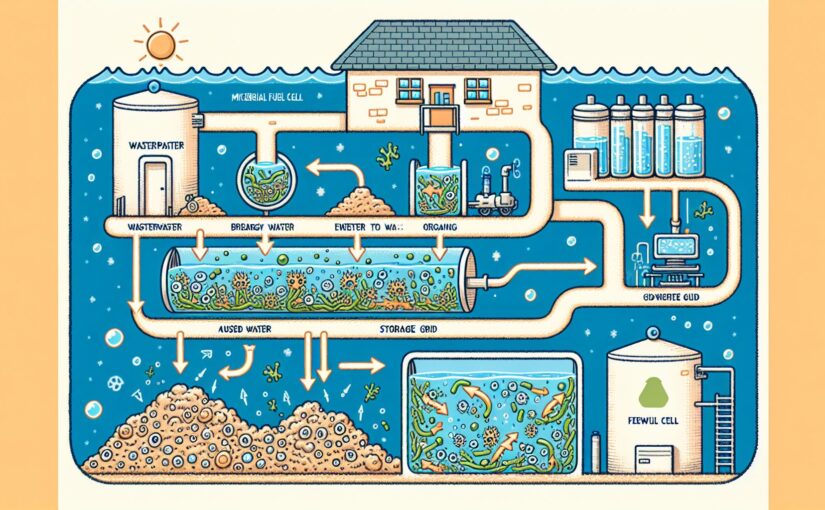
The constant search for renewable energy sources is more pressing than ever as concerns about the environmental impact of fossil fuels and the security of energy supplies increase. Remarkably, an invaluable resource is being reconsidered as a potential ally in this quest—wastewater. Not only is wastewater abundant and systematically produced, but it also harbors the potential to be converted into bioelectricity through the application of microbial fuel cell (MFC) technology. This article delves into the promising realm of renewable energy from wastewater, focusing on the potential of MFCs as a sustainable, clean, and efficient way to generate electricity.
Understanding Microbial Fuel Cells (MFCs)
Microbial fuel cells are bio-electrochemical systems that harness the ability of microorganisms to convert organic compounds into electrical energy. This process occurs in two main parts of the MFC: the anode and the cathode compartments, which are typically separated by a proton exchange membrane (PEM). As bacteria consume organic matter in wastewater, electrons are transferred to the anode, flow through an external circuit to the cathode, and ultimately reduce oxygen to form water, generating a flow of electricity in the process[^1^].
The Mechanism Behind MFCs
MFCs rely on electroactive bacteria—organisms capable of transferring electrons to an anode as part of their metabolic process. These electrons arise from the breakdown of organic matter in the wastewater; the anode, acting as an electron acceptor, makes this process energetically favorable for the bacteria. Meanwhile, protons are transferred across the PEM to the cathode side, where they combine with the electrons that have completed the circuit and with oxygen (the typical final electron acceptor) to create water. This process can be summarized in a simplified reaction:
Anode side reaction: Organic matter + Bacteria → CO2 + Protons + Electrons
Cathode side reaction: O2 + Protons + Electrons → H2O
The potential difference created by the electron flow from the anode to the cathode is what generates the electric current.
Advantages of Generating Renewable Energy from Wastewater
The potential benefits of generating renewable energy from wastewater using MFCs are substantial:
- Sustainability: Wastewater is constantly generated from domestic, industrial, and agricultural activities. By converting it into clean energy, MFCs could provide a steady energy source while also helping manage waste.
- Clean Energy: The electricity generated is virtually pollution-free, especially when compared to conventional fossil fuel sources.
- Simultaneous Waste Treatment: As a side benefit, the organic pollutants in wastewater are broken down in the MFC, thereby providing a form of treatment.
- Low Operational Costs: MFCs have the advantage of operating at ambient temperatures and pressures, which can lead to reduced operational costs.
- Versatility: They can be tailored to various scales and different types of wastewater sources, making them a flexible option for energy generation[^2^].
Challenges of Scaling Up MFCs
Despite the exciting prospects MFCs offer for renewable energy production and wastewater treatment, several challenges need to be addressed to make the technology more viable on a larger scale:
- Power Density and Coulombic Efficiency: The power output and efficiency of MFCs currently lag behind conventional power sources. Improving the power density (the power generated per unit volume of the reactor) and coulombic efficiency (the percentage of electrons recovered from the substrate as electric current) is key to making MFCs more competitive.
- Materials and Cost: The cost of electrode materials and the proton exchange membrane can be prohibitive. A focus on inexpensive and efficient materials, such as carbon-based electrodes, is necessary for practical applications.
- Design Limitations: Scaling up involves not only increasing the size but also optimizing configurations like stacked or continuous flow MFCs to ensure efficient waste treatment and electricity generation.
- Electrode Degradation: Over time, the performance of the electrodes can diminish through biofouling or material degradation. Therefore, finding durable materials and design solutions is important.
- Regulatory and Market Challenges: The adoption of MFC technology for large-scale applications is also hindered by regulatory, market, and public perception issues. Bridging the gap between science, policy, and societal acceptance is vital.
The Path Forward for MFCs in Wastewater Treatment
To harness the full potential of MFCs in generating renewable energy from wastewater, researchers and engineers must continue to tackle the various scientific and technological hurdles. Some of the most promising research directions include:
- Enhancing Electrode Performance: Work on developing high-performance, low-cost electrode materials that can increase the rate of electron transfer and resist fouling.
- Optimizing Microbial Consortia: Selecting or engineering bacterial strains that have higher metabolic rates and can thrive in the MFC environment to improve efficiency.
- Design Innovation: New MFC configurations, such as stacked or sediment MFCs, might provide better performance and scalability.
- Process Integration: MFCs can potentially be integrated with other treatment processes, such as microbial electrolysis cells or microbial desalination cells, for added value.
- Pilot Projects: Implementing pilot projects can demonstrate feasibility and help refine the technology for real-world applications[^3^].
Given the increasing demand for sustainable energy and the critical need for effective wastewater treatment, MFC technology provides a compelling intersection of environmental engineering and renewable energy. By addressing the remaining challenges, microbial fuel cells could become a cornerstone of modern waste management, water conservation, and clean energy production.
Conclusion
Wastewater is no longer merely a byproduct of human activity to be disposed of but a resource ripe with possibilities. Microbial fuel cells offer a window into a future where wastewater treatment and the generation of renewable energy go hand in hand, providing a synergistic solution to two of society’s most pressing issues. As this technology continues to develop, it could play a pivotal role in the sustainability strategies of communities and industries around the globe.
Sources
[^1^]: Logan, B. E., & Regan, J. M. (2006). Microbial fuel cells—challenges and applications. Environmental Science & Technology, 40(17), 5172-5180.
[^2^]: Pant, D., Van Bogaert, G., Diels, L., & Vanbroekhoven, K. (2010). A review of the substrates used in microbial fuel cells (MFCs) for sustainable energy production. Bioresource Technology, 101(6), 1533-1543.
[^3^]: He, Z., & Mansfeld, F. (2009). Exploring the use of electrochemical impedance spectroscopy (EIS) in microbial fuel cell studies. Energy & Environmental Science, 2(2), 215-219.