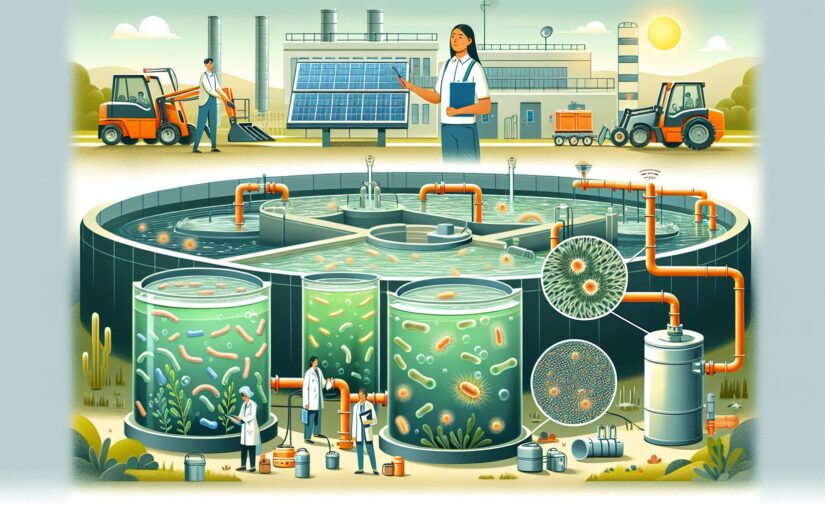
In the quest for sustainability and cleaner technologies, wastewater treatment stands out as an essential area of research. Traditional methods of treating wastewater are often energy-intensive and can be environmentally costly. However, the rise of innovative approaches such as Microbial Fuel Cells (MFCs) offers a glimmer of hope. MFCs do not just hold the potential to treat wastewater effectively, but also to produce electricity in the process. This merging of waste treatment and energy generation has captured the interest of scientists and engineers worldwide. In this extensive review, we will delve into the fascinating world of MFCs, their roles in wastewater treatment, and their potential contribution to renewable energy production.
What Are Microbial Fuel Cells?
Microbial fuel cells (MFCs) are bio-electrochemical systems that use bacteria as the catalysts to convert organic matter into electrical energy. This conversion process takes places in a two-chamber cell divided by a proton exchange membrane (PEM). In the anodic chamber, bacteria metabolize the organic compounds found in wastewater, releasing electrons and protons in the process. Electrons travel through an external circuit to the cathodic chamber, while protons pass through the PEM, generating an electric current.
The Anode and Cathode Chambers
There are several components and reactions in MFCs that need to be understood:
-
Wastewater Bioanode: At the anode, electroactive wastewater bacteria oxidize organic matter. This oxidation releases electrons and protons and is facilitated by particular bacteria known as anode respiring bacteria.
-
Wastewater Biocathode: At the cathode, the electrons and protons combine with oxygen from the air (or another oxidizing agent in the solution) to form water or other byproducts. Here, microbes are not typically involved unless specific biocathode reactions are designed.
The Role of Proton Exchange Membranes
The PEM is critical to the function of MFCs in wastewater. It allows protons to move to the cathode but blocks electrons, forcing them to flow through an external circuit – this flow is what we capture as electricity.
Electron Transfer Mechanisms in Wastewater
The electron transfer mechanism is central to the function of MFCs. Bacteria transfer electrons to the anode through:
-
Direct Transfer: Where bacteria attach to the anode and pass the electrons directly to the electrode surface.
-
Indirect Transfer: Mediator molecules, either naturally produced or added, shuttle electrons from bacteria to the anode, hence the terms mediator-less and mediator-based MFCs.
Extracellular Electron Transfer
Extracellular electron transfer (EET) is a process where electroactive bacteria move electrons outside of their cell membranes. This is key for the functioning of MFCs, as it allows the electronic communication between bacteria and electrodes.
Wastewater Treatment Using MFCs
Wastewater Substrate Degradation
When wastewater is used as the substrate in MFCs, the organic matter serves as the fuel. Here’s how it works:
- Bacteria consume organic compounds in wastewater, breaking them down into simpler molecules.
- This metabolic process releases electrons, which bacteria then transfer to the anode.
- The PEM allows these released protons to pass into the cathodic chamber while electrons flow through the circuit.
- Electrons, upon reaching the cathode, combine with the protons and oxygen to form water.
Advantages of MFCs in Wastewater Treatment
- Renewable Energy Production: MFCs can produce bioelectricity from wastewater components, contributing to a circular economy.
- Reduction of Sludge Production: MFCs typically generate less sludge during wastewater treatment, reducing disposal problems.
- Low Energy Requirement: MFCs function at ambient temperatures and pressures, reducing the energy burden of wastewater treatments.
- Elimination of Harmful Discharges: MFCs can help reduce the discharge of harmful byproducts into the environment.
Technical Challenges and Research Progress
Despite the promise that MFCs hold, several challenges exist:
-
Power Density and Coulombic Efficiency in Wastewater MFCs: While MFCs can produce electricity, the power density (the rate of power production per unit volume) and coulombic efficiency (a measure of how effectively electrons are captured as electrical current) is often lower than needed for practical applications.
-
Electrode Materials: The search for cost-effective, highly conductive, and biocompatible electrode materials is ongoing. While carbon-based electrodes are popular, research into catalyst-coated electrodes is advancing to improve efficiency.
-
Scaling up Wastewater MFCs: While MFCs show great promise on a laboratory scale, replicating that efficiency on a larger, industrial scale is a significant hurdle, involving considerations on the configurations and materials used.
-
Polarization Curve Analysis: Understanding the relationship between current, voltage, and resistance in MFCs through the polarization curve is crucial for optimizing performance.
Innovations in MFC Configurations
Innovation in MFC design is key to improving performance and making them more viable for widespread adoption:
-
Stacked MFCs: By stacking multiple MFC units, the power output can be increased.
-
Continuous Flow MFCs: These allow for the continuous treatment of wastewater without the need to refill or replace the wastewater substrate regularly.
-
Sediment MFCs: These are specially designed to be used in natural sediments, such as at the bottom of rivers, where they can draw power from organic matter in the sediment.
-
Plant-Microbial Fuel Cells: These tap into the photosynthetic processes of live plants, along with microbial activity, to generate electricity from wastewater.
Future Prospects: Microbial Electrolysis and Desalination Cells
In addition to traditional MFCs, there are specialized cells like microbial electrolysis cells (MECs) for hydrogen production and microbial desalination cells (MDCs) for saltwater desalination, all while treating wastewater.
The Interdisciplinary Approach and Social Impact
The advancement of MFC technology for wastewater treatment demands an interdisciplinary effort, involving microbiologists, electrochemists, engineers, material scientists, and more. The social impacts are also vast, offering potential for energy-neutral or even energy-positive wastewater treatment facilities.
Conclusions and the Path Forward
MFCs for wastewater treatment offer a compelling blend of environmental sustainability and energy recovery. Despite the challenges, ongoing research and innovation continue to push the boundaries of what is possible, making MFCs an area of great interest and investment in the coming years.
References:
- Logan, B. E., & Rabaey, K. (2012). Conversion of wastes into bioelectricity and chemicals by using microbial electrochemical technologies. Science, 337(6095), 686-690.
- Santoro, C., Arbizzani, C., Erable, B., & Ieropoulos, I. (2017). Microbial fuel cells: From fundamentals to applications. A review. Journal of Power Sources, 356, 225-244.
- Li, W. W., Yu, H. Q., & He, Z.