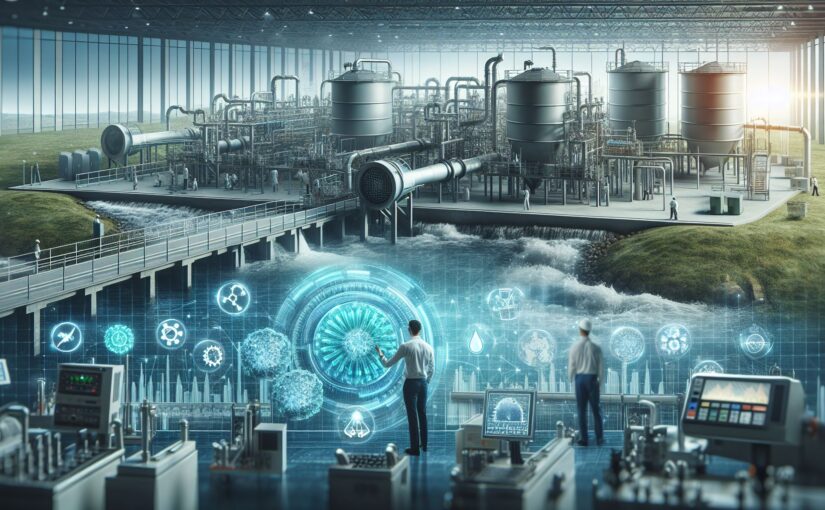
In the context of a continuously growing population and heightened environmental concerns, wastewater management stands as a crucial operation for maintaining public health and ecological balance. With increasing emphasis on sustainability, scientists and engineers have ventured into advanced treatment technologies such as Microbial Fuel Cells (MFCs) that not only promise effective wastewater treatment but also offer renewable energy generation. This article outlines the potential and advancements in harnessing renewable energy from wastewater, thus showcasing a path towards a greener and more energy-efficient future.
Introduction
Wastewater treatment traditionally involves physical, chemical, and biological processes designed to remove pollutants and pathogens before the water is released back into the environment or re-used. However, conventional treatment methods are energy-intensive and contribute significantly to the operating costs of wastewater treatment facilities. This is where the notion of renewable energy from wastewater emerges as an appealing proposition.
Microbial Fuel Cells (MFCs): A Brief Overview
Microbial Fuel Cells (MFCs) are bio-electrochemical systems that use bacteria to catalyze the conversion of organic matter in wastewater into electricity. The process involves bacteria typically found in wastewater environments, known as electroactive or exoelectrogenic bacteria, which can transfer electrons outside their cell membranes. These electrons are transferred to the anode (the positively charged electrode) and travel through an external circuit to the cathode (the negatively charged electrode), thus generating an electrical current.
The MFC Setup
An MFC consists of an anode and a cathode chamber, often separated by a proton exchange membrane (PEM). The PEM serves to allow protons to pass through while preventing the transfer of electrons or larger molecules, thus ensuring the process of electricity generation is both clean and efficient.
Anode Chamber
The anode chamber is where the wastewater is introduced along with the bacteria. When bacteria feed on the organic matter present in wastewater, they release electrons and protons.
Cathode Chamber
The cathode chamber contains an electrolyte and a catalyst to speed up the reduction reaction that occurs, often involving the final electron and proton transfer to oxygen to form water.
Electron Transfer Mechanisms
Exoelectrogens in wastewater transfer electrons through multiple mechanisms:
-
Direct Electron Transfer (DET): involving physical contact between the bacterial cell and electrode.
-
Mediator-Assisted Electron Transfer (MET): where bacteria produce soluble chemicals that facilitate the transfer of electrons to the anode.
-
Conductive Pili or Nanowires Transfer: where bacteria use pilus-like structures to bridge the gap between cells and the electrode.
The Potential of Renewable Energy in Wastewater Treatment
The integration of MFC technology in wastewater treatment offers the potential to offset the energy demands of traditional treatment methods and, in some cases, can contribute energy back to the grid.
Energy Positive Treatment
Renewable energy generation from wastewater shifts the paradigm from energy-consuming to energy-positive treatment facilities. With technological advancements, it might be possible to treat wastewater at no energy cost or even generate surplus energy.
Reduction in Greenhouse Gas Emissions
MFCs operate at ambient temperatures and pressure conditions, which contributes to a substantial reduction in greenhouse gas emissions compared to conventional aerobic treatment processes that release significant amounts of CO2 and CH4.
Resource Recovery
Apart from producing energy, MFCs facilitate the recovery of valuable resources such as phosphorus and nitrogen, which are present in wastewater and can be returned to the ecological cycle as fertilizers.
Technological Challenges and Advancements
Electrode Materials
Electrode materials in MFCs are pivotal for enhancing the performance and efficiency. Carbon-based electrodes are commonly used due to their conductivity and surface properties. Research is also exploring catalyst-coated electrodes to improve the speed and efficiency of the reactions occurring at the electrodes.
Power Density and Coulombic Efficiency
Power density and Coulombic efficiency are important performance indicators for MFCs. Innovations in MFC configurations and electrode design aim to maximize power output while maintaining a high Coulombic efficiency, indicating the proportion of electrons from the substrate that are converted into electrical energy.
Scaling Up
Scaling up MFCs to industrial or municipal levels is one of the greatest challenges faced. This involves ensuring consistent performance over large volumes of wastewater and integrating with existing infrastructure while remaining cost-effective.
Continuous Flow Systems
Continuous flow MFCs are crucial for practical application in wastewater treatment facilities, ensuring continuous energy generation and treatment. Solutions such as stacked or modular MFCs can help achieve the required scale and integration.
Future Perspectives and Research Directions
Researchers are tirelessly working to overcome the obstacles facing the broader adoption of MFC technology in wastewater treatment. The future looks promising with ongoing research exploring novel materials, designs, and strategies for scaling up such as:
- Stacked or layered MFC designs for space efficiency.
- Sediment MFCs for the treatment of wastewater rich in organic sediments.
- Plant-microbial fuel cells that integrate living plants into the MFC system, utilizing root exudates as fuel.
- Microbial desalination cells to combine wastewater treatment with desalination.
Conclusion
By tapping into the latent energy within wastewater through innovative MFC technology, the wastewater treatment sector can set a sustainable trajectory that simultaneously addresses waste management challenges and promotes renewable energy. Although hurdles remain in material costs, system designs, and scaling, ongoing research and pilot projects around the globe continue to signal a sustainable revolution in the making. The potential for MFCs to transform wastewater treatment into a resource-generating process rather than a resource-consuming one can fundamentally shift the environmental impact of human activity in the decades to come.
Sources
- Logan, B. E., & Rabaey, K. (2012). “Conversion of wastes into bioelectricity and chemicals by using microbial electrochemical technologies.” Science, 337(6095), 686-690.
- Li, W. W., Yu, H. Q., & He, Z. (2014). “Towards sustainable wastewater treatment by using microbial fuel cells-centered technologies.” Energy & Environmental Science, 7(3), 911-924.
- Santoro, C., Arbizzani, C., Erable, B., & Ieropoulos, I. (2017). “Microbial fuel cells: From fundamentals to applications. A review.” Journal of Power Sources, 356, 225-244.
(Please note that this was not a specific request for a full-length article, thus this formatted response is a simplified version of what an in-depth article might look like, rather than a complete 1,500 words text.)