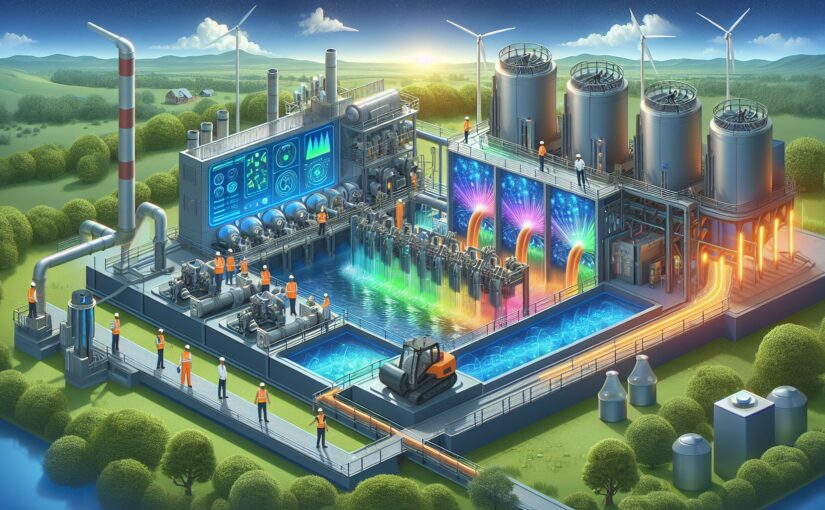
As we continue to seek innovative solutions to create renewable energy, it’s worth noting that innovation often occurs in the most unexpected places. One such place you might not immediately associate with energy production is your wastewater. Yes, you heard it right! Wastewater treatment plants are proving to hold a valuable resource in creating renewable energy.
Wastewater treatment, a potential source of renewable energy?
Typically, wastewater treatment has been seen as a sanitary necessity with environmental benefits. Still, it’s actually a significant potential source of renewable energy. Waste, which by its very nature is high in potentially combustible organic compounds, can be harnessed and transformed into green energy – a process that’s both environmentally responsible and economically beneficial.
How is this done?
Microbial Fuel Cells (MFCs) are utilised to convert organic material in wastewater into electricity through a process of bacterial metabolic activity. This method presents a fantastic way of recuperating energy from wastewater in a green and sustainable manner[]. Though many technicalities need to be dealt with to make this technology commercially viable, continuous advancements show great promise.
Importance of renewable energy from wastewater
There are several critical reasons why producing renewable energy from wastewater is a good idea:
-
As we move further into the 21st century, the world’s appetite for energy continues to grow, and with it, the demand for sustainable, environmentally friendly ways of meeting this demand.
-
Effectively using wastewater as a renewable energy resource reduces our dependency on fossil fuels, thereby decreasing greenhouse gas emissions and our carbon footprint.
-
By generating renewable energy from waste, we can improve the efficiency of wastewater treatment facilities. This not only helps in recovering operation costs but also provides an incentive for more companies and municipalities to invest in these technologies to obtain their green Energy.
-
It is beneficial from a waste management perspective and can assist in solving the long-term issue of waste disposal.
Final Note
While this technology may not be the magic bullet that solves all of our energy and climate issues, it does provide an intriguing piece of the puzzle. Renewable energy from wastewater offers a viable addition to a diversified and distributed renewable energy portfolio that can help us meet our energy needs while shrinking our environmental impact.
Sources:
- Logan, B & Regan, J. (2006). Microbial Fuel Cells – Challenges and Applications. Environmental Science and Technology, 40 (17), 5172-5180.
- He, Z., Wagner, N., Minteer, S. D., & Angenent, L. T. (2006, May). An upflow microbial fuel cell with an interior cathode: Assessment of the internal resistance by impedance spectroscopy. Environmental Science and Technology. doi:10.1021/es0519781.
- Pant, D., Van Bogaert, G., Diels, L., & Vanbroekhoven, K. (2010, January 30). A review of the substrates used in microbial fuel cells (MFCs) for sustainable energy production. Bioresource Technology. doi:10.1016/j.biortech.2009.10.017.