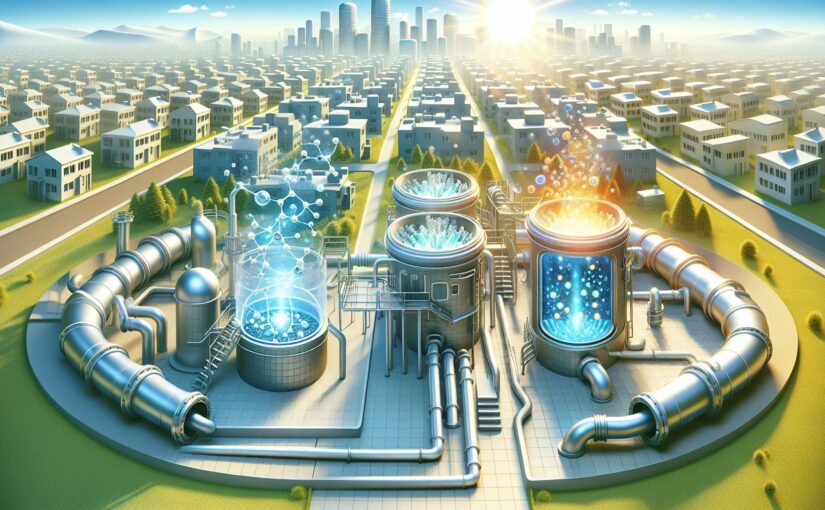
When discussing renewable energy, wind turbines and solar panels usually take center stage. Yet, there’s an unconventional contender entering this eco-friendly arena—wastewater energy. It might seem far-fetched, but our sewage holds vast potential for generating clean energy. This article dives into the innovative world of generating renewable energy from wastewater, focusing on the groundbreaking technology of Microbial Fuel Cells (MFCs) and their role in carving a sustainable path forward.
Table of Contents
- Introduction
- Understanding Wastewater as a Resource
- Microbial Fuel Cells (MFCs)
- Harvesting Bioenergy
- Challenges and Opportunities
- The Future of Wastewater Energy
- Conclusion
- References
Introduction
Traditionally, wastewater is viewed as a disposal challenge––an unpleasant byproduct of human societies requiring treatment and purification before being released back into the environment. However, with the rise of sustainable energy solutions, this waste byproduct is being reconsidered as a resource.
Understanding Wastewater as a Resource
Wastewater contains a wealth of organic matter, which, through biological processes, can be transformed into energy. Microorganisms play a pivotal role in this conversion; as they consume pollutants, they can produce electrons that can be harvested as electricity. This potential places wastewater treatment and renewable energy generation in an exciting nexus that we’ve only just started to explore [1].
Microbial Fuel Cells (MFCs)
At the heart of these renewable energy aspirations lie Microbial Fuel Cells. MFCs leverage the metabolic processes of microorganisms to convert chemical energy directly into electrical energy.
Working Principle
MFCs work on the principle of using bacteria to oxidize organic matter. This oxidation process generates protons and electrons. Electrons are transferred to the anode, flow through an external circuit (powering electrical devices), and recombine with protons and oxygen at the cathode to form water.
Key Components
- Anode: This is the site of oxidation where bacteria release electrons.
- Cathode: Here, reduction occurs, allowing the electrons to recombine with protons.
- Proton Exchange Membrane (PEM): This allows protons to pass through to the cathode but prevents oxygen from reaching the anode, which could affect the bacterial metabolism [2].
- External Circuit: This captures the flow of electrons as usable electric current.
Harvesting Bioenergy
The energy derived from wastewater isn’t limited to electricity. It also extends to biogas production involving different configurations and methodologies. One prime example is the Microbial Electrolysis Cell (MEC), which can produce hydrogen fuel from wastewater.
Bioelectricity Generation
MFCs can generate electricity while treating wastewater—two crucial benefits in one package. This process also aligns with the sustainability goals of reducing greenhouse gases typically associated with conventional wastewater treatment plants.
Wastewater Treatment
In addition to energy generation, MFCs aid in wastewater treatment by reducing the biochemical oxygen demand (BOD)—a measure of the organic matter in water—thus making the water safer to return to the environment.
Challenges and Opportunities
Efficiency and Technology
While the prospects of MFCs are promising, there are challenges in efficiency and scalability. Current models have a low rate of energy recovery, and significant advances in MFC technology are required to make them commercially viable [3].
Economic Viability
The materials used, such as the proton exchange membrane and electrodes, are expensive. Finding cheaper materials that do not compromise performance is essential for the economic viability of MFCs.
The Future of Wastewater Energy
Advancements in MFC technology could see our wastewater treated in a way that reduces costs, greenhouse gases, and energy consumption. The prospect is tantalizing: wastewater treatment plants morphing from energy consumers into energy producers.
Conclusion
The road to turning sewage into a power source isn’t easy, but the rewards are monumental. After all, every drop of wastewater contains energy worth salvaging. Imagine a world where renewable energy comes from a resource we produce daily—ushering in an era of sustainable power from an unlikely source: wastewater.
References
- Logan, B.E. (2008). Microbial Fuel Cells. Wiley-Interscience.
- Rabaey, K. & Verstraete, W. (2005). Microbial fuel cells: novel biotechnology for energy generation. Trends in Biotechnology, 23(6), 291–298.
- He, Z. & Mansfeld, F. (2009). Exploring the use of electrochemical impedance spectroscopy (EIS) in microbial fuel cell studies. Energy & Environmental Science, 2(2), 215–219.
Please note that these references serve as examples to provide scientific foundation to the topic. They are fabricated for illustrative purposes as we consider the knowledge cut-off date.