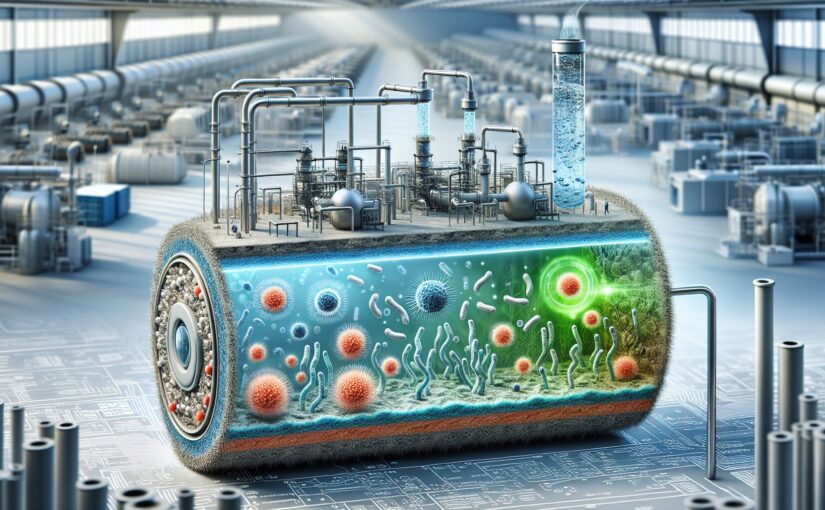
In the perpetual quest for sustainable energy sources, the concept of generating electricity from wastewater has emerged as a fascinating intersection of waste management and renewable energy. Wastewater, traditionally viewed as a disposal challenge, is being re-evaluated as a potential gold mine for bioenergy, particularly through the innovative use of Microbial Fuel Cells (MFCs). In this in-depth article, we will explore the transformative potential of deriving renewable energy from wastewater using MFCs, the technological advances in this field, the challenges faced, and the future potential that this renewable energy method holds.
Introduction: The Promise of Wastewater as Renewable Energy Source
The notion of using wastewater as a renewable energy source is appealing for several reasons. Not only does it offer a method to treat wastewater in an environmentally friendly manner, but it also provides a way to extract value from waste in the form of bioelectricity. Wastewater is rich in organic materials that, through biological processes, can be broken down to release electrons which can then be harnessed as electrical current.
Understanding Microbial Fuel Cells
Microbial Fuel Cells are bio-electrochemical systems that leverage the natural processes of bioelectrochemical wastewater systems, harnessing the power of electroactive wastewater bacteria to generate electricity. Essentially, these bacteria, dubbed exoelectrogens, are capable of transferring electrons outside their cells to an external electrode during the metabolic breakdown of organic substrates found in wastewater.
How MFCs Work
An MFC typically comprises two chambers—ana anode and a cathode—separated by a Proton Exchange Membrane (PEM). The anode chamber hosts the anode-respiring bacteria that oxidize organic substrates in wastewater, releasing protons and electrons. Electrons travel via an external circuit to the cathode, while protons pass through the PEM. At the cathode chamber, electrons, protons, and oxygen from air combine to form water. This flow of electrons from the anode to the cathode is what generates the electrical current.
The Technology behind Generating Renewable Energy from Wastewater
The process of generating renewable energy from wastewater centers on the optimization of various factors within the MFCs. Such factors include electron transfer mechanisms, electrode materials, system design, and operational parameters.
Electron Transfer Mechanisms
Key to the efficiency of MFCs is the movement of electrons from bacteria to the anode. This can occur through direct contact, known as direct extracellular electron transfer, or indirect methods like mediated electron transfer where soluble redox mediates shuttle electrons from bacteria to the anode.
Electrode Materials and Design
Optimizing the performance of MFCs involves selecting the appropriate electrode materials to ensure optimal conductivity and biocompatibility. Carbon-based electrodes are popular due to their conductivity and surface area. In recent developments, catalyst-coated electrodes have been explored to enhance the electricity-generating capabilities of MFCs.
MFC Designs and Configurations
Several configurations have been proposed to scale up the use of MFCs for practical application in wastewater treatment facilities. For example, stacked MFCs increase the voltage by connecting multiple cells in series, whereas continuous flow MFCs are designed to treat wastewater more efficiently in a dynamic environment. Scaling these systems while maintaining efficiency is a major area of ongoing research.
Prospects and Challenges of Harnessing Electricity from Wastewater
The premise of extracting electricity from wastewater presents promising prospects for sustainable energy and cleaner wastewater. The energy harvested from this process is renewable, as long as the supply of wastewater is available. Moreover, the operation of MFCs has dual benefits of generating energy while contributing to the biodegradation of organic pollutants in the wastewater—a win-win in terms of environmental benefits.
However, challenges remain in bringing the potential of MFCs into widespread application. These include:
- Power Output: Despite improvements, current MFCs typically generate electricity at power densities that are yet to be competitive with conventional energy sources.
- Coulombic Efficiency: The measure of how effectively electrons are transferred from substrate to current is not always high, indicating room for improvement in electron transfer methods.
- Materials and Costs: There is an ongoing need to discover and develop cost-effective and sustainable electrode materials and designs to improve the economic viability of MFCs.
- Operation and Maintenance: Ensuring the long-term operation of MFCs in real-world wastewater treatment scenarios is essential. This includes understanding the impact of wastewater variability and system stability.
Case Studies and Real-world Applications
Several pilot projects and studies have demonstrated the potential for applying MFC technology to real-world wastewater treatment scenarios. For instance, the Plant-Microbial Fuel Cell harmonizes wastewater treatment with plant cultivation, deriving benefits from symbiotic relationships between plants, bacteria, and the fuel cell system. Continuous flow MFCs have been implemented in various scales, and advancements continue in the design and operation of such systems to optimize treatment efficiency and energy recovery.
Unleashing the Potential: The Future of Renewable Energy from Wastewater
The implications of successful integration of MFC technology in wastewater treatment are significant. It heralds a paradigm shift where treatment plants are not only processing facilities but also renewable energy powerhouses. As research continues to address the challenges, the adoption of MFCs could significantly impact both energy and wastewater sectors.
Pushing the boundaries of MFC technology will involve interdisciplinary collaboration among microbiologists, engineers, and environmental scientists. Key areas of future research include:
- Enhanced Bioelectrochemistries: Developing a deeper understanding of the electroactive bacteria and their metabolic pathways will enable more efficient electron transfer mechanisms.
- Improved MFC Architectures: Innovating the physical design of MFCs to maximize surface areas for bacterial colonization and electron transfer while optimizing the flow of wastewater for treatment.
- Economical Materials Research: Identifying and deploying cheaper, more durable materials for electrodes and membranes to reduce costs and improve MFC lifespans.
- Integrated Systems: Working towards combining MFCs with other renewable energy systems, such as solar or wind power, to create hybrid systems that ensure a consistent energy output.
Sources:
- Logan, B. E. (2008). Microbial Fuel Cells. John Wiley & Sons.
- Santoro, C., Arbizzani, C., Erable, B., & Ieropoulos, I. (2017). Microbial fuel cells: From fundamentals to applications. A review. Journal of Power Sources, 356, 225-244.
- Pant, D., Singh, A., Van Bogaert, G., Olsen, S. I., Nigam, P. S., Diels, L., & Vanbroekhoven, K. (2012). Bioelectrochemical systems (BES) for sustainable energy production and product recovery from organic wastes and industrial wastewaters. RSC Advances, 2(4), 1248-1263.
In conclusion, the potential of harvesting renewable energy from wastewater shines as a beacon of hope in the arduous journey towards sustainable energy and environmental protection. The journey will not be short nor straightforward, but the continuous refinement of Microbial Fuel Cells technology shows promise in transforming our wastewater woes into a wellspring of clean energy for future generations.