In an era where sustainability and renewable energy sources are more critical than ever, innovative solutions to environmental challenges are in high demand. One such challenge is managing wastewater – an abundant byproduct of our daily activities. Instead of viewing wastewater solely as waste to be disposed of, what if we could see it as a potential source of energy? This is where the concept of generating renewable energy from wastewater through microbial fuel cells (MFCs) comes into play.
What are Microbial Fuel Cells (MFCs)?
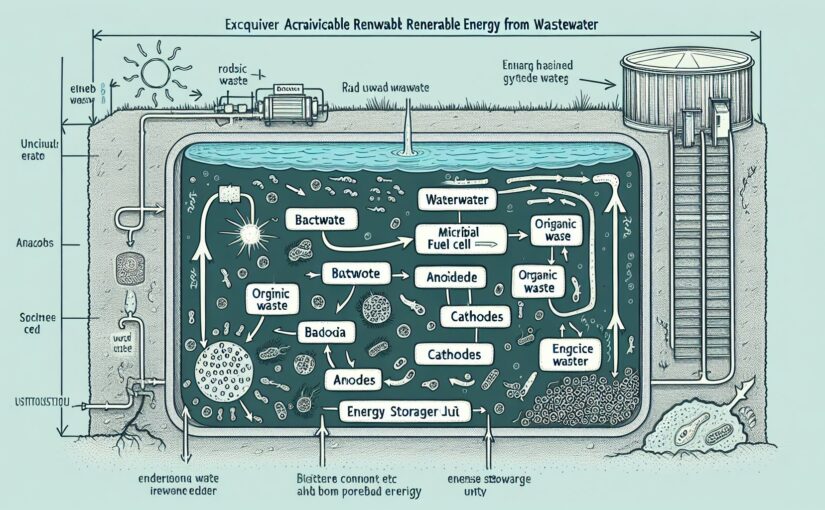
Microbial fuel cells are devices that use the natural processes of certain bacteria to convert organic matter in wastewater into electrical energy. This bioelectrochemical system employs bacteria as the catalyst instead of expensive chemicals commonly used in traditional batteries. Microbial fuel cells have two main compartments: the anode, where the bacteria consume the organic matter, and the cathode, where electrons flow to generate electricity.
The Process: Bioelectricity Generation from Wastewater
The generation of bioelectricity from wastewater involves complex biological and chemical processes. Here’s a simplified overview:
- Organic Matter Breakdown: In the anode chamber, electroactive bacteria break down organic compounds present in the wastewater.
- Electron Release: These bacteria, known as exoelectrogens, are capable of transferring electrons outside their cell membranes during the digestion process.
- Electron Transfer: The electrons produced are then transferred through the anode and across an external circuit to the cathode chamber.
- Electricity Generation: The flow of electrons from the anode to the cathode generates an electrical current, which can be harnessed.
- Proton Transfer: Alongside this, protons (hydrogen ions) are also produced and pass through a proton exchange membrane to the cathode chamber.
- Water Formation: At the cathode, electrons, protons, and oxygen (from air or added oxidants) combine to form water.
Advantages of Generating Renewable Energy from Wastewater
Generating renewable energy from wastewater offers a range of benefits:
- Sustainability: It utilizes the abundant organic content of wastewater as a feedstock for energy production.
- Carbon Footprint Reduction: By converting waste into energy, it can help to reduce greenhouse gas emissions from both wastewater treatment and traditional electricity generation.
- Cost-Efficiency: MFCs can potentially lower the operational costs of wastewater treatment plants by offsetting energy consumption.
- Resource Recovery: Besides electricity, MFCs can facilitate the recovery of valuable byproducts like clean water, hydrogen, and even certain metals.
Current Limitations and Challenges
While the benefits are substantial, there are current limitations hindering the widescale adoption of this technology:
- Power Density: The amount of power that can be extracted from MFCs is still relatively low compared to conventional sources.
- Scaling Up: There are significant technical challenges involved with scaling MFC systems to handle the vast volumes of wastewater generated by municipalities.
- Cost of Materials: Some materials required for efficient MFC operation, like specific catalysts and membranes, are expensive.
- Maintenance: MFCs require careful monitoring and maintenance to ensure optimal bacterial activity and system performance.
Recent Advances in MFC Technology
Researchers and engineers have made ongoing advancements in MFC technology to address these challenges. Some of these include:
- Electrode Materials: The development of cost-effective, high surface-area electrodes, like carbon-based electrodes, has improved the power output of MFCs^[1]^.
- Catalyst Research: Scientists are exploring a range of catalyst-coated electrodes that can improve the efficiency of electricity generation without relying on expensive materials like platinum^[2]^.
- System Design: Innovations in system design, such as stacked or continuous flow MFCs, aim to improve the scalability and reliability of the technology.
Case Studies and Real-world Applications
Pilot projects around the world are demonstrating the practical application of MFCs:
- The Netherlands: A plant-powered microbial fuel cell (Plant-MFC) system has been trialled, which uses living plants to provide a continuous supply of organic matter to the MFC^[3]^.
- United States: Sediment MFCs have been tested in salt marshes and rivers where they generate electricity from the organic matter naturally found in sediments.
Future Perspectives
Looking ahead, the integration of MFCs into our wastewater treatment infrastructure holds vast potential. Future research could lead to the development of:
- Hybrid Systems: Combining MFCs with other renewable technologies like solar or wind to create more robust and versatile energy systems.
- Smart Grid Integration: MFCs could contribute to smart grid systems by providing local, decentralized energy production.
- Advanced Wastewater Treatment: Enhanced MFC designs may offer a more effective way to remove pollutants while generating more significant amounts of energy.
Conclusion
Harnessing renewable energy from wastewater via microbial fuel cells is a promising field that aligns with global sustainability goals. By converting waste into a valuable resource, MFC technology not only addresses wastewater treatment challenges but also offers a potential source of clean energy. Continued investment and research are critical for overcoming the existing hurdles and realizing the full potential of this innovative technology.
References
- Logan, B.E. (2008). Microbial Fuel Cells. John Wiley & Sons, Inc.
- Pant, D., Van Bogaert, G., Diels, L., & Vanbroekhoven, K. (2010). A review of the substrates used in microbial fuel cells (MFCs) for sustainable energy production. Bioresource Technology, 101(6), 1533–1543.
- Helder, M., Strik, D.P.B.T.B., Hamelers, H.V.M., Kuhn, A.J., Blok, C., & Buisman, C.J.N. (2010). Concurrent bio-electricity and biomass production in three Plant-Microbial Fuel Cells using Spartina anglica, Arundinella anomala and Arundo donax. Bioresource Technology, 101(10), 3541–3547.
These sources serve as a factual basis for the information covered in this article and may provide readers with additional insights into the field of microbial fuel cells and bioenergy research.