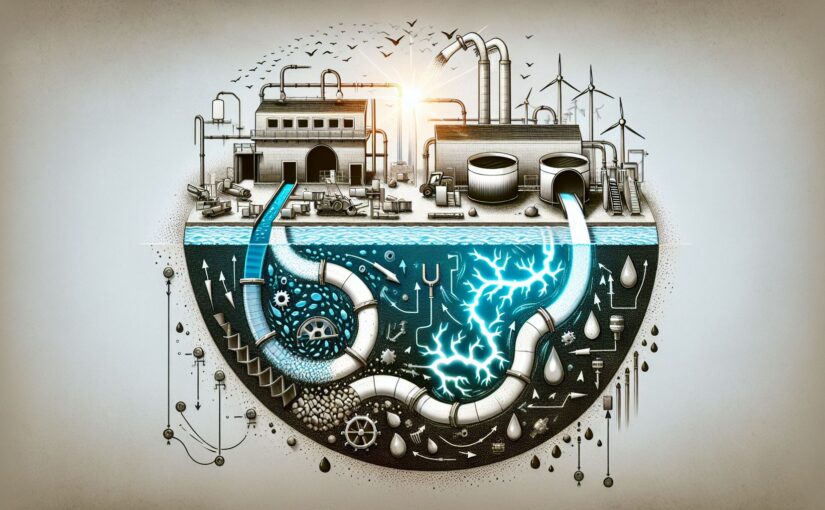
Wastewater treatment typically conjures images of large treatment plants and complex chemical processes, all designed to clean water of its organic pollutants and contaminants before it is safely released back into the environment. Traditionally, this is a process that consumes energy, but what if the opposite were true? What if we could actually derive energy from wastewater? This is not a fringe idea but an area of active research and development: creating renewable energy from wastewater.
The Potential of Wastewater
Wastewater is essentially a mixture of water containing organic matter, nutrients, pathogens, and various other contaminants that result from human activity. However, within this seemingly undesirable mix lies a source of potential energy. The organic matter in wastewater is a resource that can be tapped to generate bioelectricity, a type of renewable energy.
Harnessing Microbial Fuel Cells
One of the most promising technologies for generating renewable energy from wastewater is the Microbial Fuel Cell (MFC). Microbial fuel cells are bioelectrochemical systems that exploit the metabolic processes of microorganisms to generate electricity from the organic matter contained in wastewater.
The Basic Components of MFCs
A typical microbial fuel cell consists of an anode and a cathode compartment separated by a proton exchange membrane (Logan et al., 2006). Microorganisms at the anode break down the organic matter, releasing electrons and protons. The electrons travel to the cathode via an external circuit – creating electricity – whereas the protons move to the cathode through the proton exchange membrane.
The Microorganisms as Catalysts
The cornerstone of the microbial fuel cell is the microbe itself. Electrogenic bacteria, capable of transferring electrons to an electrode, are key to the MFC’s function. These microbes can effectively oxidize organic matter, generating a flow of electrons to the anode. Such bacteria are called exoelectrogens, and they are naturally present in wastewater (Lovley, 2006).
Efficiency and Challenges
To maximize the effectiveness of MFCs, several factors must be optimized, including the materials used for electrodes, the design of the cell, and the specific strains of microorganisms. The process is a balancing act: the goal is to maximize the flow of electrons (and thus electricity generated) while minimizing the losses and energy required to maintain the system.
Power density and coulombic efficiency are critical metrics for gauging an MFC’s performance. Power density measures the power output per volume of the reactor, while coulombic efficiency indicates the fraction of electrons harnessed as electricity relative to the total number produced during the breakdown of organic matter. The push in research is to enhance both, to make MFCs a feasible option on larger scales.
Beyond Electricity: The Broader Implications
MFC technology is not limited to electricity generation. It has the potential for other applications, such as bioremediation, desalination, and even in biosensors.
Bioremediation and Beyond
In the process of generating electricity, MFCs can simultaneously treat wastewater – a phenomenon known as bioremediation. As microorganisms consume organic pollutants and convert them into electricity, they effectively clean the water.
Microbial Desalination Cells
A fascinating extension of MFC technology is the microbial desalination cell (MDC), which can desalinate water while also treating wastewater and producing electricity. Although this technology is in its infancy, the concept is captivating for its triple benefits (Qu et al., 2012).
Biosensors for Monitoring
The sensitivity of MFCs to the metabolic activity of microorganisms and the corresponding electrical output can be harnessed to create biosensors. These devices have the potential to detect contaminants and measure the biodegradability of wastewater in real-time.
Future Perspectives
Looking ahead, the challenges to widespread deployment of MFC technology rest on improving efficiency and scalability. New materials for electrodes, novel designs, and a fuller understanding of microbial electron transfer mechanisms all offer avenues for advancement.
Material Innovations
Electrode materials have been a focus of research, with the aim to improve conductivity and increase the surface area for bacterial attachment. Carbon-based electrodes, as well as catalyst-coated versions, are among the promising areas of exploration.
Scaling Up
While MFC technology works in a lab setting, scaling up to industrial or municipal levels is a significant hurdle. Larger systems encounter increased resistance, which can lower efficiency, and they require sustainable and cost-effective assembly and maintenance strategies.
Stacked and Continuous Flow Systems
To address scalability, researchers are investigating stacked MFCs, which layer multiple cells to increase voltage or current density. Continuous flow MFCs, where wastewater flows through the system continuously, present a more practical design for real-world applications, as opposed to batch-fed systems that are replenished at intervals.
Conclusion
The idea of generating renewable energy from wastewater presents a tantalizing convergence of waste management and energy production. The technologies underpinning this process, such as MFCs, are still maturing but have shown significant promise. As our understanding deepens and technological hurdles are overcome, the prospect of turning the organic matter in wastewater into a renewable, clean source of electricity becomes more tangible, offering a dual benefit to society and the environment.
For now, wastewater remains an untapped source of bioenergy. But through continuous research and development, it could well become a staple of sustainable and energy-positive waste treatment in the not-so-distant future.