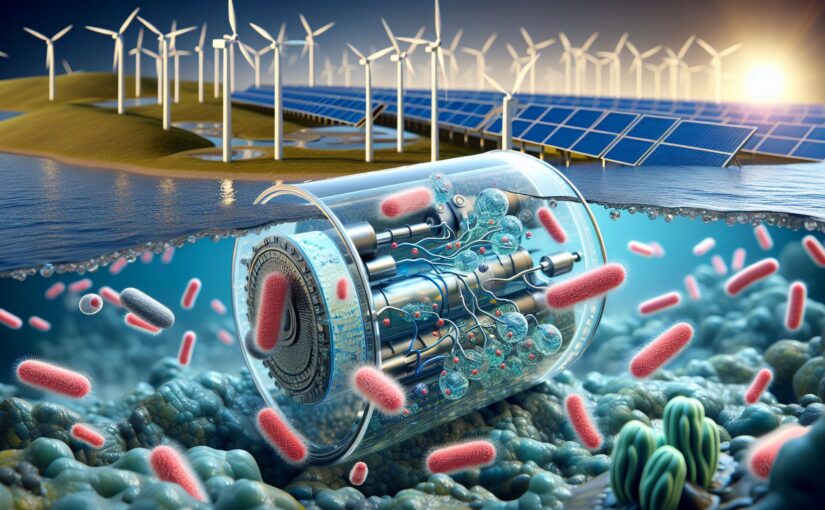
In an era of unprecedented environmental challenges, the search for renewable energy sources is more urgent than ever. Fossil fuels are not only depleting at an alarming rate but also cause severe environmental damage, including air pollution and climate change. As society looks towards sustainable alternatives, an intriguing solution has emerged from the intersection of biotechnology and electrochemistry – the generation of renewable energy from wastewater through bioelectrochemical systems (BES).
The Untapped Potential of Wastewater
Wastewater is often seen as a nuisance – a byproduct of human activity that needs to be treated and disposed of. However, within this ‘waste’ lies a goldmine of untapped energy. Wastewater is rich in organic compounds that can be converted into electricity through biological processes. The technology harnessing this potential is known as Microbial Fuel Cells (MFCs), a cornerstone of bioelectrochemical systems.
The Rise of Microbial Fuel Cells (MFCs)
Microbial Fuel Cells represent a technology that allows for the direct conversion of the chemical energy in organic matter to electricity through the metabolic activity of microorganisms. The basic setup includes two chambers, or half-cells, separated by a proton exchange membrane. One chamber contains an anode (where oxidation occurs), and the other contains a cathode (where reduction occurs).
Operation of a Standard MFC:
- The Anode Chamber: In the anode chamber, bacteria attach themselves to the anode and break down the organic matter in wastewater, releasing electrons and protons in the process.
- Electron Flow: The electrons flow from the anode, through an external circuit, generating electricity, and then to the cathode.
- The Cathode Chamber: At the cathode, electrons combine with protons and oxygen from the air to form water.
- The Proton Exchange Membrane: The membrane allows protons to pass from the anode to the cathode chamber while preventing the mix of the oxidized and reduced substances.
The beauty of this system is its dual functionality. Not only does it clean wastewater by breaking down pollutants, but it also generates electricity – a win-win situation for both the environment and our energy needs.
Electroactive Bacteria: Unlocking the Power of MFCs
A crucial component of MFCs is the electroactive bacteria that facilitate the conversion of organic compounds to electrical energy. These bacteria, sometimes referred to as exoelectrogens, utilize organic substrates as their fuel and are capable of transferring electrons to an external surface – the electrode.
Understanding the mechanisms of electron transfer in these bacteria is critical. Bacteria transfer electrons via three main pathways:
- Direct Transfer: Some bacteria form direct connections with the electrode through structures called ‘nanowires,’ transmitting electrons directly to the electrode surface.
- Mediator Compounds: Other bacteria secrete redox-active compounds that shuttle electrons from the cell to the electrode.
- Membrane-associated Redox Proteins: These proteins act as electron carriers transferring electrons from the bacteria to the electrode.
Engineering MFCs to boost the performance of these electroactive bacteria is a hotbed of current research. Enhancements focus on optimizing the microbial environment within the MFC to increase metabolism and electron transfer rates.
The Present Challenges
The potential of MFCs is vast, but so are the challenges in scaling them up for practical applications, such as:
- Power Density: Current MFCs have a relatively low power density compared to other energy technologies, making them not yet viable for large-scale applications.
- Coulombic Efficiency: The efficiency at which electrons from the organic matter are converted into electrical current needs to be improved.
- Electrode Materials: The search for cost-effective, efficient, and durable electrode materials is ongoing. Carbon-based electrodes and catalyst-coated electrodes are among the frontrunners.
Future Perspectives: Upgrading MFC Scale and Efficiency
The future of MFCs in renewable energy generation is contingent on addressing these challenges. Efforts are underway to scale up the technology from laboratory prototypes to systems capable of handling real-world wastewater treatment plant volumes.
Advancements in Electrode Design:
Intense research is going into developing new electrode materials that increase the surface area for bacterial attachment and electron transfer.
Structured Microbial Communities:
By understanding and manipulating the microbial community structure within MFCs, researchers aim to improve efficiency.
Integrating MFCs into Existing Infrastructure:
To become a viable option, MFCs must be designed to fit into existing wastewater treatment facilities without requiring extensive retrofitting.
Environmental and Economic Impact
Adopting MFC technology could significantly impact both environmental protection and economic growth. From an environmental perspective, MFCs offer a cleaner waste treatment option with a renewable energy bonus. Economically, MFCs could reduce the energy costs associated with wastewater treatment, one of the most energy-intensive processes in the municipal sector.
Conclusion
The vision for the future is clear – integrating MFC technology into wastewater treatment could revolutionize the way we view and handle waste. By turning a treatment expense into an energy resource, we open possibilities for sustainability and resilience in energy infrastructure.
Moving forward, interdisciplinary research, supported by industrial partnerships, could pave the way for this technology’s evolution from a niche solution to a mainstream renewable energy resource.
Sources:
- Logan, B. E. (2008). Microbial Fuel Cells. John Wiley & Sons.
- Rabaey, K., & Rozendal, R. A. (2010). Microbial electrosynthesis — revisiting the electrical route for microbial production. Nature Reviews Microbiology, 8(10), 706-716.
- Li, W. W., Sheng, G. P., & Yu, H. Q. (2011). Extracellular electron transfer in microbial fuel cells: mechanisms, influencing factors and recent advances. Environmental Science and Technology, 45(8), 3387-3394.