In recent years, the global demand for sustainable and renewable energy sources has increased significantly. With the depletion of fossil fuels and the environmental concerns associated with their usage, the search for alternative energy solutions has become more critical. One of the less conventional yet promising areas of research is the generation of bioelectricity from wastewater using microbial fuel cells (MFCs). This technology not only provides a way to generate renewable energy but also offers a sustainable method for wastewater treatment.
What are Microbial Fuel Cells?
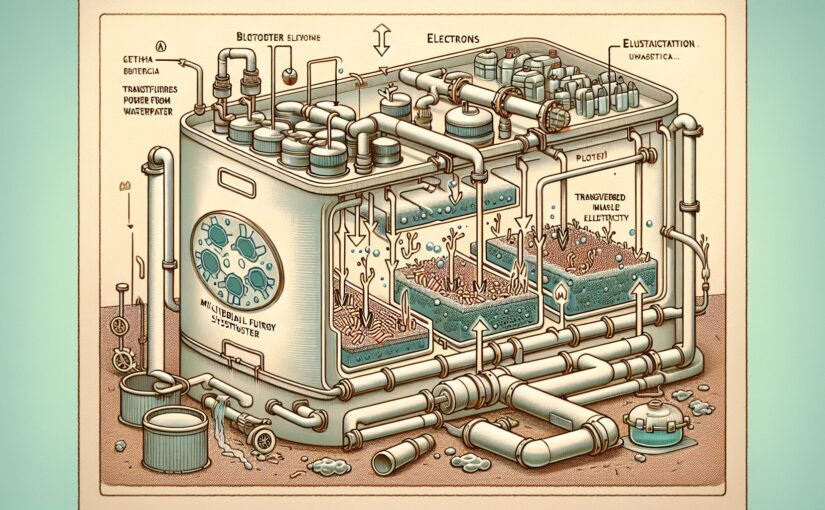
Microbial fuel cells are bio-electrochemical systems that use bacteria to convert organic and inorganic matter in wastewater into electrical energy. These microorganisms act as biocatalysts, breaking down the compounds in the wastewater and releasing electrons in the process. These electrons travel through an external circuit, generating electric current. MFCs consist of two compartments, an anode and a cathode, separated by a proton exchange membrane.
The Process of Bioelectricity Generation from Wastewater
The process of generating electricity from wastewater using MFCs involves several steps:
-
Organic matter breakdown: In the anode chamber, electroactive bacteria break down the organic matter present in wastewater.
-
Electron transfer: The bacteria transfer the electrons produced during the breakdown process to the anode.
-
Proton exchange: Protons also released during the breakdown move through the proton exchange membrane to the cathode chamber.
-
Electricity generation: The electrons flow from the anode to the cathode through an external circuit, producing electricity.
-
Reduction reaction: At the cathode, the electrons and protons combine with oxygen to form water.
Benefits of Using Wastewater for Energy Production
Using wastewater as a source for generating electricity provides multiple benefits:
-
Renewable Energy: Wastewater is an abundant resource that is constantly generated by domestic, industrial, and agricultural activities.
-
Waste Reduction: MFCs contribute to lowering the amount of waste, substantially reducing the organic load in the wastewater.
-
Energy-efficient Treatment: Wastewater treatment through MFCs requires less energy compared to traditional treatment methods.
-
Cost-effective: The operation and maintenance of MFCs can be more cost-effective in the long run, as they produce energy.
Challenges in Using MFCs for Wastewater Treatment
While MFCs offer numerous advantages, there are also challenges associated with their use:
-
Power Output: The power density of current MFCs needs to be increased to make the technology more practical for widespread application.
-
Scalability: Scaling up MFCs for industrial-level wastewater treatment poses design and operational challenges.
-
Cost of Materials: The cost of materials, particularly electrodes and proton exchange membranes, can be high.
-
Long-term Stability: Ensuring the long-term stability and performance of MFCs is crucial for practical applications.
Recent Advances in MFC Technology
Research in this field has led to several advances designed to overcome the obstacles faced by MFCs:
-
Electrode Materials: The development of cost-effective and efficient electrode materials is ongoing, with focuses on carbon-based and catalyst-coated electrodes.
-
Design Improvements: Efforts are being made to improve the design of MFCs, with innovations such as stacked and continuous flow MFCs.
-
Increased Power Density: Techniques to increase the power density in MFCs are being developed, including optimizing the microbial consortia and the reactor configurations.
-
Wastewater Substrate Degradation: Enhanced degradation of complex substrates in wastewater through genetically modified microorganisms or by using pre-treatment methods is a focus area.
Future Perspectives
The potential of MFCs to revolutionize wastewater treatment and energy generation is immense. Researchers continue to focus on:
-
Sustainability: Developing more sustainable and environmentally-friendly electrode materials and membrane technologies.
-
Integration: Integrating MFCs with other renewable energy technologies such as solar and wind.
-
Customization: Tailoring MFCs for specific applications in different industries, considering the particular types of wastewater generated.
-
Commercialization: Overcoming economic and technical challenges to make MFCs a commercially viable option.
Conclusion
The possibility of generating renewable energy from wastewater using microbial fuel cells is a testament to the innovative solutions being developed to address global energy and environmental challenges. As research progresses and technological advancements are made, MFCs have the potential not only to provide a source of clean energy but also to revolutionize the way we treat and perceive wastewater.
Sources
-
Logan, B. E., & Rabaey, K. (2012). Conversion of wastes into bioelectricity and chemicals by using microbial electrochemical technologies. Science, 337(6095), 686-690. doi: 10.1126/science.1217412
-
Lefebvre, O., Moletta, R., & Flora, J. R. V. (2010). Microbial fuel cells: A promising technology for wastewater treatment and bioenergy. Biotechnology Advances, 28(3), 279-299. doi: 10.1016/j.biotechadv.2010.02.005
-
He, Z., & Mansfeld, F. (2009). Exploring the use of electroactive bacteria to improve the performance of microbial fuel cells: A review. Environmental Science & Technology, 43(8), 2847-2857. doi: 10.1021/es803531g